

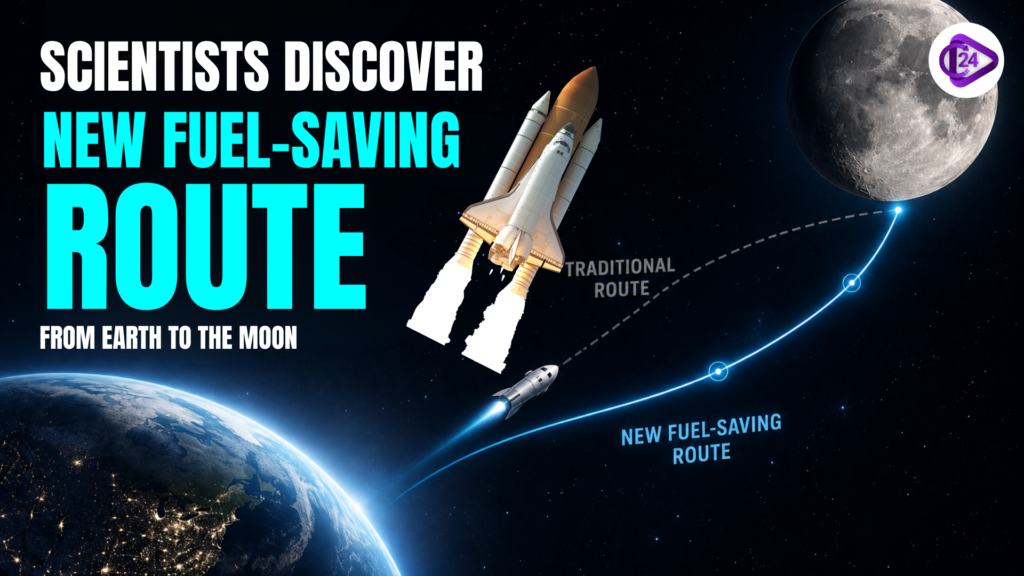
Researchers have developed a new low-energy method to get spacecraft from Earth to the Moon, while requiring much less fuel. Discovery uses a complex interaction of gravity forces between the Earth, Moon and Sun that enables spacecraft to move through natural highways in space. They feel the technique will cut costs on their missions and make future lunar and especially deep space ventures more efficient. These results will be helpful for future Moon exploration missions, particularly for long missions with cargo transport. In the future, these energy-efficient orbits will play a crucial role in ensuring sustainable and cost-effective space missions. The potential for these energy-efficient orbits in supporting sustainable and economical space exploration in the future years is being studied by space agencies and researchers.
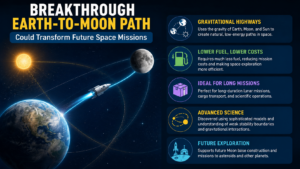
Breakthrough Earth-to-Moon Path Could Transform Future Space Missions
- Researchers have come across a new low-energy transfer route between the Earth and the Moon for spacecraft.
- The path utilises the force of gravity that the Earth, the Moon and the Sun provide.
- It is said that the researchers termed these pathways “gravitational highways” in space.
- The new trajectory will require much less fuel for lunar missions.
- With reduced fuel expenditures, the total cost of space missions can be reduced.
- The find will benefit long-duration lunar exploration programmes.
- They used sophisticated mathematical models and orbital calculations to find the way.
- It is a pathway that is based on weak stability boundaries and gravitational interactions.
- Those types of low-energy transfers might take longer than direct-moon flights.
- The lower requirement for fuel consumption, on the other hand, can be very advantageous in the transport of cargo loads and scientific operations.
- Path could be used in the future for Moon base construction and sustainable exploration.
- The technique would probably even benefit missions to asteroids and other planets, researchers say.
- Some space missions using robots were previously carried out using similar methods of achieving fuel efficiency in orbital design.
- The cost-effectiveness of mission planning is a plus to interest every space agency, including NASA and other global ones.
- This is an indicator of the increasing role of orbital mechanics in the modern space exploration program.
Previous Year Questions (PYQs) on Earth and Moon
| Exam Name | Year | Question | Options | Answer |
| SSC CGL | 2022 | The Moon is a natural satellite of which planet? | A) Mars B) Venus C) Earth D) Jupiter | C) Earth |
| Railway NTPC | 2021 | What is the primary source of light on the Moon? | A) It produces its own light B) Reflection of sunlight C) Reflection of Earth’s light D) Stars | B) Reflection of sunlight |
| UPSC Prelims | 2019 | Why is there no atmosphere on the Moon? | A) Absence of gravity B) Excess oxygen C) Very high gravity D) Presence of oceans | A) Absence of gravity |
| SSC CHSL | 2020 | The force responsible for keeping the Moon in orbit around the Earth is: | A) Magnetic Force B) Nuclear Force C) Gravitational Force D) Frictional Force | C) Gravitational Force |
| NDA | 2021 | The Moon takes approximately how many days to complete one revolution around the Earth? | A) 7 Days B) 14 Days C) 27.3 Days D) 365 Days | C) 27.3 Days |
| CDS | 2020 | Which phenomenon occurs due to the gravitational pull of the Moon on Earth? | A) Earthquake B) Volcano C) Tides D) Cyclone | C) Tides |
| SSC GD | 2023 | The study of celestial objects such as Earth, Moon, and stars is known as: | A) Biology B) Astronomy C) Geology D) Meteorology | B) Astronomy |
| UPSC CDS | 2018 | The term ‘Syzygy’ is associated with which astronomical phenomenon? | A) Alignment of celestial bodies B) Solar Wind C) Asteroid Belt D) Black Hole Formation | A) Alignment of celestial bodies |
| SSC MTS | 2022 | A syzygy occurs when the Earth, Moon, and Sun come in: | A) Circular Motion B) Random Position C) Straight Line Alignment D) Opposite Rotation | C) Straight Line Alignment |
International Day for Biological Diversity 2026
Conclusion
The construction of a new space exploration route from Earth to the Moon that would reduce costs on fuel is a significant step in space science and space exploration. Employing natural gravitational forces, spacecraft can move more efficiently with the aim of minimising fuel use and costs. This technique has the potential to assist future lunar exploration missions, as well as cargo delivery and long-term development of a moon base. The increasingly important position of advanced mathematical modelling and orbital mechanics in today’s space missions is also highlighted. In the future, scientists think, such low-energy trajectories might come in handy for missions to asteroids and far-off planets. The finding could make a big impact on more economical and sustainable space exploration around the entire globe.