

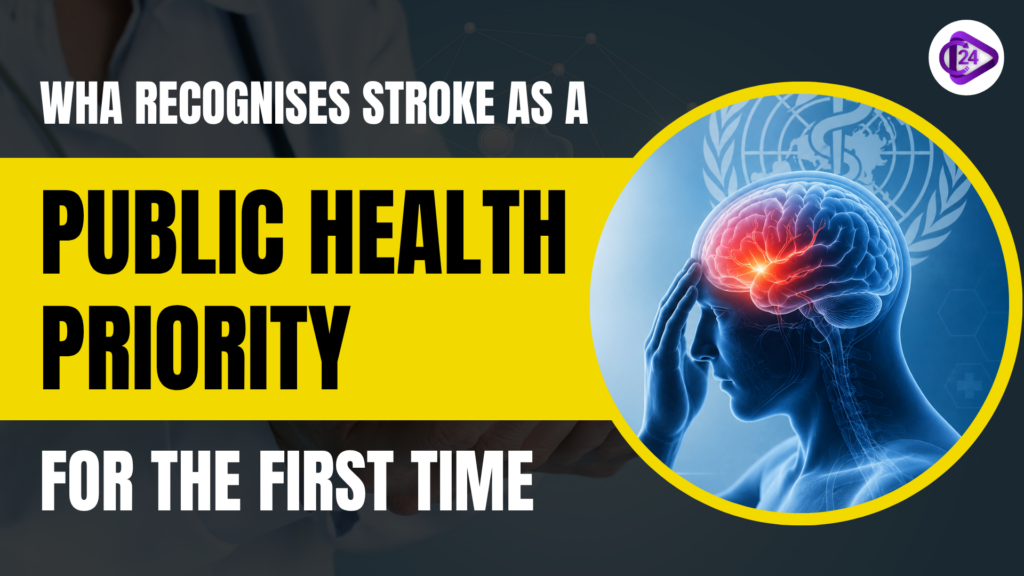
This momentous resolution, titled “Reducing the burden of stroke: strengthening prevention, acute care, rehabilitation and health-system readiness”, was made during the 70th World Health Assembly (WHA), the organisation’s highest decision-making body. Adopted at the 79th World Health Assembly, in May, 2026, in Geneva. WHO underscored on an increase nearly 20% of the lifetime risk of stroke from last 20 years, as one among 4th adult population is in danger of stroke in lifetime. The resolution urges increased prevention efforts, better treatment centres, rehabilitation and increased preparedness of health systems globally.
Highlights of Stroke Receives First-Ever Public Health Priority Status at WHA
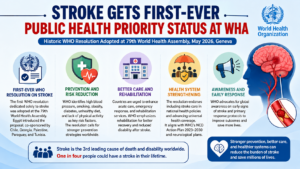
- The first WHO resolution dedicated solely towards stroke was approved by the 79th World Health Assembly.
- The resolution comes under the title: Reducing the burden of stroke: strengthening prevention, acute care, rehabilitation and health-system readiness.
- Egypt introduced the proposal, which was co-sponsored by Chile, Georgia, Palestine, Paraguay, and Tunisia.
- In 2021, stroke was the third leading cause of death and disability worldwide, said the WHO.
- As per the WHO, approximately 93.8 million strokes were reported in the world in 2021.
- In 2021, the World Health Organisation (WHO) reported almost 11.9 million new stroke cases worldwide every year.
- One in four people could have a stroke in their lifetime, the organisation said.
- The resolution calls on the countries to increase the capabilities of the health system, emergency response and rehabilitation, and prevention measures.
- WHO determined high blood pressure, smoking, obesity, diabetes, unhealthy diet and lack of physical activity as the most important risk factors for stroke.
- The resolution endorses the inclusion of stroke care in national health policies and embraces universal health coverage policies.
- WHO stressed the rehabilitative services for better recovery and minimised the disability following stroke.
- It fits in with WHO’s NCD Action Plan 2023-2030 and neurological disorder action programmes.
- WHO also advocated for awareness creation on early signs of stroke and primary response protocols.
- The resolution in the UN is a significant progress in addressing premature death from non-communicable diseases on the international stage.
Previous Year Questions (PYQs) Related to WHOIndia Tops Global Heat List
| Exam Name | Year | Question | Options | Answer |
| SSC CGL | 2023 | The headquarters of the World Health Organization (WHO) is located in which city? | A) Paris B) Geneva C) New York D) Vienna | B) Geneva |
| UPSC Prelims | 2020 | World Health Organization (WHO) is a specialised agency of which organisation? | A) IMF B) World Bank C) United Nations D) WTO | C) United Nations |
| Railway NTPC | 2022 | Which day is observed as World Health Day every year under WHO? | A) 5 June B) 7 April C) 1 December D) 24 October | B) 7 April |
| SSC CHSL | 2021 | Who is known as the head of the World Health Organization (WHO)? | A) Secretary-General B) Director-General C) President D) Chairman | B) Director-General |
| CDS | 2022 | The World Health Organization was established in which year? | A) 1945 B) 1947 C) 1948 D) 1950 | C) 1948 |
Conclusion: WHA Recognising Stroke as a Public Health Priority
The World Health Assembly’s acknowledgement of stroke as a public health priority has taken an unprecedented step in global healthcare policy. It underscores the world’s increasing mortality and morbidity due to stroke. The resolution asks countries to enhance strategies for preventing such casualties, the capacity to respond in emergencies, rehabilitation facilities, and access to affordable health care services. WHO feels that good national policies and education campaigns could greatly reduce the risk of strokes and improve mortality rates. This is also contributing to efforts in the world to achieve universal health coverage and reduce non-communicable diseases by 2030. This will help bulk up global partnership in stroke prevention, therapy and research.