

Day: July 30, 2025

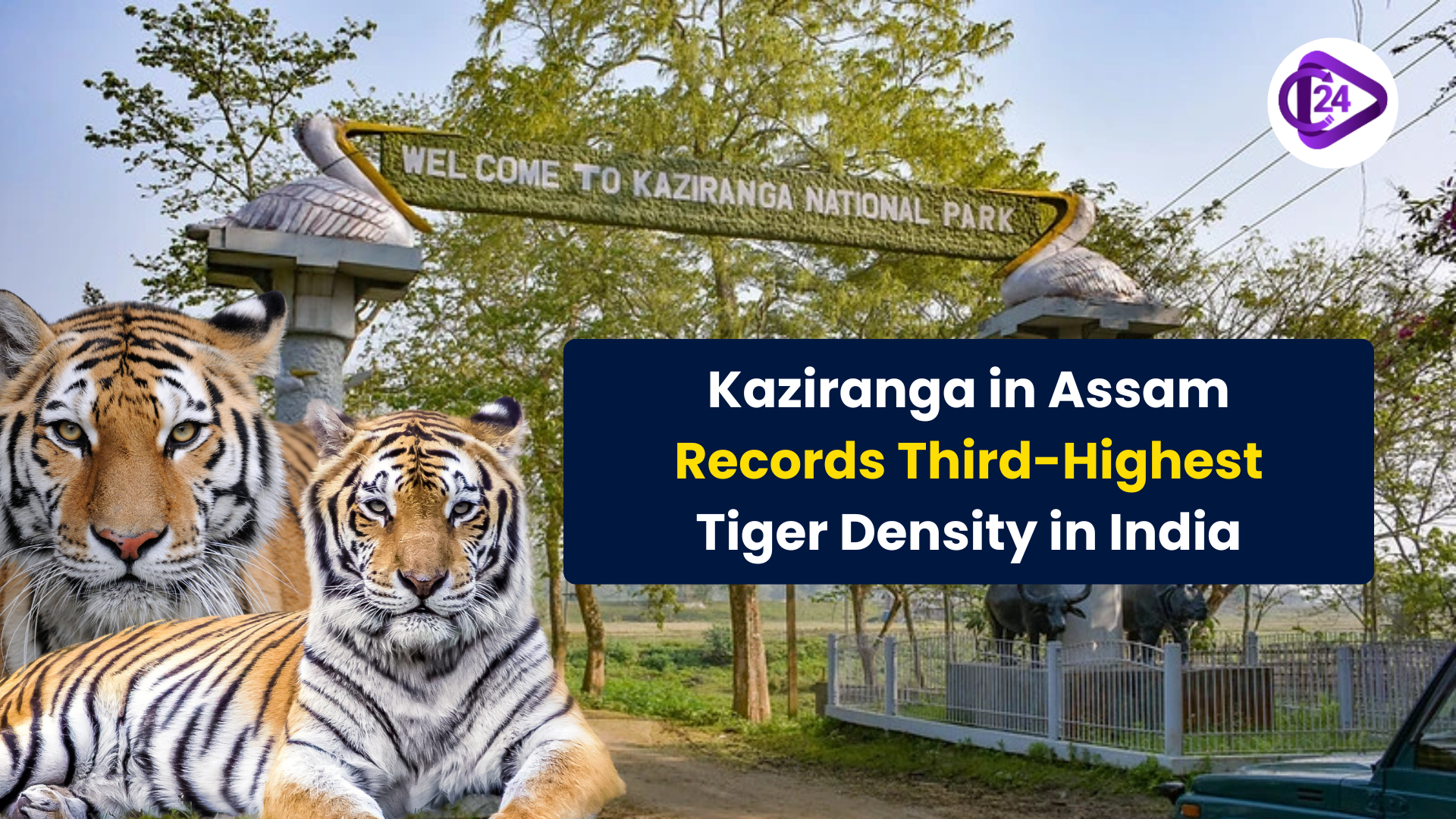
Kaziranga in Assam Records Third-Highest Tiger Density in India

More than 70% of the wild tigers in the world live in India and it is important that the population of tigers be monitored as a form of conservation of biodiversity there. Tiger density, or the number of tigers per 100 sq. km is a very important indicator of the health of an ecosystem, and of conservation success. Recent figures indicate that the Kaziranga Tiger Reserve in Assam is classified as the third place in India with tiger density.

Highlights of recent study

  • Location: Assam; spans 1,307.49 sq. km

  • Tiger Population (2024): 148 individuals

  • Tiger Density: 18.65 tigers per 100 sq. km

  • Rank: 3rd in India, after:

    • Bandipur Tiger Reserve (Karnataka): 19.83/100 sq. km

    • Corbett Tiger Reserve (Uttarakhand): 19.56/100 sq. km

Division-Wise Tiger Count in Kaziranga Landscape (2024)

Division

No. of Tigers (2024)

No. of Tigers (2022)

Eastern Assam Wildlife Division

115

104

Biswanath Wildlife Division

27

– (first survey)

Nagaon Wildlife Division

6

Not specified

The total of 148 tigers in the Kaziranga landscape indicates both stable numbers and effective conservation.

Methodology Used

  • The time range of the survey: December 2023 April 2024

  • Technique: Camera trapping via the Spatially Explicit Capture Recapture (SECR) technique

  • Guidelines Adhered To: National Tiger Conservation Authority (NTCA) and Wildlife Institute of India (WII) guidelines

Conservation Significance

  • The density rate is high on Kaziranga which is a good ecological sign- indicating prey base, its safe habitat and high efforts to curb poaching.

  • It implements the comprehensive approach of tiger conservation in Assam that aims at restoring the habitat and coordination across the divisions.

  • The inclusion of the Biswanath Division for the first time indicates the possibility of expanding the range and the potential of landscape level conservation of tigers.

Broader Implications

  • Replicable Model: The model of Kaziranga has replicable strategies to other reserves.

  • Biodiversity Corridors: Increase in the distribution of tigers in the divisions will need ecological corridors and human-wildlife conflict reduction.

  • Tourism & Livelihoods: Presence of high density of tigers may be used to enhance eco-tourism which will contribute to household income of the locals.

About Tiger Reserve

About tiger

  • Tiger ( Panthera tigris ) is an apex predator and keystone species, i.e. it is one of the most important species in the preservation of the ecological balance. 

  • The tiger is a national animal of India, which was recognised in 1973, and it represents the nation which is devoted to the conservation of bio-diversity.

Significance of Tiger Conservation

  • Ecological Role: Tigers are at the apex of the food chain hence, control the populations of prey and maintain the ecosystem of forests.

  • Umbrella Species: The conservation of tigers means the preservation of biological diversity since its habitat is in the range of different plants and animals.

  • Cultural and Ecotourism Value: The tigers have rich cultural value that was incorporated in Indian mythology and enhances ecotourism that gives local communities chances to make a living.

Rank and Allocation

  • It has an IUCN status of Endangered.

  • Listed in the first schedule of the Wildlife (Protection) Act, 1972.

  • According to the All India Tiger Estimation 2018, there are 2,967 tigers in the country which constitutes close to 75 per cent of all wild tigers in the world.

  • At present there are 57 notified Tiger Reserves in 18 states.

Institutional and Legal structure

  • Project Tiger (1973)

    • It began last year with 9 reserves, and has grown to 57.

    • Core- buffer approach to habitat conservation.

    • The Ministry of Environment, Forest and Climate Change (MoEFCC), has been sponsoring this Centrally Sponsored scheme.

  • National Tiger Conservation Authority (NTCA)

    • Since 2005 after the recommendations of the Tiger Task Force.

    • Wildlife (Protection) Act, 1972 (amended in 2006) Statutory body.

    • Oversees carrying out Project Tiger and adherence to norms of conservation.

  • Wildlife Institute of India (WII)

    • It is a training and research center on wildlife conservation based in Dehradun.

    • It is central to tiger census and technical evaluation.

The Approaches of Monitoring and Prevention

  • M-STrIPES: Anti-poaching and ecological monitoring mobile application.

  • Camera Trapping and DNA Fingerprinting: Ways to do correct population estimation accurately.

  • LIDAR Technology: This will be to control habitat areas and areas where there are conflicts between humans and animals.

International and Binary Cooperation

  • Global Tiger Forum (GTF): A feature unique to all other entities concerned with tiger conservation is that Global Tiger Forum is an inter-governmental organization located in New Delhi.

  • Tx2 Goal: Green promises to make two times the number of tigers by the year 2022 (base year: 2006). The only country that can fulfill this target is India.

  • Global Tiger Initiative (GTI): Interprogram alliance that emerged in 2008 with the efforts of the World Bank to facilitate the coordination of the tiger conservation initiatives across countries.

  • Bilateral Agreements: The cross border conservation bamboo zones through countries such as Nepal, Bangladesh, Bhutan, China and Russia.

Challenges

  • Fragmentation and disruption of the habitat and corridors.

  • Poaching and illegal wildlife trade.

  • The conflict situation between people and tigers in marginal regions.

  • Tiger habitat stress because of climate change (e.g. Sunderbans).

Way Forward

  • Empower eco-sensitive areas, as well as wildlife corridors.

  • Relocation with compensation which would be community based conservation.

  • Landscape level cross-border conservation.

  • An environmentally friendly tourism policy in order to prevent habitat deterioration

Conclusion

The fact that Kaziranga has registered the highest third density of tigers is testament to the fact that India leads in the area of conservation as evidenced in the project tiger framework. The health of these efforts to maintain this success will lie in continued actions to support scientific monitoring, landscape level planning and community involvement. The case example of Assam demonstrates how the national biodiversity goals can be smoothly supplemented with nation level efforts and be of use to the Global Tiger Recovery Programme (GTRP).

NASA-ISRO NISAR Satellite Launch: Strengthening Global Collaboration in Earth Observation

The NISAR satellite mission is the combined project between NASA and ISRO and it is going to be launched on GSLV-F16 in Sriharikota. It will be put into a sun-synchronous narrow orbit, with 743 km, to deliver all-weather and 12-day reoccurring data of the earth. The mission is an example of international collaboration and globalization in the context of COVID times. The S-band radar and satellite bus were developed by ISRO and L-band radar and other payloads by NASA. The project enhances the Indo US cooperation in space, and provides a model to the rest of the world in terms of global Earth science missions.

Context

  • NISAR The NASA-ISRO Synthetic Aperture Radar (NISAR) mission is a milestone in Indo-U.S. space collaboration. It will be the initial joint satellite enterprise of both agencies and it is to detect the surroundings of the Earth at an unprecedented level of frequency and precision.

Characteristics and Goals of NISAR

Launch Details:

  • Vehicle: GSLV-F16

  • Launch site: Satish Dhawan Space Centre, Sriharikota

  • Weight: 2,392kg

  • Orbit: 743km sun-synchronous

  • Take Off time: 5.40 p.m., Wednesday

Mission Capabilities:

  • International coverage with 12 days revisit.

  • Day-and-night observation of the Earth, in all weather conditions.

  • Polarization Cross-correlation on dual-band synthetic aperture radar (S: by ISRO, L: by NASA).

Applications:

  • Monitoring of climate change (melt of glaciers, forest biomass, carbon emissions).

  • Earthquake and tsunami management, floods management.

  • Food security and soil moisture (crop yield).

  • City planning and land evaluation.

Significance of this cooperation

  • Technological Partnership:

    • ISRO: S-band radar, bus of the spacecraft and a launch operation developed.

    • NASA (JPL): L-band radar, radar boom, communications and GPS, and payload data system provision.

  • Problem of Resistance and Success:

    • During COVID-19 65 ISRO engineers were operated at JPL; 175 NASA engineers came to India.

    • Demonstrated ability to do and adapt well within the UN functions.

  • International Relations and Strategic Value:

    • Strengthens the science and technology association between India and U.S.

    • Increases India on the international front in space exploration and data-diplomacy.

Implication for India

  • Scientific Advancement:

    • Increases India in its capabilities of earth science research and remote sensing.

    • It helps in policy making, especially in climate resilience, using the data.

  • Strategic Autonomy:

    • Eliminates the need to rely heavily on foreign sources of data regarding the monitoring of natural resources.

    • Covers national objectives of India such as Bharat@2047, Digital India, and Climate Resilient Development.

  • Global Leadership:

    • Places India as a sustainable partner in cutting edge big international missions.

    • Prime time to take the lead in green technologies to the Global South.

Conclusion

The NISAR mission is not only the next big step in Earth observation but also the example of Indo-U.S. long-range use of collaboration in the sphere of space. This is because with the increasing risk posed by climatic factors, natural hazards and development challenges facing the world today, NISAR will prove to be an effective and opportune science-oriented decision-making platform. 

Frequently Asked Questions (FAQs)

The current affairs cover recent national and international events related to UPSC, SSC, Banking, Railways, and State PCS.

You need to read about the current affairs daily, and revise them every week and every month to keep them longer in your memory.

Yes, Class24 provides free downloadable Daily Current Affairs PDFs for easy revision.

Yes, you can practice MCQs and quizzes to boost your exam preparation.

Absolutely. The content is written in simple, easy-to-understand bilingual language suitable for beginners.

Go to class24.com and click on the current affairs section directly, where you find everything that you need.

ssc-toppers

Start Learning Today with Class24

Related current affairs

Class24 offers free video lectures for smart preparation, covering CGL, CPO, CHSL, MTS, and GD exams. Learn from expert faculty, revise concepts easily, practice with PYQs, and improve speed and accuracy through high-quality, exam-focused video lessons anytime, anywhere.

Get success in your hand. Start study anytime anywhere.

The journey becomes simple and enjoyable when you start taking interest in it. And through our app “Class24”, we will be your trusted partners in developing that interest.

Daily Quizzes
Mock Tests
Ongoing

No ongoing tests right now.