Day: July 25, 2025

India Achieves 20% Ethanol Blending in Petrol — 5 Years Ahead of Target

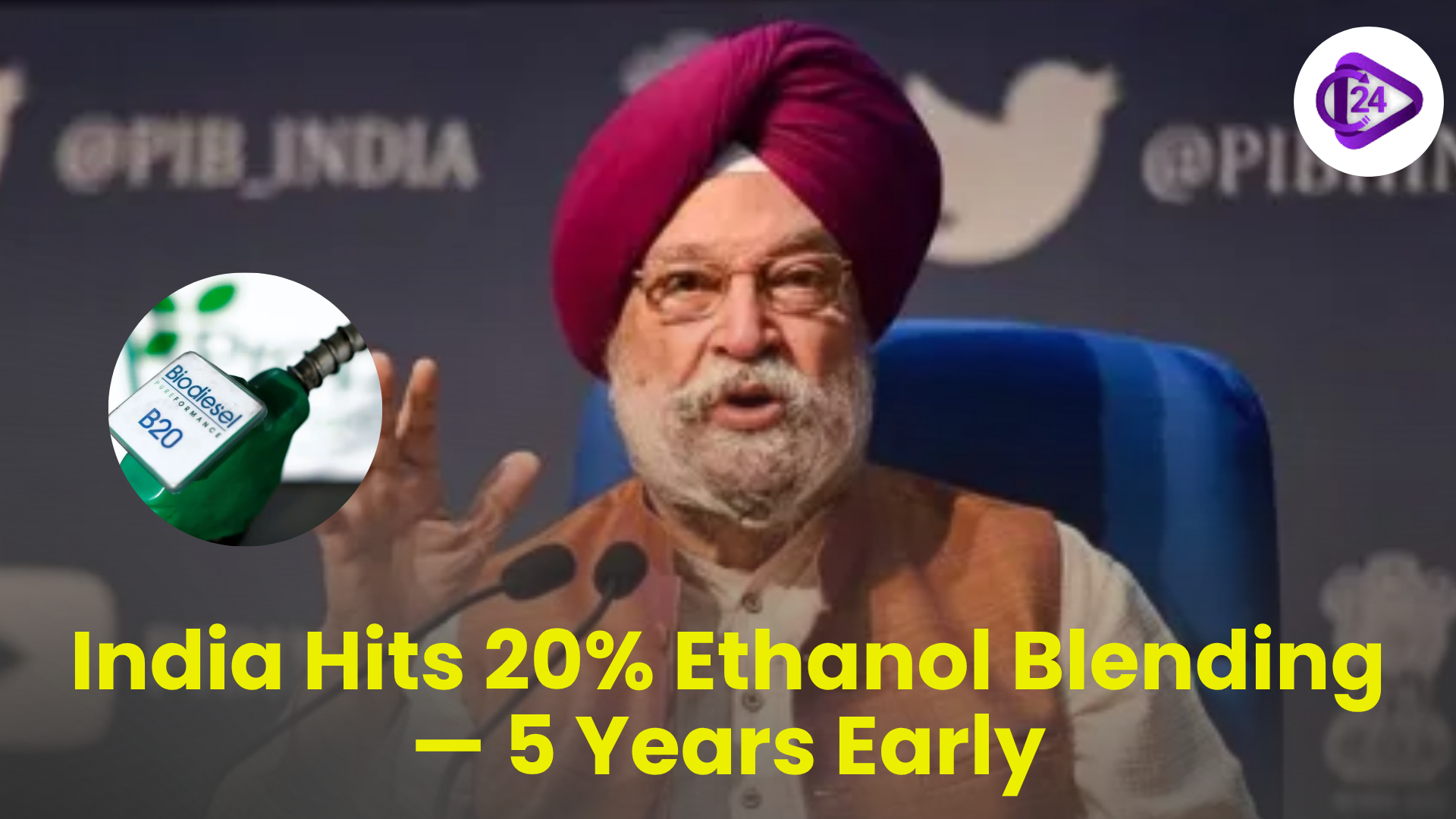
Blending 20 percent ethanol in petrol has been reached in India in 2025 whereas the goal is 2030, making it one of the biggest steps towards clean energy transformation. This upswing of 1.5% in 2014 and 20 % in 2025 makes India lean towards energy security, environment, and development of rural areas. The production of ethanol increased to 661.1 crore litres which limited the importation of crude and foreign exchange. It has helped the farmers and distilleries to economically prosper. The project is in line with India net-zero emission targets and environmentally friendly farming.

Context:

  • Introduced by: Hardeep Singh Puri,Union of Petroleum and Natural Gas

  • Event: July 2025 announcement of milestone

  • Original ambition: 20 per cent blending by 2030 (now reached in 2025)

  • Global Relevance: In India energy diversification and climate action measure A part of the approach to strategy

Key Facts & Figures:

Indicator

Value

Ethanol Blending (2014)

1.5%

Ethanol Blending (2025)

20%

Increase

~13-fold

Ethanol Production (2014)

38 crore litres

Ethanol Production (2025)

661.1 crore litres

Foreign Exchange Saved

₹1.36 lakh crore

Payment to Distilleries

₹1.96 lakh crore

Payment to Farmers

₹1.18 lakh crore

CO₂ Emissions Reduced

698 lakh tonnes

Aspects of Ethanol blending:

Economic Benefits:

  • Minimises the reliance on foreign crude oil

  • Foreign exchange saving

  • Increases rural economy by parting with farmers and distilleries

Environmental Benefits:

  • Reduces carbon emission

  • Favours alternatives to low-carbon fuels

  • In line with climate pledges of India (Net Zero by 2070)

Agricultural Benefits:

  • Ethanol in the form of sugarcane, molasses, maize, and excess grains

  • Creates stable demand and higher prices to the farmers

  • Promotes diversification in crops and agri-wastes use

Government Efforts And Policy Development:

  • National Bio- ensure Policy

  • Ethanol Blended Petrol (EBP) Programme

  • Pradhan Mantri JI-VAN Yojana- second generation ethanol produced out of agricultural waste

  • Cabinet-approved increase in ethanol made out of molasses (2024-5 season)

International Comparisons:

Country

Ethanol Blending Target

Brazil

~27%

USA

~10% (E10)

India

20% (Achieved in 2025)

India now joins Brazil among the few nations with high-level ethanol blending in petrol.

Challenges Ahead:

  • Understanding how to get sufficient feedstock due to no harm to food security

  • Increased bio-refinery capacity

  • The equilibrium between the cost of transport fuel with the unfixed price of ethanol

  • Sustainably growing water-thirsty crops such as sugarcane

Conclusion:

The country of India has achieved its target of ethanol blending by making 20 percent in advance of the year 2025, which is a significant step to make the clean energy transition. It can enhance the energy security and increase the rural incomes, lower emissions and serve as a world-emulating example of integrating agricultural production with sustainable energy policies. Further investment, sustainable farming, and engineering of biofuels shall be important in sustaining the movement.

India Calls for Gaza Ceasefire, Reaffirms Support for Palestine at UNSC

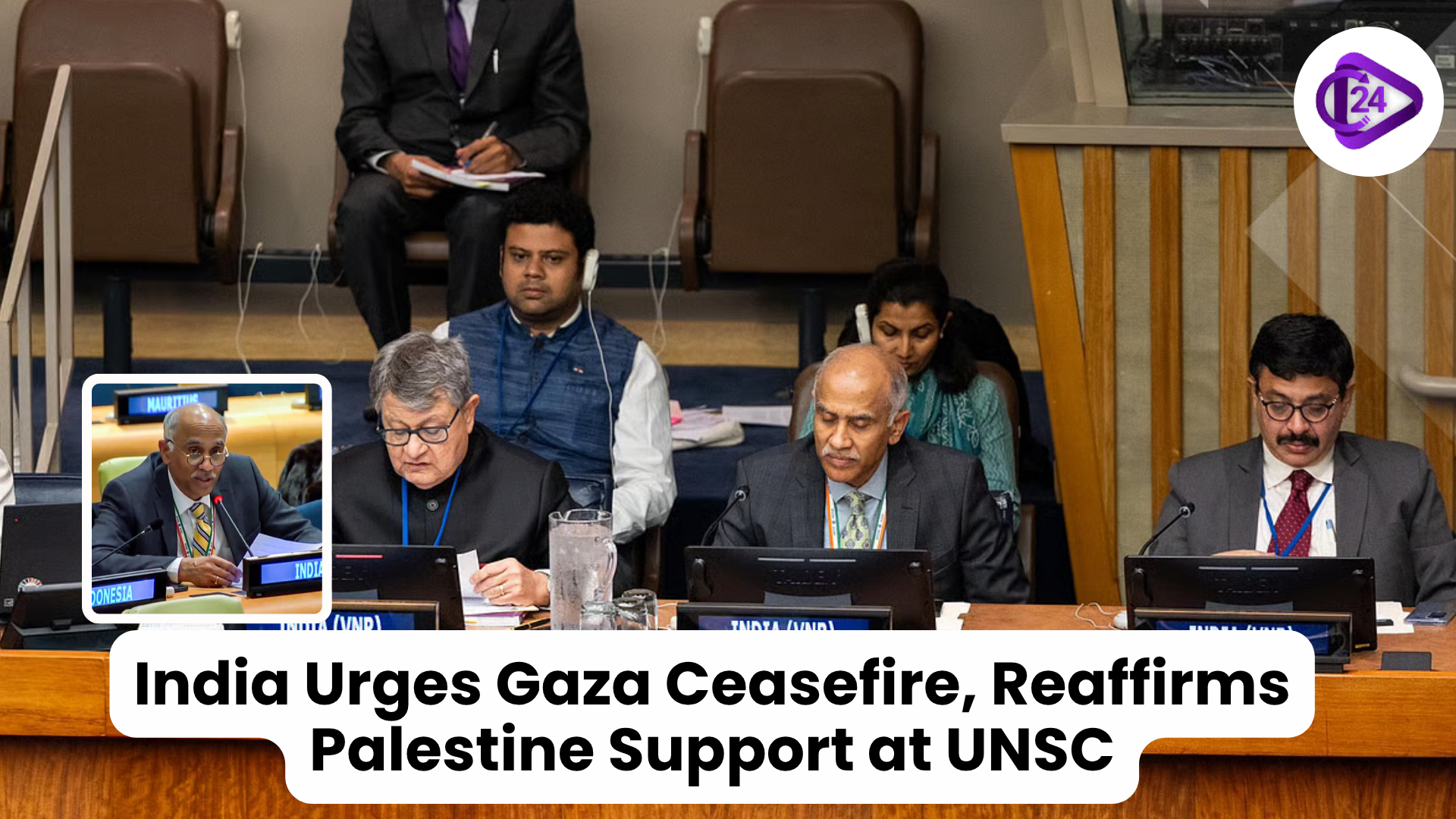
During the debate on the Middle East in the UNSC, India said that there should be a ceasefire immediately in Gaza and all the hostages should be freed. Indian envoy P. Harish highlighted the level of humanitarian suffering and said that periodic lapses are inadequate. He again reiterated the unequivocal support of India on the Palestinian cause and the two-state solution. It is a more assertive note than when India had abstained from the UNGA resolution on a ceasefire. India had also emphasized on dialogue and diplomacy to maintain a long-lasting peace in the region.

Context

  • The statement follows deteriorating humanitarian situations in Gaza, as the UN documents destroyed hospitals and children not being in school months after.

  • Two points can be noted in the remarks of India that point to a slight change in its previous neutral position to a stronger humanitarian and diplomatic stand.

  • The UNSC meeting led by Pakistan also allowed India to once again advocate its historical stance of supporting Palestine despite maintaining its global image in the world of diplomacy.

Key Points

Overview

  • Meeting: UNSC Quarterly Open Debate on Middle East

  • Date: 2025 July

  • India Representative: India has Parvathaneni Harish, who is the Permanent Representative of India to the UN.

  • The setting was in the United Nations Security Council, New York.

  • Sponsored by: Pakistan (July 2025 UNSC President)

Highlights of India’s statement

Humanitarian Crisis in Gaza:

  • Quoted reports found in UN and WHO:

  • 95% of the Gaza hospitals in damaged/destroyed conditions

  • 6.5 lakh OOP children (more than 20 months)

  • Occasional truce in fighting is not enough to solve the widespread misery.

India's Position:

  • There must be a ceasefire and all hostages set free.

  • The only possible ways out are dialogue and diplomacy.

  • Powerful support of Two States Solution as the sole viable choice toward peace.

Transactional Change in India:

  • June 2025 (UNGA): India abstained on the resolution forcing such a ceasefire.

  • July 2025 (UNSC): Bout of stronger words according to ceasefire and humanitarian aid.

  • This change could be an adjusted balancing act in the foreign policy of India.

Strategic and Historical Background:

  • Policies of India regarding Israel and Palestine:

  • Brief history of bearing a long-term stance towards Palestinian sovereignty since the independence of 1948.

  • The approval of Two-State Solution is always supported.

  • Concurrent building up of strategic relations with Israel after 1992.

Recent Humanitarian Aid:

  • India provided:

    • 6.5 tonnes of medicine relief

    • 32 tonnes worth of relief supplies

    • USD 29.53 million to the UNRWA on Palestinian refugees

De-hyphenation Diplomacy:

  • In 2017, PM Modi paid a visit to Israel (first by an Indian PM).

  • In 2018, PM Modi made a trip to Palestine continuing Indian material support.

  • India is pragmatic in its relationship with Israel, Arab nations, and Palestine.

Broader Implications for India:

Area

Potential Impact

Defence

Israel is one of India's top defence suppliers; regional instability may delay deliveries.

Energy Security

Conflict could raise oil prices, affecting India's economy.

Geopolitics

India needs to maintain balance amid rising global polarization.

IMEC Corridor

Violence could hinder progress on the India-Middle East-Europe Economic Corridor.

The Indian vision of peace:

  • Proponents of reforms and equitable multilateralism of UNSC.

  • Facilitates peaceful coexistence, non interference, and multilateral negotiations.

  • Insists on fighting terrorism and impersonal retaliation.

Conclusion

The new statement in UNSC by India is a response to a developing but steady pattern of promoting peace, diplomacy, and humanitarian considerations. As it forms ever-closer alliances with Israel, India is still maintaining its positions in favor of Palestinian rights, and the two-state solution, carefully walking down the line between geopolitics.

India–U.K. Sign Comprehensive Economic Trade Agreement and Launch ‘Vision 2035’

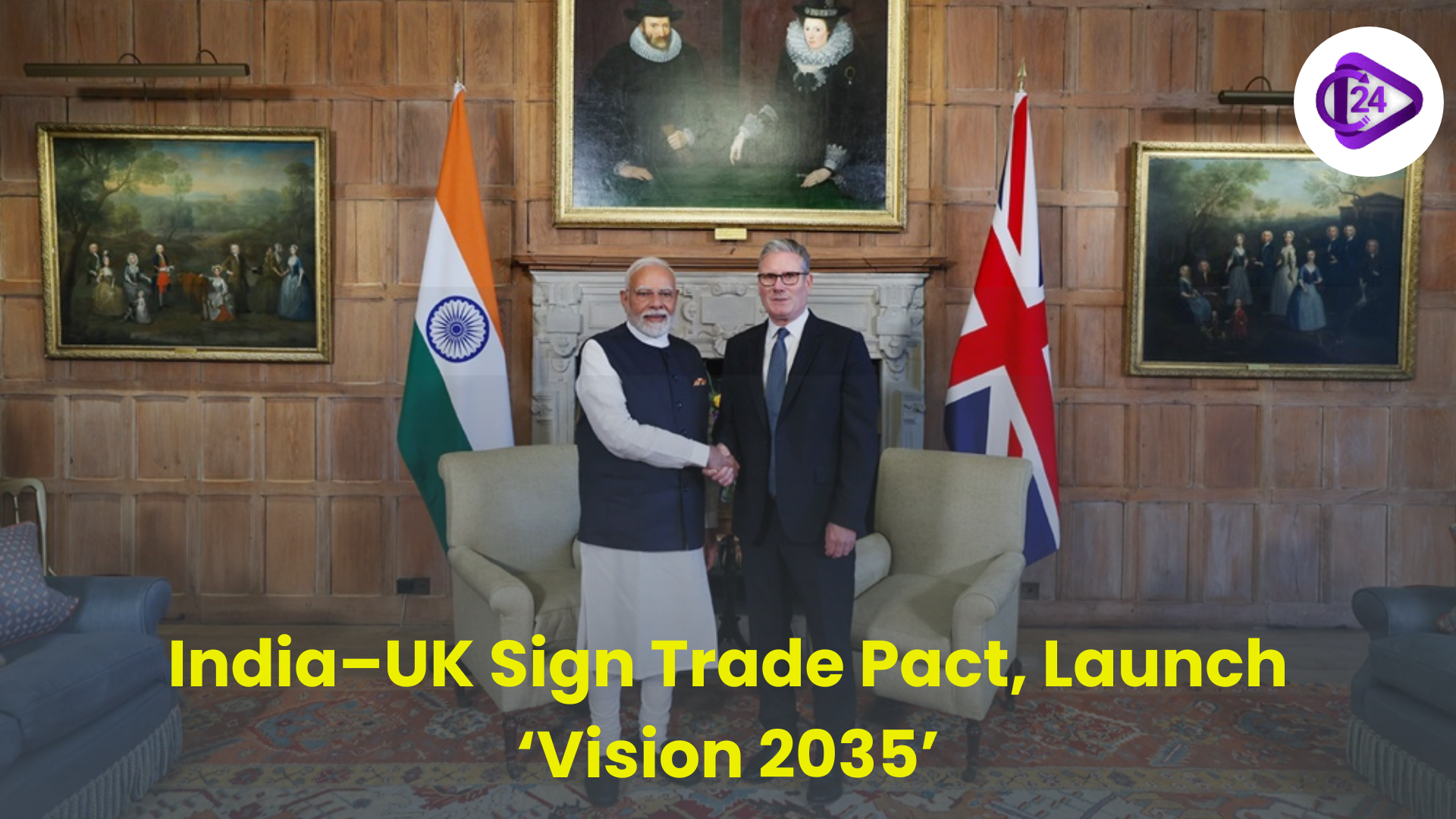
A Comprehensive Economic Trade Agreement (CETA) was signed by India and the United Kingdom on a visit of the Prime Minister of India, Narendra Modi, to the U.K. The agreement will lower tariffs, increase exports, improve bilateral trades, as well as intensify in the sectors of MSMEs, aerospace, food, and jewellery. The two countries converted the Roadmap 2030 to a greater India U.K. Vision 2035. The contract has a clause of social contribution exemptions as a part of a new Double Contributions Convention (DCC). U.K. termed it to be its largest post-Brexit agreement and the most generous trade deal that India has ever had.

Context:

  • Event: the signing of Comprehensive Economic Trade Agreement (CETA)

  • Time: July 2025

  • Location: Chequers Estate, the U.K.

  • Important Leaders: PM Narendra Modi (India), PM Keir Starmer (U.K.)

Key Points

Summary of the Agreement:

Tariff and Trade advantage:

  • The Indian exports consider MSME products, footwear, jewellery, seafood, and engineering goods to enjoy tariff cuts in the U.K.

  • Medical devices and aerospace components produced by Britain will have reduced tariffs in India.

  • U.K consumers will enjoy Indian cheaper clothes, foods, and shoes.

Economic Significance:

  • The agreement was described as the U.K. largest since Brexit.

  • The deal was referred to as the best one that India has ever produced to any nation.

  • Will enhance two-way trade and produce employment on both sides.

Framework vision 2035:

  • Overshadows previous IndiaU.K. Roadmap 2030.

Key Pillars:

  • Jobs growth and trade

  • Technology & Innovation (a development of Technology Security Initiative)

  • Climate Action

  • Defence and Strategic Security

  • PM-level interaction on a regular basis and monitored on Annual basis at Foreign Ministerial level.

Double Contributions Convention (DCC):

  • Fresh social security arrangement to employees.

  • Enables Indian and British professionals working in the other country that they can only pay social contributions in one country up to 3 years (as opposed to 1 year).

Strategic and Multilateral Cooperation:

  • Commitment to UNSC reforms; U.K. supports India’s permanent membership.

  • Joint pledge to reform multilateral bodies:

    • United Nations

    • WTO

    • WHO

    • IMF

    • World Bank

    • Commonwealth

  • Common stand on anti-terrorism, with no tolerance for double standards

Conclusion

The commercial treaty between India and the U.K. is a radical shift in the bilateral relationships. The agreement is very economically advantageous, symbolizes a common strategic agenda, and enhances the collaboration in international governance. It also places India and the U.K. as similar-minded partners sharing an auspicious value of prosperity, security and the ability to both cooperate and gain sufficiency in the 21 st century.

Frequently Asked Questions (FAQs)

The current affairs cover recent national and international events related to UPSC, SSC, Banking, Railways, and State PCS.

You need to read about the current affairs daily, and revise them every week and every month to keep them longer in your memory.

Yes, Class24 provides free downloadable Daily Current Affairs PDFs for easy revision.

Yes, you can practice MCQs and quizzes to boost your exam preparation.

Absolutely. The content is written in simple, easy-to-understand bilingual language suitable for beginners.

Go to class24.com and click on the current affairs section directly, where you find everything that you need.

ssc-toppers

Start Learning Today with Class24

Related current affairs

Class24 offers free video lectures for smart preparation, covering CGL, CPO, CHSL, MTS, and GD exams. Learn from expert faculty, revise concepts easily, practice with PYQs, and improve speed and accuracy through high-quality, exam-focused video lessons anytime, anywhere.

Get success in your hand. Start study anytime anywhere.

The journey becomes simple and enjoyable when you start taking interest in it. And through our app “Class24”, we will be your trusted partners in developing that interest.

Daily Quizzes
Mock Tests
Ongoing

No ongoing tests right now.