Day: May 20, 2025

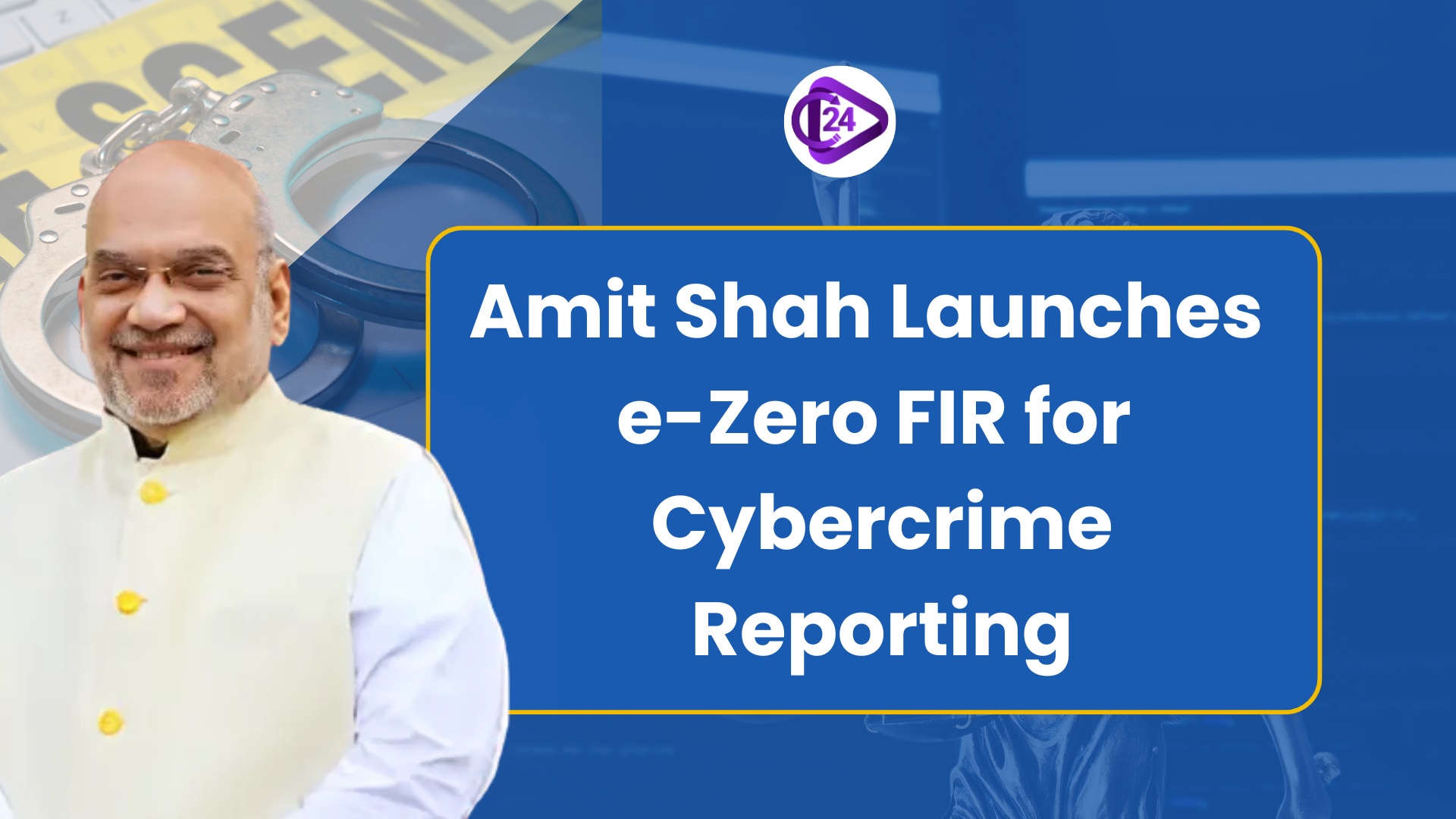
Amit Shah Launches e-Zero FIR Initiative to Streamline Financial Cybercrime Reporting

The I4C has developed a system that ensures complaints about financial cybercrime exceeding ₹10 lakh are recorded as First Information Reports (FIRs). Union Home Minister Amit Shah launched the pilot version of e-Zero FIR in Delhi. It uses several digital tools such as the National Cybercrime Reporting Portal, the e-FIR system from Delhi Police and the National Crime Record Bureau’s system. The aim is to work quickly and lessen the obstacles for victims in getting back their money. The initiative will soon be carried out across the country.

Summary:

 Within the e-Zero FIR, cybercrime complaints are converted into FIRs automatically to speed up actions against those who conduct financial crimes online. After being established in Delhi, it will soon operate nationally to help people report cybercrimes and support victims.

Key Points 

Features of e-Zero FIR

  • Purpose:

    • Automation of the process to transfer cybercrime reports (financial fraud over ₹10 lakh) into First Information Reports (FIRs).

  • Process:

    • Reports made through:

      • 1930 helpline

      • Cybercrime.gov.in portal

    • If fraud causes damages greater than ₹10 lakh, an FIR will automatically be registered.

  • Integration:

    • Using systems from both industries.

    • The National Cybercrime Reporting Portal (I4C)

    • The Delhi Police have an e-FIR service.

    • The Crime and Criminal Tracking Network and Systems of the National Crime Record Bureau

How important is the initiative?

  • Enhanced Efficiency:

    • Reduces mistakes in the registration of FIRs and increases the speed of the investigation.

  • Nationwide Rollout:

    • After finishing the pilot in Delhi, the program will be applied countrywide.

    • Support for people who are affected by crime is available.

    • Especially important for people who become victims of cybercrimes related to money.

  • Being Proactive in Law Enforcement:

    • Intended for a fast response to threats from cybercriminals.

Background:

  • Problem Addressed:

    • There are also many reports of financial cybercrimes now and victims often struggle to create an FIR and withdraw the stolen sum.

  • Government’s Focus:

    • Contributes to the Digital India plan for strengthening cybersecurity and keeping the public safe.

  • Policy Alignment:

    • This initiative helps the Home Ministry in its mission to improve cybercrime reporting and track criminals.

Technological Integration:

  • Involved Technologies:

    • The FIR process is automated for convenience.

    • The I4C shares data with both the Delhi Police and NCRB.

    • Processing of data as soon as it happens

  • Cybercrime Helpline:

    • A victim can report their case either to 1930 or to cybercrime.gov.in.

  • Data Monitoring:

    • Organizing all data in a central location for quicker resolving of cases.

Difference Between e-Zero FIR and Zero FIR

Feature

e-Zero FIR

Zero FIR

Definition

Automated FIR for financial cybercrime cases above ₹10 lakh.

FIR registered outside crime jurisdiction to start investigation.

Scope

Only high-value financial cybercrimes via online portals/helpline.

Any cognizable offence filed at any police station.

Process

Automated digital conversion and integration.

Manual FIR filing at any police station.

Use Case

Cybercrime complaints registered online/helpline.

FIR filed where complainant is, even if crime occurred elsewhere.

Benefit

Faster FIR registration and action in cybercrime.

Enables timely FIR registration regardless of location.

Conclusion:

The e-Zero FIR initiative is an important move to enhance India’s ability to handle cybercrime using technology and police systems together. It quickens legal help for people who suffer cyber financial fraud and supports the government’s effort to address such problems, aligning with its other digital-related policies.

A Haryana YouTuber has been arrested under the Official Secrets Act, 1923, for disclosing details to Pakistani officials

During the ongoing Operation Sindoor, Haryana’s Jyoti Rani was apprehended for giving sensitive information to a Pakistani High Commission official. She was accused under OSA and Section 152 of BNS for acts that could weaken India’s independence. This act was made in 1923 to prevent the spreading of confidential government secrets that could harm national security. The arrest of Jyoti Rani shows how strongly this antiquated law is applied to defend India’s sovereignty from secret information from outside.

Details:

  • The Official Secrets Act was created in 1923.

  • Formulated under the rule of Britain, based on their OSA 1911 legislation.

  • Hides secrets of the government, military and intelligence community from being leaked.

  • Should be considered by all individuals on the unknown list with classified information, including government officials, civilians and foreign nationals.

Key Provisions:

  • Protects secret codes, passwords, maps, documents and various types of military plans used by the government.

  • Makes spying, false communication, counterfeiting and unapproved uniforms illegal.

  • It covers any activity that endangers the country or helps its enemies.

Penalties:

  • If the offence concerns defence matters, you can receive up to 14 years in prison; otherwise, you could serve up to 3 years.

  • Misleading messages: At most 3 years in prison and a fine.

  • Being involved or encouraging the commission of an offense: Considered as the principal offense.

Authorities’ Powers:

  • Can search, seize papers and handle prosecutions in private for reasons involving national interests.

Under BNS Section 152, there are additional charges.

  • Handles instances where someone attempts to threaten the country’s unity such as supporting the separation of regions or starting a rebellion.

  • Punishment could result in life imprisonment or a term of up to 7 years, as well as a fine.

  • It is acceptable to suggest reform of the law when done peacefully.

Conclusion:

The reason for the Official Secrets Act, 1923, is to stop security threats with a ban on spying and on exposing confidential information. The arrest of a War Crime suspect demonstrates that preserving national and international security is still essential, yet individuals are able to express their opinions legally.

UPSC Prelims Practice Question

Q. With reference to the Official Secrets Act (OSA), 1923, consider the following statements:

  1. The Act applies only to government officials who have access to classified information.

  2. The maximum punishment under the Act for defence-related offences can extend up to 14 years of imprisonment.

  3. The Act empowers authorities to conduct searches and seizures without a warrant.

  4. Section 152 of the Bharatiya Nyaya Sanhita (BNS) deals with offences related to promoting secession and rebellion.

Which of the statements given above are correct?

A) 1 and 2 only

B) 2 and 4 only

C) 2, 3 and 4 only

D) 1, 3 and 4 only

FAQs

It is a colonial-era law designed to protect government, military, and intelligence secrets from being leaked.

Government officials, civilians, foreign nationals, or anyone with access to classified information.

Up to 14 years imprisonment for defence-related offences; up to 3 years and fines for other violations.

Charges related to acts threatening India’s sovereignty, such as rebellion or promoting secession, punishable by life imprisonment or up to 7 years.

They can conduct searches, seize documents, and keep prosecutions confidential for national security reasons.

Government Permits Private Investors to Participate in India’s Nuclear Energy Market

As part of its plans, the Indian government will adjust important laws in nuclear energy to let private and foreign entities be involved in generating nuclear power. At present, operating power plants with nuclear fuels has been permitted only to state-owned firms like NPCIL and NTPC. The new laws will also modify the liability requirements under the Civil Liability for Nuclear Damage Act, 2010, so that more Americans become interested in investing and sharing advanced technology here.

Summary:

  • India is easing rules and establishing a cap on liabilities to allow both foreigners and private firms to invest in nuclear energy. 

  • The purpose behind this action is to grow India’s nuclear power and promote greater cooperation between India and the US.

Details:

Legal Reforms:

  • Civil Liability for Nuclear Damage Act, 2010 sets rules for a maximum liability, depending on the contract amount and imposes a time limit for bringing liability claims.

  • The Minorities Act, 1962 was amended so that private and foreign groups could invest a share of equity in nuclear energy projects.

Reason for the initiative

  • Nuclear power in India is handled by the government, without any role for the private sector.

  • These companies have opted out because they are concerned about legal issues when handling radioactive materials.

  • The reliability of laws drives foreign investment and allows India to gain from the Indo-US Civil Nuclear Agreement.

A key advancement has been made in the U.S. recently.

  • Holtec International was given permission to transfer the technology for Small Modular Reactors to Indian companies Tata Consulting Engineers and L&T.

  • Makes it possible for India to produce SMRs at home, leading to better development of nuclear technology.

Objectives of India’s nuclear capacity.

  • Grow from 8,180 MW in the present day to 22,480 MW in 2031 and 2032.

  • The country intends to increase its nuclear energy capacity to 100 GW by 2047.

  • Using nuclear power partly to deal with rising electricity demand, as well as with the rise of renewable energy.

  • Supports the Indian government’s target of reducing emission intensity by 44% by 2030 and having half of its energy generated from non-fossil fuels.

What is Nuclear Energy?

  • All over the world, wind energy is the next biggest form of low-carbon electricity after hydropower.

  • In 2019, 30% of the global supply of low-carbon electricity came from nuclear power.

  • Last year, nuclear power contributed 9.8% of the electricity generated which is a decrease of 0.4 percentage points compared to 2020.

  • Nuclear energy was responsible for a greater portion of energy in 1980 than in 1990, but its use has dropped from that point on.

The Nuclear Energy Mission in India

  • The goal is for green energy to make up 55 GW by 2047, while also working toward India’s energy vision and strategy.

  • Currently, the country’s nuclear power capacity is 8,180 MW which will rise to 22,480 MW by the years 2031-32.

  • They are planning to create SMRs and set up at least five units by 2033.

  • The Atomic Energy Act, 1962 and Civil Liability for Nuclear Damage Act, 2010, were both revised to let in companies and foreign participants.

  • Cooperate with companies to build Bharat Small Reactors, improve SMRs and work on new nuclear technology.

  • Creating SMRs at BARC is aimed at transforming coal plants and offering electricity to remote areas.

  • Indigenous Technology: Design small 220 MW PHWR BSRs, high-temperature gas-cooled reactors to produce hydrogen and molten salt reactors with thorium.

  • It helps India achieve its goal to supply 500 GW of clean energy and use 50% renewable resources by 2030 as announced at COP26.

Conclusion:

The amendments will change the country’s policy by allowing more foreign investment and nuclear technology, while also increasing its clean energy sources. Through these reforms, India further aligns with the United States, while also getting closer to achieving its goals in energy and climate.

UPSC Prelims Practice Questions 

Q.1 Consider the following statements regarding nuclear energy reforms in India:

  1. The Civil Liability for Nuclear Damage Act, 2010 is being amended to ease liability norms for foreign investors.

  2. Private companies in India were already allowed to operate nuclear power plants before the latest reforms.

  3. India aims to generate 100 GW of nuclear power by 2047.

  4. Holtec International is transferring nuclear fusion technology to Indian companies.

Which of the statements given above are correct?

A) 1 and 3 only

B) 1, 2 and 4 only

C) 1, 3 and 4 only

D) 2 and 4 only

Q.2 Which of the following Acts are being amended to facilitate private and foreign participation in India's nuclear energy sector?

  1. The Atomic Energy Act, 1962
  2. The Civil Liability for Nuclear Damage Act, 2010
  3. The Environment Protection Act, 1986
  4. The Minorities Act, 1962

Select the correct answer using the code below:
A) 1 and 2 only
B) 1, 2 and 4 only
C) 2 and 3 only
D) 1 and 4 only

FAQs – Nuclear Energy in India UPSC

India’s nuclear capacity is around 8,180 MW as of 2025.

India aims to reach 22,480 MW by 2031-32 and 100 GW by 2047.

Currently, only government entities like NPCIL and NTPC operate nuclear plants.

Laws have been amended to allow private and foreign investment in nuclear power and cap liability.

Nuclear power helps reduce carbon emissions and supports India’s target of 50% non-fossil fuel power by 2030.

Nicaragua quits UNESCO in protest over a Press Freedom Prize.

Nicaragua decided to pull out of UNESCO in response to the group’s decision to give the UNESCO/Guillermo Cano World Press Freedom Prize to its newspaper La Prensa. The government of Nicaragua was against this step because it saw it as interference in its own matters. In 1997, the prize known as the Guillermo Cano World Press Freedom Award was created to applaud international contributions to freedom of the press. Many member states have voiced more criticism of UNESCO which promotes peace by supporting education, science, culture and communication. The decision makes it clear that there are rising tensions between countries and international organizations regarding press freedom and ownership of land.

Context

  • Nicaragua opted out of UNESCO after the international organization gave its press freedom prize to La Prensa newspaper for challenging the government. 

  • This incident shows there are disagreements about media freedom and global countries’ involvement in a nation’s affairs.

Details:

  • UNESCO/Guillermo Cano World Press Freedom Prize:

    • Since 1997, it has been the UN’s only journalism award.

    • It is celebrated every May 3 as World Press Freedom Day.

    • It is named after the Colombian journalist Guillermo Cano.

    • Offers awards to those who stand up for press freedom.

    • The award was presented to Myanmar’s Kyaw Soe Oo and Wa Lone (2019) and to Belarus’ group of independent journalists (2022).

About UNESCO:

  • The organization was founded in Paris in 1945.

  • Works to ensure peace and equality across the globe with the help of education, science, culture and communication.

  • Institutes worldwide standards and helps bring countries together.

About Nicaragua:

  • The biggest country in Central America, it is bordered by Honduras, Costa Rica, Pacific Ocean and Caribbean Sea.

  • Spain and Britain ruled over the country; it became completely independent in 1838.

  • Much of the population is made up of people who have mixed Indigenous and European heritage.

Conclusion:

Nicaragua did this because supporting free press on a global scale often conflicts with its own sovereignty. Because some nations are resisting outside influence, it leads us to ask what the future may hold for organizations like UNESCO in safeguarding democracy.

UPSC Prelims Practice Question

Q. Consider the following statements regarding the UNESCO/Guillermo Cano World Press Freedom Prize:

  1. It is awarded annually by UNESCO to recognize outstanding contributions to the defence or promotion of press freedom.

  2. The award is named after a Colombian journalist who was assassinated for his critical reporting.

  3. The prize has never been awarded to journalists from Southeast Asia.

  4. It is conferred every year on World Press Freedom Day, May 3.

Which of the statements given above are correct?

A) 1, 2 and 4 only

B) 2 and 3 only

C) 1 and 3 only

D) 1, 2, 3 and 4

UPSC Mains Practice Question (GS Paper 2)

Q. The withdrawal of Nicaragua from UNESCO following the award of the Guillermo Cano World Press Freedom Prize to its local newspaper reflects a growing trend of friction between sovereign states and global institutions. Discuss the implications of such withdrawals on global governance and international norms related to freedom of expression. (Answer in 250 words)

FAQs-  UNESCO UPSC

Nicaragua withdrew in protest after UNESCO awarded the Guillermo Cano World Press Freedom Prize to its newspaper La Prensa, which the government opposed.

It is an international award established in 1997 to honor individuals or organizations contributing significantly to press freedom worldwide.

The government viewed it as interference in its internal affairs and a challenge to its control over the media.

UNESCO promotes peace by supporting global cooperation in education, science, culture, and communication.

It reflects growing tensions between sovereign nations and international bodies over issues like press freedom and national sovereignty.

India Charts New Sea Route for North-East via Myanmar, Bypassing Bangladesh

Upgrading travel to its North-Eastern states is a priority, so India is working on a four-lane highway linking Shillong (Meghalaya) and Silchar (Assam). As part of this highway, plans will include a long-awaited project from Myanmar, the Kaladan Multi-Modal Transit Transport Project (KMMTTP) which will make a new sea-land route around Bangladesh and the insecure Siliguri Corridor. In April 2025, the Union Cabinet gave its approval to the ₹22,864 crore Shillong-Silchar highway as a part of India’s Act East Policy and also because of recent issues and instability in Bangladesh and Myanmar.

Project Overview:

Shillong to Silchar High-Speed Corridor (NH-6).

  • Distance: 103.6 miles (144.8 in Meghalaya, 22 in Assam)

  • Cost: Rs. 22,864 crore

  • By the end of 2030, it should be completed.

  • The government uses Hybrid Annuity Mode (HAM) within the framework of Public-Private Partnership (PPP).

  • National Highways and Infrastructure Development Corporation Limited (NHIDCL) is in charge of the project.

  • The project is referred to as the Kaladan Multi-Modal Transit Transport Project (KMMTTP).

Components:

  • The sea route was built from Kolkata to Sittwe port in Myanmar (539 km) and is now complete.

  • Sittwe-Paletwa route on the Kaladan river is now finished (158 km).

  • If taking the road, travel from Paletwa to Zorinpui, Mizoram (108 km), as the last 50 km along the new four-lane highway are still under development.

  • A road exists between Zorinpui and Silchar and another between Zorinpui and Shillong, the Shillong-Silchar highway is being constructed as well.

Strategic Significance:

  • The corridor avoids passing through Bangladesh and the Siliguri Corridor which is both narrow and important for the North-East of India.

  • Having a 3rd Way: Allows India to trade without going through Bangladesh during disagreements and after Bangladesh increased its claims in the Bay of Bengal.

  • Focus on the Act East Policy: Pushes up trade, tourism, infrastructure projects and logistics for the military with Southeast Asia, builds more connections with countries in the region under BIMSTEC.

  • With the new rail link, cost and time for transporting goods between Kolkata and Mizoram will be reduced by up to 1,000 kilometers and the area’s economy can gain.

  • Counterbalancing China’s CMEC: Ensures India can maintain its influence in Myanmar and nearby areas.

Focus on Advanced Engineering and Innovations 

  • The Shillong-Silchar highway will be the first such high-speed highway  to be built in the North-East region.

  • Among these features are methods for preventing landslides, using the latest LiDAR technology for survey and adding instruments to monitor the environment and ground stability such as geophones, inclinometers, rain gauges and piezometers.

  • To build, 19 major bridges, 153 minor ones, 326 culverts, 22 underpasses, 26 overpasses, 8 limited-height subways and 34 viaducts will be needed.

Challenges Faced by Nations:

  • Since the 2021 military coup, Myanmar deals with civil conflict and there have been only 21% of people controlled by the junta. This state, where the Kaladan project is located, is mostly administered by the Arakan Army which is known as a terrorist organization by the Myanmar junta. This causes complications in handling security and diplomacy.

  • Negotiating Relationships: New Delhi must ensure that dealing with non-state organizations like the Arakan Army does not affect its existing relations with the government of Myanmar.

  • Regional Tensions: The idea behind the project is to address Bangladesh’s demand for control in the area and rising disputes in the region, helping India reinforce its sovereignty and independence.

Conclusion:

The linking of the Shillong-Silchar highway with the Kaladan Multi-Modal Transit Transport Project has changed the way India connects its regions. Building a new route past Bangladesh and the Siliguri area is helping India develop a dependable and secure inland-sea corridor towards its North-East. Despite the difficulties of Myanmar’s political situation and the nearby region, the project reflects India’s strategy of securing itself, expanding economic growth and playing a bigger role in Asia’s critical and sensitive borders.

Frequently Asked Questions (FAQs)

The current affairs cover recent national and international events related to UPSC, SSC, Banking, Railways, and State PCS.

You need to read about the current affairs daily, and revise them every week and every month to keep them longer in your memory.

Yes, Class24 provides free downloadable Daily Current Affairs PDFs for easy revision.

Yes, you can practice MCQs and quizzes to boost your exam preparation.

Absolutely. The content is written in simple, easy-to-understand bilingual language suitable for beginners.

Go to class24.com and click on the current affairs section directly, where you find everything that you need.

ssc-toppers

Start Learning Today with Class24

Related current affairs

Class24 offers free video lectures for smart preparation, covering CGL, CPO, CHSL, MTS, and GD exams. Learn from expert faculty, revise concepts easily, practice with PYQs, and improve speed and accuracy through high-quality, exam-focused video lessons anytime, anywhere.

Get success in your hand. Start study anytime anywhere.

The journey becomes simple and enjoyable when you start taking interest in it. And through our app “Class24”, we will be your trusted partners in developing that interest.

Daily Quizzes
Mock Tests
Ongoing

No ongoing tests right now.