

Day: April 8, 2025

India Strengthens BFSI Cybersecurity with Digital Threat Report 2024

The distinguished authorities of MeitY and CERT-In and CSIRT-Fin together with SISA launched the "Digital Threat Report 2024" targeting the BFSI sector. The goal of this report is two-fold: it detects cyber weaknesses within India's financial system and evaluates upcoming threats before establishing a common strategy to construct sustained financial cybersecurity endurance.

Context:

  • Due to financial sector digitization the industries in India must contend with growing cyber attacker penetration possibilities. 

  • The projected value of digital transactions until 2028 reaches $3.1 trillion which means cybersecurity infrastructure needs thorough strengthening and security enhancement. 

  • The Digital Threat Report 2024 represents an essential joint production between government institutions and private sector security experts to direct financial sector organizations through digital threats.

What is digital threat or Cyber Crime?

  • Any attack on digital assets represents a digital threat that seeks to steal information while seeking unauthorized admission and attempting to damage or disrupt digital networks. 

  • Digital threats stem from all sorts of sources including cybercriminals, organized criminal operations and national governments which attack software programs and network systems as well as human conduct to gain unauthorized access.

Types of Digital Threats:

  • Malware (e.g., viruses, worms, trojans, ransomware)

  • Phishing and Social Engineering

  • Ransomware Attacks

  • Denial of Service (DoS/DDoS)

  • Zero-Day Exploits

  • Deepfakes and AI-Powered Fraud

  • Digital Scams that include digital arrests together with fake job proposals and fraudulent investment schemes exist online.

  • Data Breaches and Theft

  • Cryptojacking (unauthorized cryptocurrency mining)

  • The hijacking of smart devices represents one type of IoT exploit.

Legislative Measures:

  • Information Technology Act, 2000: Provides legal basis for electronic governance and cybercrime control.

  • Digital Personal Data Protection Act, 2023: Enforces data privacy principles such as lawful processing, accountability, and data minimization.

Institutional Framework:

  • CERT-In: The nodal agency for incident response and cybersecurity coordination.

  • NCIIPC: Safeguards critical information infrastructure in vital sectors.

  • I4C serves as the national body that leads cybercrime fighting operations by utilizing tools such as the cybercrime reporting portal.

  • Cyber Swachhta Kendra operates with the mission to identify and defend against botnet and malware threats.

  • Cyber Surakshit Bharat serves as a platform to develop government official capacity while raising cybersecurity knowledge.

Strategic Initiatives:

  • National Cyber Security Policy (2013): Vision document for cyberspace security and resilience.

  • The Bharat National Cybersecurity Exercise 2024 will host real-time simulation drills to improve national readiness levels.

  • Sector-Specific Regulations:

    • SEBI Cyber Resilience Framework imposes essential cyber operations regulations that capital market organizations must follow.

    • Telecom Rules 2024 functions to specify Critical Telecommunication Infrastructure as well as its control methods.

Key Emerging Cyber Threats:

  • The digital arrest scams through impersonation has cost the public ₹120.3 crore during 2024.

  • Ransomware Attacks: Disruption in banking and healthcare (e.g., C-Edge, AIIMS).

  • Supply Chain Attacks occur when major institutions suffer breaches through the networks of their third-party vendor organizations.

  • State agencies conduct espionage campaigns against power distribution networks as well as government IT infrastructure.

  • Deepfakes: AI-generated media manipulation for misinformation.

  • The number of IoT-related cyberattacks experienced a significant growth of 59% during 2024.

  • The fraudulent activities known as Crypto Fraud take advantage of unregulated areas through well-crafted fraud schemes.

  • The Dark Web marketplace operates as a platform for selling stolen information together with malware which criminals use for cyber attacks.

Conclusion

The BFSI sector in India can protect itself against quick-moving cyber security threats through the Digital Threat Report 2024 which acts as a strategic information base. The leadership approach with enhanced intelligence creates fundamental capabilities to develop resilient cyber infrastructure in finance. The launch creates a critical milestone which advances India’s protection of financial stability while establishing digital security in interconnected global platforms.

Project Varsha: Strengthening India’s Maritime Nuclear Deterrence

The Indian Navy operates Project Varsha secretly to create INS Varsha which will become India’s unique homebase for nuclear submarines near Visakhapatnam. The facility will enter service in 2026 to provide a strategic response against Chinese military expansion in the Indian Ocean area. INS Aridhaman represents India’s third SSBN while its operationalization strengthens the nuclear triad forces of the country.

Context:

  • The increase in Indo-Pacific geopolitical tensions drives India to strengthen its maritime forces.

  • The development of INS Varsha under Project Varsha, along with advancements in nuclear-powered submarines like INS Aridhaman, underscores India’s focus on strategic maritime deterrence and undersea dominance.

What is Project Varsha?

  • The Indian Navy launched an elite project to create the modern nuclear submarine base called INS Varsha.

  • INS Varsha exists in Rambilli which lies approximately 50 kilometers south of Visakhapatnam at Andhra Pradesh.

Objectives and Strategic Aims:

  • The enhancement of Indian maritime strike capabilities aims to extend through the Bay of Bengal and Indian Ocean Region.

  • INS Varsha protects Indian interests by countering the expanding Chinese naval presence in the area.

Key Features of INS Varsha:

  • Submarine surface tunnels together with underground shelters serve dual purposes of protection and operational secrecy.

  • INS Varsha has the capacity to hold 12 nuclear submarines at one time.

  • Offers protection against satellite and aerial surveillance.

  • Close proximity to BARC Atchutapuram for advanced nuclear support.

  • This platform enables fast movement to security areas like the Strait of Malacca.

Strategic Significance:

  • Counters Chinese bases like Hambantota (Sri Lanka) and BNS Sheikh Hasina (Bangladesh).

  • Enhances India’s second-strike nuclear capability.

  • India rises as an influential maritime power in the Indo-Pacific because of this development.

INS Aridhaman – India’s Third SSBN:

  • Part of the Advanced Technology Vessel (ATV) project.

  • 7,000-tonne nuclear-powered ballistic missile submarine (SSBN).

  • The military vessel underwent construction at Shipbuilding Centre Visakhapatnam under joint development between DRDO and BARC.

  • The submarine possesses the capability to deploy K-4 SLBMs which provide a 3500 km range.

  • More advanced than INS Arihant and INS Arighaat.

  • Expected commissioning in 2025.

  • Key component of India’s underwater nuclear deterrence and nuclear triad.

Conclusion

The introduction of Project Varsha along with INS Aridhaman brings India closer to developing an effective maritime-based nuclear deterrent force. India moves forward with these developments to safeguard its national security and demonstrate its dedication to keeping both strategic autonomy and regional balance in the Indo-Pacific area. India’s naval development reaches a transformative point due to this synchronicity between infrastructure capability and operational platform readiness.

Palna Scheme under Mission Shakti: Childcare Support for Working Women

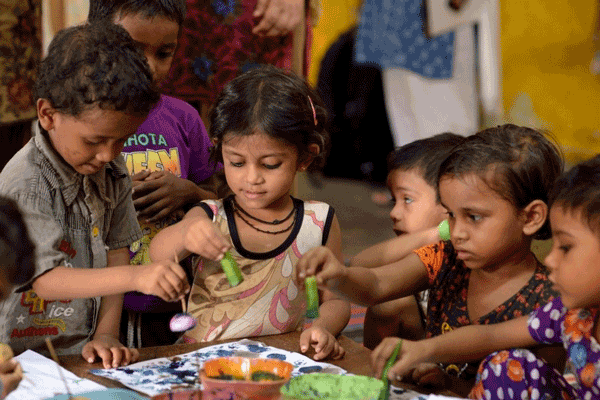
The growing trend of nuclear families together with rising women workforce participation requires immediate implementation of established child care facilities. Joint family systems that used to provide care basis support are no longer prevalent so day-care services became vital. The childcare institution Palna provides institutional care during this period of social transformation. The scheme operates through state and central government joint efforts so it harmonizes with health services and educational programs and nutritional services.

Context:

  • As part of Mission Shakti the Palna Scheme represents a revolutionary Government of India project to solve concurrent women workforce issues while improving child care operations. 

  • The program offers affordable child care facilities with excellent standards for children between 6 months old and 6 years old so both mothers can work and society becomes more gender-sensitive. 

  • The scheme operates through state and central government joint efforts so it harmonizes with health services and educational programs and nutritional services.

Key Points:

  • Scheme Structure and Funding:

    • The program has existed under the 'Samarthya' sub-scheme of Mission Shakti since 2022.

    • The program receives funding distribution as Centrally Sponsored Scheme where Center and States share 60:40 but NE and Special Category States share 90:10 and UTs without legislatures receive full funding from the Center.

Objectives:

  • Crèches at Palna provide safe child care services to children between 6 months old and 6 years old.

  • The scheme strives to support child health and expand nutrition access and advance cognitive development in young children.

  • Every year check that working women receive proper child facilities according to the Maternity Benefit Act regulations.

Key Services Provided:

  • The provision of day-care rest and sleeping facilities along with hygiene accommodations forms part of the services.

  • Early stimulation (below 3 years) and pre-school education (3-6 years).

  • Day care facilities combine health care checks and nutrition services and growth assessment together with vaccination procedures.

  • Crèche timings: 7.5 hours per day, 26 days/month; locally adjustable.

Types of Crèches:

  • Standalone Crèches: Independent facilities with dedicated staff.

  • Anganwadi cum Crèches (AWCCs): Leverage existing Anganwadi infrastructure.

  • The government aims to open 17,000 AWCCs in the fiscal year 2024-25 although March 2025 shows the approval of over 11,000 crèches.

Implementation Guidelines:

  • Child-centric safety and hygiene protocols.

  • Emphasis on local accessibility (near residence or workplace).

  • The program integrates health services through Asha/PHC and Poshan 2.0 initiatives.

Conclusion

Through the Palna Scheme women can enter the workforce while maintaining their parenting duties because it provides solutions for child care. The initiative enables professional caregiving for children so it helps achieve Sustainable Development Goals particularly SDG 8 and drives inclusive economic progress through quality child care services for every child.

Magnetic Nanoparticles: A New Frontier in Cancer Treatment

The world faces cancer as its deadliest condition while India carries one of the largest cancer disease loads globally. The benefits of traditional cancer treatments through chemotherapy and radiation remain effective even though they produce significant adverse side effects. Modern healthcare approaches now use magnetic hyperthermia therapy which allows precise and safer damage of cancer cells.

Context:

  • Scientists in India developed a magnetic nanoparticle system which demonstrates potential for cancer therapy via magnetic hyperthermia that uses external magnetic fields to heat tumor cells specifically until they are destroyed. 

  • The new minimal procedure offers a potential solution to minimize the adverse effects chemotherapy along with radiation treatments produce.

Key Scientific Development:

  • Magnetic Hyperthermia selects tumor cells through magnetic nanoparticles to heat them to the necrotic temperature of 46°C without harming adjacent healthy tissue.

  • Indian research teams at IASST and NIT Nagaland have synthesized nanocrystalline cobalt chromite magnetic nanoparticles which contain rare-earth Gd as a doping material.

  • Synthesis Method: Conventional chemical co-precipitation technique.

  • These nanoparticles demonstrated strong potential for cancer treatment using hyperthermia procedures because they produced effective heat when an alternating magnetic field was applied in fluid state.

  • The discovery has potential applications to provide externally regulated cancer treatment therapies that minimize systemic adverse side effects.

Data Related to Cancer in India

  • The total new cancer cases detected in India for 2022 reached 1,413,316 although women suffered more cancers (722,138) than male patients (691,178).

  • The incidence of breast cancer among Indian patients was 192,020 cases, defining 13.6% of cancer cases and affecting more than 26% of female patients.

  • Oral cavity cancer along with cervical and lung cancer and esophageal cancer are among the most commonly occurring malignancies in India.

  • India faced 32.9% of global Oral cavity cancer deaths together with 28.1% of new cases during 2019 because of its high smokeless tobacco usage.

  • The low survival rate of 51.7% for cervical cancer in India means that it contributes to 23% of global cervical cancer deaths below the US at 70%.

Key facts related to Cancer

  • Observed on: 4th February annually.

  • Organized by: Union for International Cancer Control (UICC) serves as the organizer of this initiative.

  • Origin: Historical records show that the World Summit Against Cancer hosted in Paris marked the inaugural celebration of this event in the year 2000.

  • Paris Charter: The Paris Charter aims to prompt research activities while enhancing cancer prevention methods together with better service programs and increasing worldwide cancer consciousness.

  • Theme of 2025: United by Unique

Cancer Overview:

  • Tumors spread through organs while occurring from uncontrolled cell proliferation in diseases which form malignant growths.

  • Mutations within DNA cause abnormal cell control which produces cancerous conditions.

Cervical Cancer Focus:

  • Type 16 and 18 HPV infections along with other strains represent 99% of the factors that lead to cervical cancer within the cervix.

  • Accounts for the fourth most common cancer in women globally.

  • The majority of cervical cancer diagnoses together with cervical cancer-related fatalities happen predominantly in regions with lower and middle incomes.

Government Initiatives Related to Cancer in India:

  • In the interim budget for 2024-25 the government supported a recommendation for girls between 9 to 14 years old to receive HPV vaccination.

  • National Programme for Prevention and Control of Cancer, Diabetes, Cardiovascular Diseases and Stroke.

  • National Cancer Grid: Enhances cancer care standards.

  • The holiday of National Cancer Awareness Day carries the mission to educate people about cancer prevention measures and early diagnosis methods.

  • The HPV Vaccine has been promoted to protect people from cervical cancer through its distribution.

Conclusion

India has taken a substantial step toward global medical progress through its development of nanocrystalline magnetic nanoparticles meant for cancer therapies. Magnetic hyperthermia joins forces with HPV vaccination and national awareness programs to provide several strategic cancer prevention tools that fight increasing cancer prevalence among Indian women. The improvement of survival rates alongside the closure of equality gaps depends on continuous study along with fair healthcare accessibility.

Frequently Asked Questions (FAQs)

The current affairs cover recent national and international events related to UPSC, SSC, Banking, Railways, and State PCS.

You need to read about the current affairs daily, and revise them every week and every month to keep them longer in your memory.

Yes, Class24 provides free downloadable Daily Current Affairs PDFs for easy revision.

Yes, you can practice MCQs and quizzes to boost your exam preparation.

Absolutely. The content is written in simple, easy-to-understand bilingual language suitable for beginners.

Go to class24.com and click on the current affairs section directly, where you find everything that you need.

ssc-toppers

Start Learning Today with Class24

Related current affairs

Class24 offers free video lectures for smart preparation, covering CGL, CPO, CHSL, MTS, and GD exams. Learn from expert faculty, revise concepts easily, practice with PYQs, and improve speed and accuracy through high-quality, exam-focused video lessons anytime, anywhere.

Get success in your hand. Start study anytime anywhere.

The journey becomes simple and enjoyable when you start taking interest in it. And through our app “Class24”, we will be your trusted partners in developing that interest.

Daily Quizzes
Mock Tests
Ongoing

No ongoing tests right now.