
Day: March 11, 2025

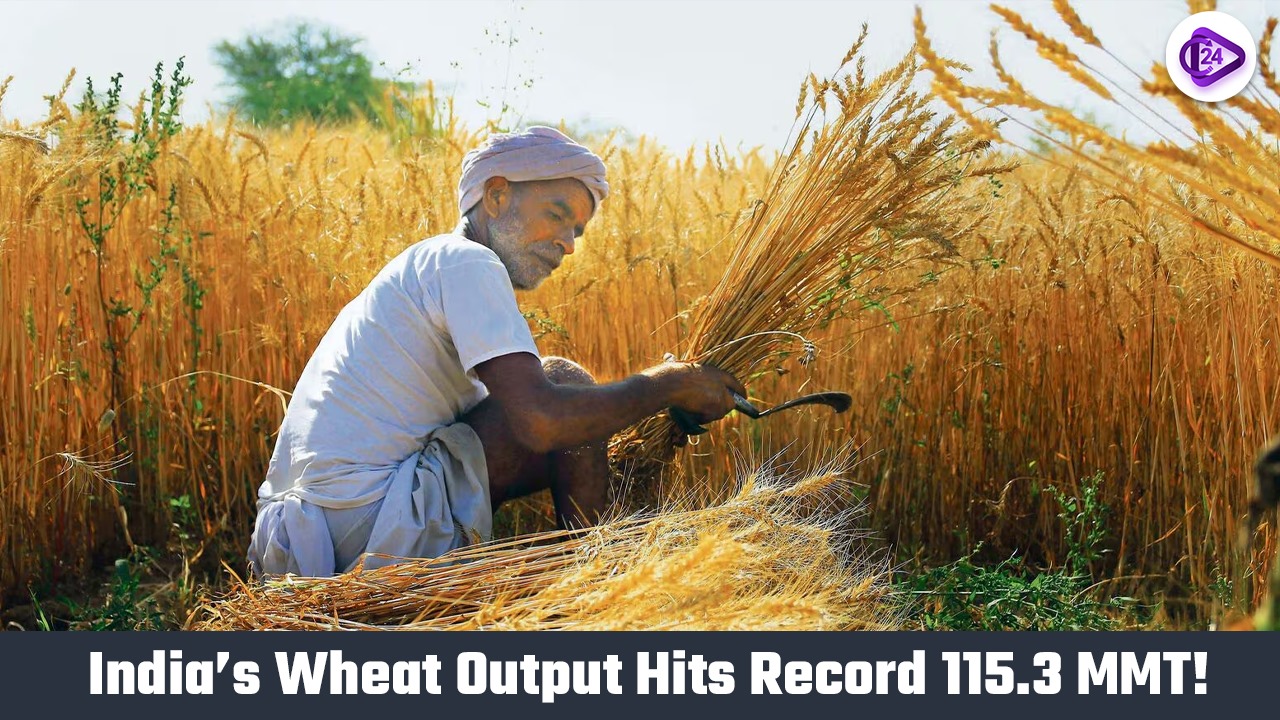
India’s Wheat Production Estimated to Hit Record High of 115.3 Million Metric Tonnes in 2024-25

The wheat stock in the central pool exceeded the April 1 buffer norm of 7.46 million tonnes with 14.41 million tonnes at the beginning of March. The Ministry of Agriculture and Farmers’ Welfare reports through its Second Advance Estimates that wheat production exceeded all previous records by reaching 115.3 million metric tonnes during 2024-25 whereas 2023-24 witnessed 113.3 million metric tonnes.

The wheat production levels for 2022-23 amounted to 110.05 million tonnes while the 2021-22 year delivered 107.7 million tonnes. Indian authorities established a target of 31 million tonnes wheat procurement for the upcoming Rabi marketing season (2025-26).

Production Trends and Government Targets

  • Production forecasts for the 2024-25 wheat season establish India as a premier global wheat producing nation through new all-time high output numbers.

  • Wheat procurement by the government exceeded 26.6 million tonnes while the annual target oscillated between 30-32 million tonnes for this current period.

  • For the Rabi Marketing Season (RMS) 2025-26 the Indian government has established an MSP of Rs 2,425 per quintal for wheat as an increase of 6.59% compared to the previous RMS 2024-25 price of Rs 2,275 per quintal.

India’s Wheat Production Data (2021-2025)

Year

Wheat Production (Million Metric Tonnes)

MSP (Rs/Quintal)

2021-22

107.7


2022-23

110.05


2023-24

113.3

2,275

2024-25

115.3 (Estimated)

2,425

About Wheat: Climatic and Soil Conditions

  • Wheat cultivation occurs as a Rabi Crop within the September-December planting period before wheat farmers gather their harvest during February-May.

  • The temperate wheat plant needs cool temperatures along with medium annual rainfall to thrive.

  • For successful wheat cultivation growers need 75 cm of rainfall while more than 100 cm becomes excessive.

  • The crop grows best in alluvial and clay loam soils that remain drain well and possess high fertility together.

Major wheat-growing regions include:

  • Central and Southern Peninsular Region: Karnataka, Maharashtra, Andhra Pradesh, Madhya Pradesh, and West Bengal (Sowing: Sep-Oct, Harvesting: Jan-Feb)

  • Northern and Northwestern Plains: Bihar, Uttar Pradesh, Punjab, Haryana, Rajasthan (Sowing: Oct-Nov, Harvesting: Feb-Mar)

  • Himalayan Region: Himachal Pradesh, Jammu and Kashmir (Sowing: Nov-Dec, Harvesting: Apr-May).

  • The most premium wheat variety in India bears the name durum wheat though it is additionally known by pasta wheat and macaroni wheat.

1.

Uttar Pradesh

2.

Madhya Pradesh

3.

Punjab

4.

Haryana

5.

Rajasthan

India’s Wheat Production vs Global Leaders

  • Wheat production in India takes the position of second largest worldwide behind China.

  • About 3.37 tonnes of wheat can be produced from each hectare of land that India owns whereas other leading wheat-producing nations reach:

  • France: 6.84 tonnes per hectare

  • Germany: 6.67 tonnes per hectare

  • China: 5.42 tonnes per hectare

Challenges and Measures for Improved Wheat Production

  • Challenges: 

    • Declining soil fertility

    • irrigation dependency

    • pest attacks

    • climate fluctuations.

  • Measures for Enhancement:

    • Improved seed quality

    • Efficient fertilization

    • Enhanced irrigation techniques (e.g., micro-irrigation in dry areas)

    • Pest and disease control

Significance of Wheat in India

  • Wheat stands as the second fundamental staple food in India behind rice while serving mainly the northern and northwestern states.

  • Numerous Indian agricultural workers depend on wheat cultivation for their sustainable living.

  • The establishment of Food Security through wheat production makes India more self-sufficient in grain production while guarding against food stability.

  • India owns opportunities to enhance its wheat export volume which will increase foreign currency reserves because of its surplus wheat output.

Conclusion

The projections for 2024-25 wheat production in India have set new records as the country's wheat production status continues to enhance global leadership and supports national food security together with economic stability.

Lok Sabha Passes Bills of Lading Bill, 2025, Modernizing 169-Year-Old Colonial Shipping Law

The Lok Sabha has passed the Bills of Lading Bill, 2025, replacing the British-era Indian Bills of Lading Act, 1856. This legislation modernizes India's maritime laws, aligning them with global standards for smoother shipping operations. It enhances efficiency, reduces legal complexities, and promotes business-friendly trade practices. The bill also empowers the Central Government to issue necessary directions for effective implementation. By removing outdated colonial laws, India strengthens its position in global maritime commerce.

Members of the Lok Sabha approved the Bills of Lading Bill, 2025 which supersedes the British-imposed Indian Bills of Lading Act, 1856. The legislation integration brings Indian maritime laws into alignment with international standards to create more effective shipping procedures and business-friendly operations.

Key Features of the Bill:

  • This current bill serves to replace the obsolete legal framework which was established by the Indian Bills of Lading Act, 1856.

  • Lawmakers have refined terminology while restructuring provisions of the document without changing the core legal rights and responsibilities of parties.

  • The legislation incorporates Indian shipping regulations fully consistent with worldwide conventions.

  • The Central Government obtains power to give essential directions that will improve implementation.

  • The new legislation removes obsolete colonial legal structures for the purpose of modernizing maritime commercial procedures.

Historical Context:

  • The Indian Bills of Lading Act from 1856 received introduction under British administrative control to manage shipping documents that operated for goods transportation. 

  • The brief three-section law only dealt with two main points which included the confirmation of vessel cargo and the transfer of rights pertaining to the shipments. 

  • Time has proven the act insufficient because it does not recognize contemporary features of global trade along with modern shipping approaches.

Impact on India:

  • Modernizing laws will create better legal standards which dissolve complicated maritime trade terms and prevent conflicts.

  • Modern business processes in India will become more efficient through the adoption of global trade standards that reduce the cost of international shipping operations and decrease the need for litigation.

  • Maritime commerce receives important stimulus as the bill establishes stronger shipping practice security which helps India achieve its goal of global maritime trade leadership.

  • Digital documentation in shipping can become more prevalent because of the newly enacted framework which aims to encourage digital transactions.

Government’s Vision:

Shri Sarbananda Sonowal at Ports, Shipping & Waterways introduced to the nation that this bill demonstrates Prime Minister Narendra Modi's dedication to get rid of outdated colonial-era laws to establish an advanced maritime sector that operates efficiently and competitively. This pending legislation aims to boost India's trade potential while putting it at the forefront of global business activities.

Conclusion:

India advances its legal modernization through the Bills of Lading Bill, 2025. Human commerce benefits from the removal of historical colonial restrictions since the legislation develops conditions supportive of business expansion alongside international market entry. The transformation enables India to approach its goal of 'Viksit Bharat' while making its maritime sector robust and competitive for the coming years. The bill needs approval from both the Rajya Sabha and the President to transform into an official enactment.

Promotion of Kheta Embroidery: Government Initiatives for Handicrafts Promotion

Kheta embroidery, a centuries-old craft of Shershabadi women in Bihar, is receiving strong government backing through schemes like NHDP and CHCDS. These initiatives focus on financial aid, skill development, and market access, ensuring sustainable livelihoods for artisans. The government is also supporting the PM MITRA Parks Scheme and PLI Scheme to modernize textile industries. By integrating traditional art with contemporary markets, India aims to preserve its rich cultural heritage while fostering economic growth.

  • National Handicrafts Development Programme (NHDP)

  • Comprehensive Handicrafts Cluster Development Scheme (CHCDS)

The schemes provide artisans with multiple forms of assistance based on their needs which include:

  • Marketing support

  • Skill development training

  • Cluster development

  • Formation of Producer Companies

  • Direct financial benefits

  • Infrastructure and technology support

  • Research and development support

During the period between FY 2020-21 to 2024-25 the Office of DC (Handicrafts) conducted six skill development programs in Kishanganj which provided financial support to develop 290 artisans.

Kheta Embroidery: A Cultural Treasure

The Craft and Its Unique Features

According to traditional practices of the Shershabadi in Bihar only female members of the community can make this rare embroidery called Kheta embroidery. The elaborate needlework derives its motifs from natural river elements which include:

  • Ripples of water

  • Movement of earthworms

  • The Distinctive qualities of betel leaves (pan patta) form part of this texture pattern

Rural women create hand embroidery by using needles and threads for their daily activities during their household work.

Need of Promoting Textile

  • Economic Growth: Strengthening India's position as a global textile manufacturing hub.

  • Employment Generation: A total of 3 lakh direct and indirect positions will become available through each PM MITRA Park.

  • Investment Attraction: Large-scale investment in textile infrastructure.

  • Modernisation: The PM MITRA project promotes technological advancement for sustainable global competition in modern manufacturing practices.

  • Support for traditional art: Handloom and handicraft industries will receive backing through programs that aim to protect India’s cultural textile heritage.

Key Schemes and Initiatives

PM MITRA Parks Scheme

  • Objective: Create modern, integrated, world-class industrial ecosystems for the textile industry.

  • Implementation: Establishment of 7 PM MITRA Parks in Tamil Nadu, Telangana, Gujarat, Karnataka, Madhya Pradesh, Uttar Pradesh, and Maharashtra.

  • Outlay: Rs. 4,445 crore for seven years (2021-22 to 2027-28).

  • Through this scheme India would gain big investments which creates job opportunities to build a complete textile value chain.

Production Linked Incentive (PLI) Scheme

  • The PLI Scheme directs its support to Man-Made Fibre (MMF) & Apparel as well as Technical Textiles.

  • The objective aims to enhance both the scale of manufacturing levels and international market competitiveness.

National Technical Textiles Mission

  • The mission includes four essential parts which combine Research with innovation & development together with market promotion and skills development and export promotion.

  • Objective: Strengthen India's position in the technical textiles sector.

SAMARTH – Scheme for Capacity Building in Textile Sector

  • The program exists to create skill development services which match with market needs and lead to employment placements.

  • The target recipients of this program include all textile industry workers and artisans.

  • The Technology Upgradation Fund Scheme has undergone an amendment to become ATUFS.

  • The objective of this scheme focuses on motivating textile sector companies to adopt modern technology through capital expenditure incentive programs.

Silk Samagra-2

  • The scheme works to develop all aspects of the sericulture value chain fully.

National Handloom Development Program & Raw Material Supply Scheme

  • The project seeks to boost handloom product markets while providing assistance to handloom workers.

  • Support Provided:

  • Financial aid for raw materials.

  • Upgraded looms together with their accessories will be procured through the program.

  • Solar lighting units.

  • Product diversification and design innovation.

  • Common infrastructure development.

  • Marketing support in domestic and international markets.

  • The Weavers’ MUDRA Scheme provides both social security benefits and low-interest loans to weavers.

National Handicrafts Development Programme (NHDP) & Comprehensive Handicrafts Cluster Development Scheme (CHCDS)

  • The Office of the Development Commissioner (Handicrafts) executes this program.

  • The Support Areas comprise Marketing events together with skill development and cluster formation and infrastructure and technology support and direct benefits to artisans.

Conclusion

Government schemes and exhibitions supporting Kheta embroidery play a crucial role in maintaining along with revitalizing this century-old traditional craft. Extra market connections together with financial backing from these initiatives let artisans maintain their living while allowing cultural heritage preservation. Widespread national and international backing can help Kheta embroidery gain global recognition while establishing itself as an essential part of traditional Indian textile heritage.

India’s R&D Growth: Increased Investment & Innovation Reforms

India stands as the world's second largest manufacturing nation of Science Technology Engineering and Mathematics graduates after China. India holds the 39th position on the Global Innovation Index 2024 while China stands at 11th rank because India dedicates limited funding to Research and Development. To strengthen India’s R&D ecosystem, reforms such as increased funding, industry-academia partnerships, and efficient project management are needed.

Features of R&D system in India

  • R&D Funding Status:

    • The R&D funding rate in India for 2022 equaled 0.65% of the national GDP but China distributed 2.43% and Brazil allocated 1.15%.

  • Need to Prioritize R&D:

    • The national economic growth depends heavily on R&D because it helps India earn global competitiveness and upgrades its position from lower-middle-income classification to enhance productivity levels.

    • Modernization efforts in pharmaceuticals along with chemicals and automotive industries are necessary to face opponents from developed countries as well as emerging economies.

    • Deep-tech companies that develop quantum computing systems along with biotechnology and robotics and nanotechnology need major R&D funding.

    • The increase in labor costs requires manufacturing companies to develop automated assembly systems that incorporate AI and digital technologies for better productivity and export potential and higher added value.

  • Global R&D Scenario:

    • South Korea underwent a fundamental transformation after doubling its R&D funding from 0.4% to 2.5% of GDP during two decades which enabled the nation to develop into a modern society and its corporate sector made an 800-fold increase in research spending by 2005.

    • The Chinese government increased their research and development investments from 0.6% of GDP in the late 1990s to 2.4% in the current period which corresponds to their greatest economic growth period.

Challenges in India’s R&D Ecosystem

  • The expenditure for R&D research in India stands much lower than comparable levels in developed economies such as the United States and Japan at 3.46% and 3.30% respectively and Israel and South Korea at 5.56% and 4.93% respectively.

  • The main source of R&D funding during 2020-2021 came from government institutions since they provided 63.6% of the total while private sector support reached only 36.4%.

  • Indian research institutions and industries perform operations independently from each other which diminishes innovation possibilities and interdisciplinary collaborations.

  • The successful link between Stanford University and Silicon Valley development highlights a missing pattern in Indian industry-academia connections.

Lack of Diversification:

  • The research and development (R&D) priorities in India primarily concentrate on defense and scientific space applications while completely disregarding industrial production science.

  • Example: Prioritization of missile technology (Agni, BrahMos) over semiconductor advancements.

  • The majority of Indian companies choose to bring in foreign technology solutions although startup companies primarily work on IT and e-commerce solutions instead of pursuing deep-tech innovation.

  • The research outputs from DRDO, ISRO and BARC become incapable of appearing as commercialized products because of bureaucratic procedures.

India’s Initiatives Related to R&D

  • Vigyan Dhara Scheme

  • Rashtriya Vigyan Puraskar (RVP)

  • Science, Technology, and Innovation Policy 2020

  • VAIBHAV Fellowship

  • Reforms to Strengthen India’s R&D Ecosystem

Increased R&D Investment:

  • India needs to increase research and development spending during the forthcoming decade by obtaining essential financial support from the private sector.

  • The Anusandhan National Research Foundation (ANRF) must serve as a mechanism for stimulating private sector and philanthropic donations toward research programs.

  • The government should speed up the process of distributing the Rs 1 lakh crore innovation fund released in the Union Budget 2025–26 over the next 3–5 years to enhance deep-tech research and development.

Efficient Project Management:

  • The ANRF should use the US Defense Advanced Research Projects Agency (DARPA) model to establish an efficient program management system combined with transparent funding along with a CEO-led operational structure.

Encouraging Risk-Taking:

  • Research at its initial stage nearly always includes open-ended exploratory work that produces long-term outcomes rather than instant findings.

  • The government should track project development initiatives but maintain flexibility to accept reasonable risks.

Conclusion

India's economic future hinges on robust R&D investment, industry-academia collaboration, and policy reforms. India will achieve global science and technology leadership position by dedicating increased financial support to research alongside university innovation development and open-minded risk management. The country's position as a significant force in the world innovation market will be permanently secured through this economic expansion combined with technological independence.

India as the Second-Largest Arms Importer: A Strategic Perspective

India stands as a persistent top-ranking importer of military armaments since it faces various security threats while adapting its defense requirements. Although India actively works to cut its dependence on international arms it holds the position behind Ukraine as the second-biggest arms importing nation throughout the 2020-24 period. This study investigates how India acquires its military equipment through examination of its recent import activities as well as its main sources and procurement determination elements.

Ukraine: The Largest Arms Importer (2020-24)

  • Russian conflict with Ukraine made Ukraine the top arms importing nation among all countries in the world.

  • Arms imports increased 100-fold compared to 2015-19.

  • The major contributing factor behind this rise was Western military aid and acquisition of defense equipment from the United States and European countries.

India: The Second-Largest Arms Importer

  • India holds the position of second-largest arms importer although it experienced a 9.3% decrease in acquisitions between 2015-19 and 2020-24.

  • The Russian supply of weapons to India maintained its position as leader but decreased its market share regarding Indian imports from 55% to 36%.

  • France became the leading supplier for global arms exports since it provided 28% of its total sales which surpassed European competitors.

India’s Arms Imports Trends (According to SIPRI)

Time Period

Russia (%)

France (%)

USA (%)

Others (%)

2010-2014

72

28

2015-2019

55

45

2018-2022

45

29

11

15

2019-2023

36

28

36

2020-2024

36

64

Russia’s Global Arms Exports

  • The Russian arms market reached 33 nations while India acquired 38% of their exports and China received 17% with Kazakhstan following at 11%.

  • The geopolitical landscape did not discourage Russia from holding its position as one of the world’s leading weapon exporters.

France’s Expanding Defense Exports

  • The major arms contracts with India led France to experience a 155% increase in its exports of military equipment.

  • India bought Rafale fighter jets alongside Scorpène-class submarines in substantial international defense acquisitions.

  • The signing of major weapon procurement agreements by India made it the leading country to purchase French military equipment thus increasing French power in global arms commerce.

China’s Declining Role in Arms Imports

  • China reached a decade-long record by missing the top 10 arms importers ranking after 1990-1994.

  • China has dedicated itself to building its domestic defense industry and achieving defense self-sufficiency which explains this market trend.

Other Major Arms Importers

  • Saudi Arabia together with Qatar and Pakistan maintained their positions as three of the leading ten importers of military weapons.

  • The arms imports of Pakistan grew while China became its main military supplier with an 81% share.

India’s Changing Arms Procurement Strategy

  • Diversification of Suppliers

    • The Indian military continues to decouple from Russian supply routes by escalating its acquisitions from France and the United States.

    • India’s arms imports amount to 8.8% of the global market which indicates the country has adopted a wider supply base.

  • Strengthening Domestic Defense Industry

    • The government of India supports military manufacturing operations through both “Make in India” and Atma Nirbhar Bharat efforts.

    • India now consistently chooses its national defense contractors to supply fighter jets and submarines and missile system technology.

    • The defense budget is showing active growth as the government plans to allocate ₹6.81 lakh crore during the fiscal year 2025-26 to develop military strength.

    • The expansion of domestic defense manufacturing within India will cause its arms imports to decrease steadily during the future.

  • Global Arms Transfer Trends

    • The world-wide arms business exhibited no significant change between the time periods of 2015-19 and 2020-24.

    • The increased export of Italian military arms established Italy as one of the world’s leading 10 arms exporters.

    • A number of 35 countries actively contributed military equipment to Ukraine throughout the conflict starting from 2022.

    • The French defense industry received substantial progress in exports to India because of large-scale military procurement agreements.

Stockholm International Peace Research Institute (SIPRI) Research

  • As an independent research organization operating from Stockholm Sweden the Stockholm International Peace Research Institute (SIPRI) dedicates itself to investigating international conflict together with armaments control and disarmament approaches and studies of weapons systems.

  • SIPRI shows that India continues to lead as the world’s biggest weapons buyer during 2018-22 despite a 11% decrease in military imports between 2013-17 and 2018-22 alongside Saudi Arabia.

  • India reduces its reliance on Russian military equipment because its military seeks to reach a greater degree of independence through multiple suppliers and domestically produced weapons.

  • The Arms imports of India are strongly influenced by these essential factors.

Regional Security Challenges:

  • Current border conflicts with China and Pakistan demand India to maintain its military development program constantly.

  • Between 2013–17 and 2018–22 Pakistan’s arms imports showed a 61% growth while China supplied 81% of their acquisitions leading India to strengthen its regional defenses.

Strategic Partnerships and Diversification:

  • India has established multiple defense partnerships which help the country reduce its dependence on any individual supplier.

  • The strategic procurement flexibility of India emerged through important defense deals signed with France, the U.S. and Israel.

Indigenous Defense Capabilities:

  • The government of India leads the ‘Atmanirbhar Bharat’ mission to achieve defense self-reliance.

  • The restrictions in domestic advanced technological capabilities force India to maintain vital defense system imports from foreign sources.

Defense Budget Allocation 2025-26

  • The Indian Ministry of Defence received its largest budget allocation reaching ₹6.81 lakh crore during the current fiscal year with an increase of 9.53% when compared to the previous year.

  • The Capital Budget received ₹1.80 lakh crore to allow modernization of armed forces.

  • A budget allocation of ₹1.12 lakh crore exists for defense procurement from home-based industries to promote domestic manufacturing.

Conclusion

India stands as the world’s second-largest arms-buying nation because it needs advanced weapons systems to protect its regional areas from possible threats. Despite ongoing initiatives to increase local defense manufacturing India needs to sustain foreign procurement for its armed forces to remain ready. Defense acquisition policies of India will be influenced by strategic partnerships and changes in the geopolitical environment throughout the forthcoming years.

Frequently Asked Questions (FAQs)

The current affairs cover recent national and international events related to UPSC, SSC, Banking, Railways, and State PCS.

You need to read about the current affairs daily, and revise them every week and every month to keep them longer in your memory.

Yes, Class24 provides free downloadable Daily Current Affairs PDFs for easy revision.

Yes, you can practice MCQs and quizzes to boost your exam preparation.

Absolutely. The content is written in simple, easy-to-understand bilingual language suitable for beginners.

Go to class24.com and click on the current affairs section directly, where you find everything that you need.

ssc-toppers

Start Learning Today with Class24

Related current affairs

Class24 offers free video lectures for smart preparation, covering CGL, CPO, CHSL, MTS, and GD exams. Learn from expert faculty, revise concepts easily, practice with PYQs, and improve speed and accuracy through high-quality, exam-focused video lessons anytime, anywhere.

Get success in your hand. Start study anytime anywhere.

The journey becomes simple and enjoyable when you start taking interest in it. And through our app “Class24”, we will be your trusted partners in developing that interest.

Daily Quizzes
Mock Tests
Ongoing

No ongoing tests right now.