

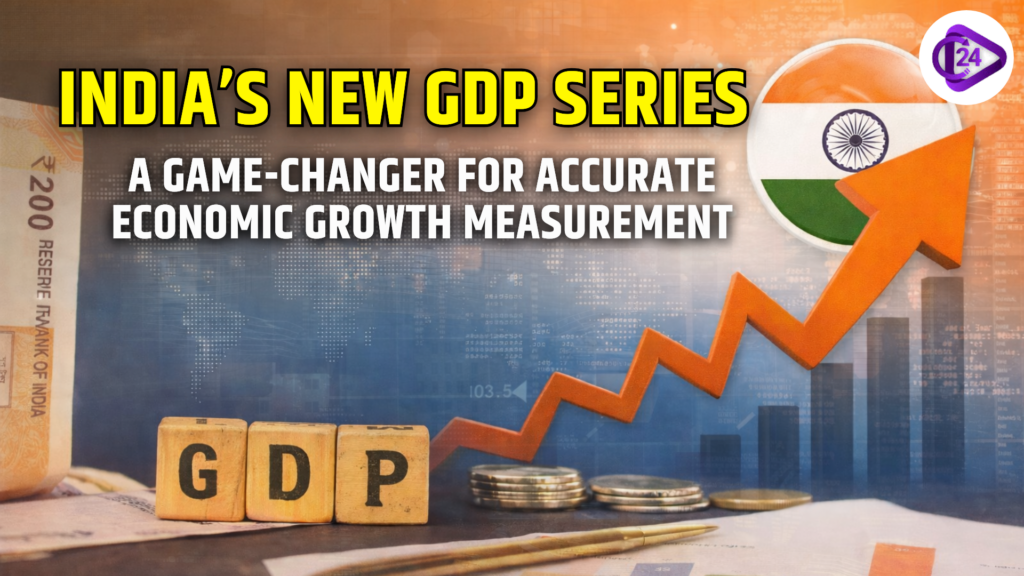
India is set to introduce a new GDP series with 2022-23 as the base year, replacing the previous 2011-12 series. This change aims to provide a more accurate representation of the economy by incorporating recent structural shifts, including digitalisation, formalisation, and evolving consumption trends. The updated methodology includes better price deflators, improved sectoral measurements, and the use of double-deflation techniques to refine data accuracy. This overhaul is expected to provide more reliable GDP and gross value figures and add data, aiding policymaking and enhancing economic analysis, while addressing discrepancies in past growth estimates.
What is India’s New GDP Series?
- India is introducing a revised GDP series with 2022‑23 as the new base year, replacing the old 2011‑12 base year.
- The new series reflects significant economic changes over the past decade, such as growth in the digital economy, formalisation post-GST, and a shift towards service sector expansion.
- The updated GDP calculation now includes new data sources such as GST collections, vehicle registrations, and quarterly business indicators, improving data accuracy.
- It adopts advanced double‑deflation techniques and new price deflators for better real GDP calculation.
- The updated methodology aims to more accurately reflect the contributions of the informal sector and services.
- Backdated data for previous years will also be available when the series is first published on February 27, 2026.
- The overhaul aims to improve the transparency, reliability, and relevance of India’s economic statistics for better policymaking.
GDP Factors Important Formulas
| Formula | Description |
| Expenditure Approach to GDP | (GDP = C + I + G + (X – M)) |
| This approach calculates GDP by adding up: – (C) = Consumption expenditure (households) – (I) = Investment expenditure (businesses) – (G) = Government spending – (X) = Exports, (M) = Imports (net exports) | |
| Income Approach to GDP | (GDP = W + R + P + T – S ) |
| This approach sums all income earned by individuals in the economy, including: – (W) = Wages – (R) = Rent – (P) = Profits – (T) = Taxes – (S) = Subsidies | |
| Production or Output Approach | (GDP = \sum (Output of all sectors)) |
| This method calculates GDP by summing the value added at each production stage in all sectors of the economy (e.g., agriculture, manufacturing, services). | |
| Real GDP | (Real , GDP = \frac{Nominal , GDP}{Price , Index} \times 100 ) |
| Adjusts nominal GDP for inflation to measure the true value of goods and services produced in an economy, using a price index. | |
| GDP Deflator | (GDP , Deflator = \frac{Nominal , GDP}{Real , GDP} \times 100 ) |
| The GDP deflator measures the level of price changes in the economy, helping distinguish between nominal and real GDP. | |
| Gross National Product (GNP) | (GNP = GDP + {Net Income from Abroad}) |
| GNP adjusts GDP by including the net income earned by residents from abroad and excluding income earned by foreigners within the domestic economy. | |
| Net National Product (NNP) | (NNP = GNP – Depreciation ) |
| NNP accounts for the depreciation of capital, reflecting the net value of the country’s output after accounting for capital losses. | |
| NNP at Factor Cost | (NNP_{FC} = GNP – Indirect , Taxes + Subsidies) |
| This version of NNP adjusts GNP for taxes and subsidies that affect the production costs. | |
| Per Capita GDP | (Per capita GDP = \frac{GDP}{Population}) |
| Per capita GDP divides the total GDP by the population, offering a measure of average income per person in an economy. | |
| Net Domestic Product (NDP) | (NDP = GDP – Depreciation ) |
| NDP subtracts depreciation from GDP to show the value of the economy’s output after capital used in production is accounted for. | |
| Relationship Between GDP and GNP | (GNP = GDP + {Net Factor Income from Abroad}) |
| GNP is GDP adjusted by adding income earned from abroad and subtracting income paid to foreign workers in the domestic economy. |
India Unveils PRAHAAR, First National Anti-Terror Doctrine
Conclusion (India’s New GDP Series)
India’s new GDP series, with 2022–23 as the base year, offers a more accurate representation of the economy by incorporating structural changes. This revision improves data reliability, captures informal and service sector contributions, and enhances policymaking, providing a clearer picture of India’s economic growth and development.