

The latest Union Budget 2026-27, laid down on 1 February 2026, puts sustainable economic development, infrastructure development, and inclusive development in the first line. It underlines the promotion of large-scale production in the strategic and frontier industries through improved investments in the health sector, in logistics and technology, and simplifying customs and central excise to help the domestic industry. The Budget supports an extensive allocation in capital expenditure by the government for the populace, improves social welfare programmes, and also proposes tariff reforms to enhance ease of doing business. Some of the important initiatives taken are enhancing the coastal fisheries value chain, developing biopharma capabilities, developing employment-based textile development, and establishing medical hubs to promote medical value tourism.
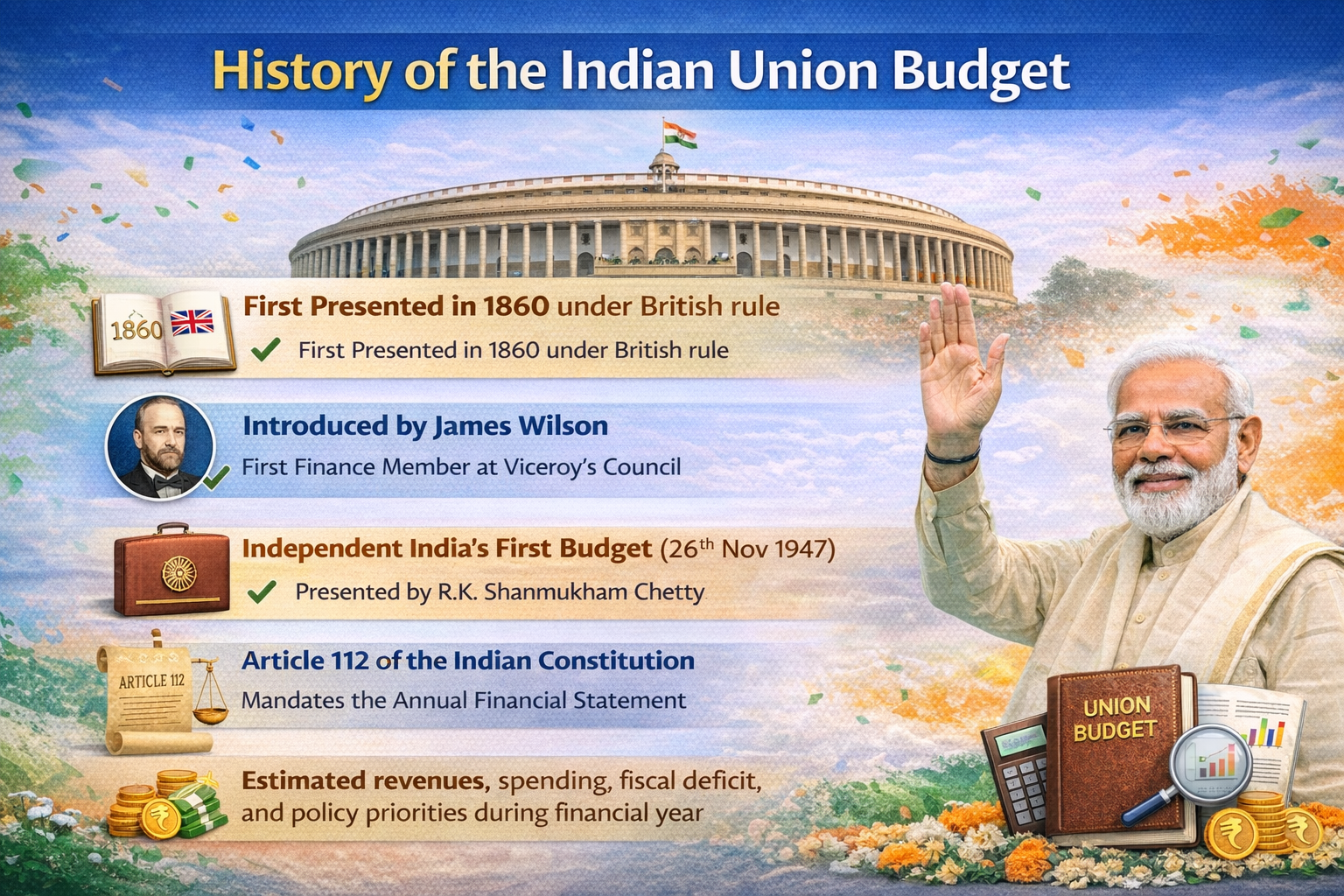
History of the Indian Union Budget
-
The Indian Union Budget was first presented in 1860 when it was ruled by the British.
-
It was presented by James Wilson, who was the first Finance Member at the Viceroy Council.
-
R.K. Shanmukham Chetty was the first person to introduce the first Budget of independent India on 26 November 1947.
-
Article 112 of the Indian Constitution, which is called the Annual Financial Statement, introduces the Union Budget annually.
-
It states the estimated government revenues, government spending, fiscal deficit and policy priorities during the financial year.
-
The Budget is a very important element in the planning and development strategy of the economic plans of India.
Vision of Union Budget 2026-27
-
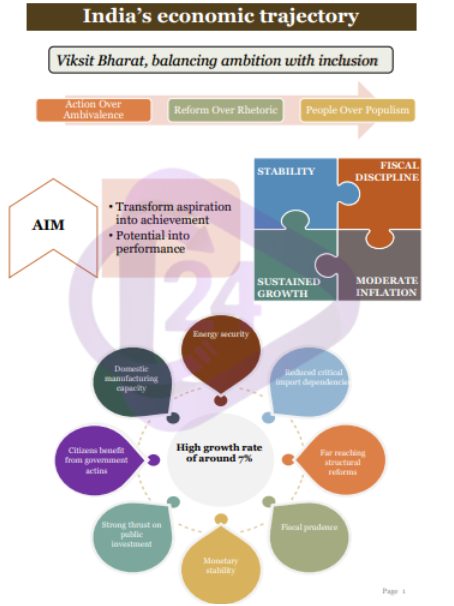
Viksit Bharat works on behalf of both ambition and inclusivity towards a long-term national development.
-
Core approach gives priority to Action rather than to Ambivalence, Reform rather than to Rhetoric and people rather than to Populism.
-
Intention should be to turn desire into a reality and the potential into performance.
-
The economic framework is on the basis of Stability, Fiscal Discipline, Sustained Growth and Moderate Inflation.
-
A high growth rate of about 7% is aimed at facilitating development.
-
Intensifying the domestic production capability in order to increase self-reliance.
-
Improving energy security and severing the dependence on vital imports.
-
Carrying out deep-seated structural reforms to resilience.
-
Facilitating so that citizens directly benefit from the actions of the government.
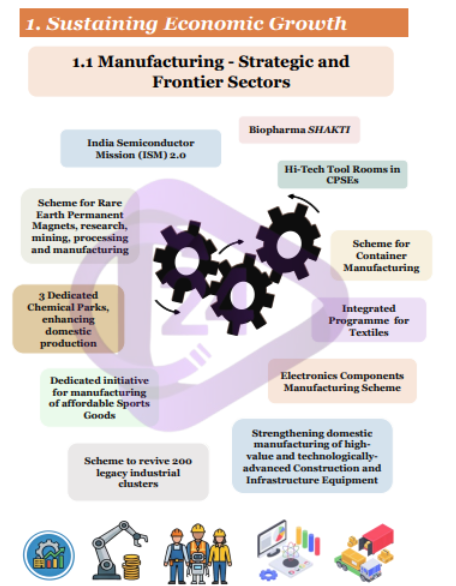
Sustainable Economic Growth
-
Focus on maintaining economic growth through manufacturing-led development.
-
Strategic and Frontier Sectors that should be prioritised to be competitive in the long run.
-
India Semiconductor Mission (ISM) 2.0 was launched to increase chip production.
-
Biopharma SHAKTI to enhance pharmaceutical products and innovation.
-
Having Hi-Tech Tool Rooms at CPSEs to assist in skills and technology.
-
Scheme of Rare Earth Permanent Magnets, including research, mining, processing, and manufacturing.
-
Separate parksare used to manufacture locally.
-
Push Electronics Components Manufacturing Scheme.
-
Programme on Textiles to increase value chains.
-
Sponsoring cheap sports equipment, 200 industrial clusters and manufacturing of high-value construction and infrastructure equipment.
Service Sector in Budget 2026-27
-
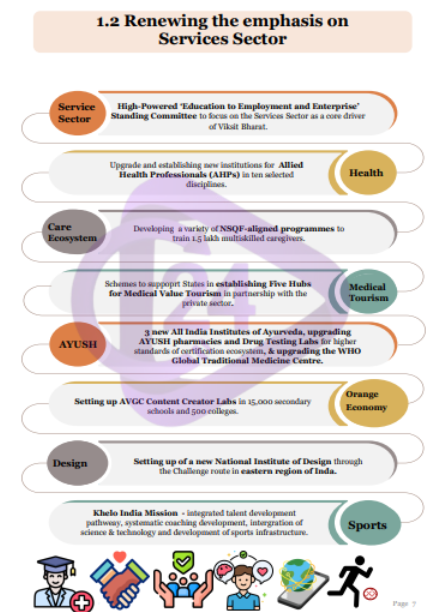
The revised focus on the Services Sector as one of the Viksit Bharat.
-
Constitution of a High-Powered Education, Employment and Enterprise Standing Committee to give emphasis on service-led growth.
-
Administrative Upgrading and the formation of Allied Health Professionals (AHPs) facilities in the chosen disciplines.
-
Empowering the Care Ecosystem by using NSQF-congruent programmes to educate 1.5 lakh medical professionals.
-
Support Programs to start five Medical Value Tourism hubs in collaboration with the private sector.
-
AYUSH enhance with the efforts of upgrading the laboratories, testing the drugs, and certification, depending on the WHO guidelines.
-
Increased AVGC Centres of Excellence in 15,000 schools and 500 colleges to market the Orange Economy.
-
Established in the eastern region, a National Institute of Design in the Challenge Route.
-
Khelo India Mission to unite talent, international exposure, sports science and infrastructure.
Enhancing the Agriculture Sector in Union Budget 2026-27
-
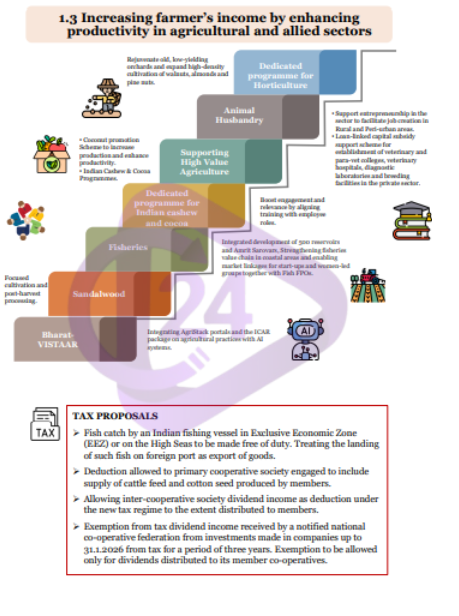
Put emphasis on boosting the income level of farmers through the improvement of productivity in allied industries like agriculture.
-
Encouragement of organic farming, low-input farming and natural farming, such as millets and oilseeds.
-
Horticulture to upgrade this through an Intensive Programme.
-
Enhancing Animal husbandry and promoting entrepreneurship in dairy, poultry, fisheries and livestock.
-
Value Chains and post-harvest management promoting High-Value Agriculture.
-
Specialised cashew programme that focuses on the Indian cashews in order to enhance processing and exportation.
-
Combined development of Fisheries including inland and marine, as well as aquaculture.
-
Sandalwood farming and processing.
-
Increased Bharat VISTAR to rural regional growth that is technologically oriented.
-
Tax proposals in support of fisheries and cooperative societies, such as challenge-free duties and exemptions on income tax.
What are the Receipts and Expenditures in the Union Budget 2026-27?
-
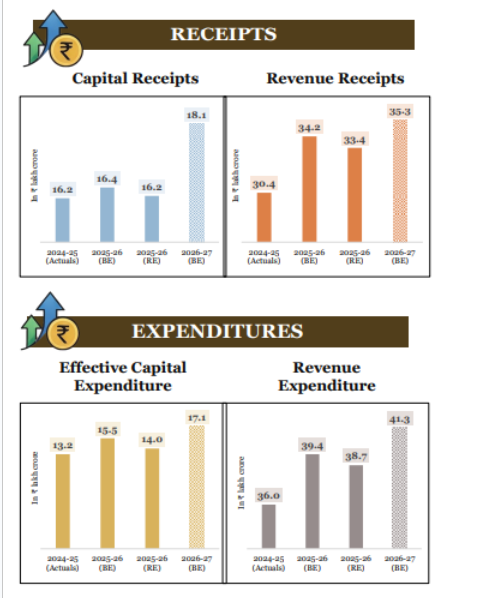
Capital and Revenue Receipt increases are gradually increasing over recent years, as indicated by the receipts.
-
Capital Receipts went up to ₹18.1 lakh crore (2026-27 BE) as compared to ₹16.2 lakh crore (2024-25 Actuals).
-
Revenue Receipts increased to 35.3 lakh crore (2026-27BE), compared to 30.4 lakh crore(2024-25Actuals).
-
On the expenditure aspect, emphasis is on productive expenditure.
-
There was an increase in effective Capital Expenditure by 13.2 lakh crore to 17.1 lakh crore, which focused on an infrastructure push.
-
Revenue Expenditure grew by 2026-27 BE by 2.3 lakh crore to 36.0 lakh crore.
-
The pattern indicates a trade-off between capital expenditure that is geared towards growth and the crucial revenue expenditure.
Conclusion (Union Budget 2026-27)
Union Budget 2026-27 has charted out a firm and progressive roadmap on how to construct a Viksit Bharat based on stability, inclusiveness, and long-term growth. The Budget strikes a balance between fiscal discipline and development of an economy that has a major focus on manufacturing, services, agriculture and infrastructure. Specific focus on technology, healthcare, education, and the well-being of farmers is supposed to transform the dreams into tangible results. Enhancing the resilience of the long-term economic growth, the Budget strengthens domestic capacity, backs innovation, and makes sure that citizens are enjoying the fruit of the policy actions. Unity Union Budget 202627, in general, provides a strong platform in ensuring the high growth, creation of jobs and equal national development.