


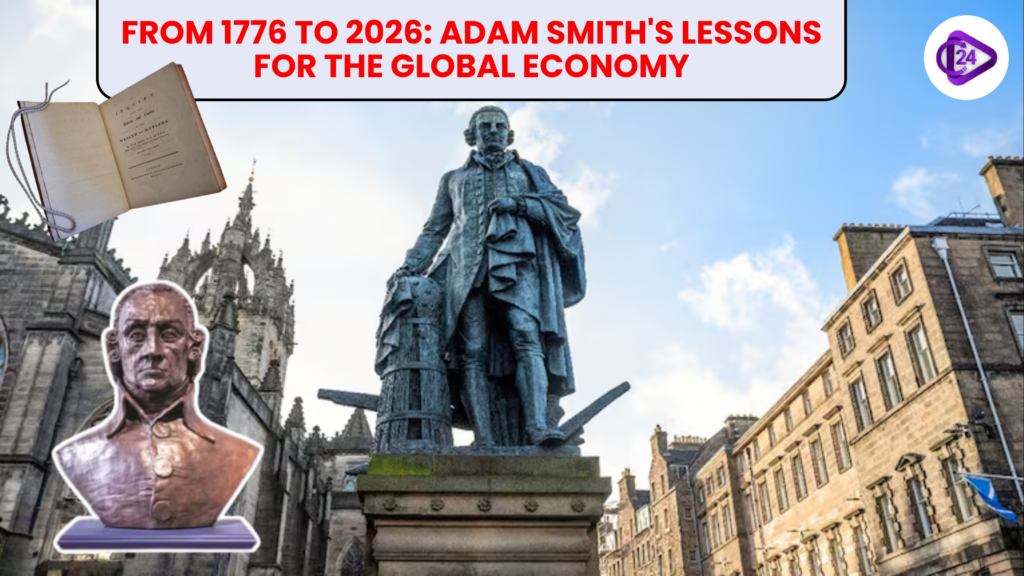
In 1776, the Scottish economist Adam Smith published The Wealth of Nations, a landmark work that laid the foundation of modern economics. His ideas about free markets, division of labour, and limited government intervention shaped global economic thinking for centuries. Nearly 250 years later, in 2026, Smith’s insights remain highly relevant in debates on globalization, trade, and economic policy. As the world faces challenges such as inequality, protectionism, and technological disruption, policymakers and economists continue to revisit Smith’s principles to understand how markets function and how prosperity can be created through productivity, innovation, and efficient allocation of resources.
Adam Smith’s Lessons for the Global Economy
-
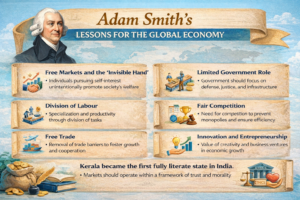
Adam Smith emphasized the importance of free markets, arguing that individuals pursuing their self-interest can unintentionally promote the welfare of society through the concept of the “invisible hand.”
-
His theory of division of labour showed how specialization increases productivity, a principle still visible in modern global supply chains and industrial production.
-
Smith strongly supported free trade, criticizing mercantilist policies and advocating the removal of trade barriers to promote economic growth and international cooperation.
-
He believed governments should play a limited but essential role, focusing on defense, justice, and public works such as infrastructure that markets may not provide efficiently.
-
Smith warned against monopolies and excessive market power, highlighting the need for fair competition to ensure efficiency and consumer welfare.
-
His ideas underline the value of innovation and entrepreneurship, which drive economic development and technological advancement in modern economies.
-
Smith also recognized the importance of moral philosophy, arguing that markets should operate within a framework of ethics, trust, and social responsibility.
-
In the context of globalization, Smith’s principles encourage open economies, cooperation, and efficient resource allocation, which remain crucial for sustainable and inclusive economic growth.
Important MCQs on Adam Smith
| Question | Options | Answer | Explanation |
|---|---|---|---|
| Who is regarded as the “Father of Modern Economics”? | A) Adam Smith B) John Maynard Keynes C) Karl Marx D) David Ricardo | A | Adam Smith is called the Father of Modern Economics for his systematic analysis of markets and economic growth. |
| Adam Smith’s famous book published in 1776 is: | A) Das Kapital B) The Wealth of Nations C) General Theory of Employment, Interest and Money D) Principles of Political Economy | B | The Wealth of Nations laid the foundation for classical economic theory. |
| The concept of the “Invisible Hand” refers to: | A) Government control over markets B) Market forces guiding economic activity C) International trade agreements D) Welfare state policies | B | Adam Smith used the term “Invisible Hand” to explain how self-interest in a free market can benefit society. |
| According to Adam Smith, which factor greatly increases productivity? | A) Population growth B) Division of labour C) Government subsidies D) Protectionism | B | Smith highlighted division of labour as the key source of efficiency and productivity. |
| Adam Smith strongly criticized which economic system? | A) Capitalism B) Mercantilism C) Socialism D) Mixed economy | B | He opposed mercantilism, arguing that trade restrictions reduce overall wealth. |
| Adam Smith belonged to which school of economic thought? | A) Keynesian School B) Classical School C) Monetarist School D) Institutional School | B | Smith is one of the founders of the Classical School of Economics. |
| Adam Smith believed the primary role of government should include: | A) Price fixing B) Trade restrictions C) Defense, justice, and public works D) Nationalization of industries | C | Smith supported limited government roles such as defense, justice, and infrastructure. |
| Adam Smith was from which country? | A) England B) Germany C) Scotland D) France | C | Adam Smith was a Scottish economist and philosopher. |
| Which earlier book written by Adam Smith focuses on ethics and morality? | A) The Theory of Moral Sentiments B) The Communist Manifesto C) Capital in the Twenty-First Century D) Road to Serfdom | A | Published in 1759, it discusses morality, sympathy, and ethical behavior in society. |
| Adam Smith supported which type of international economic policy? | A) Protectionism B) Autarky C) Free Trade D) Trade embargoes | C | Smith believed free trade allows countries to specialize and increase global wealth. |
Conclusion
The ideas of Adam Smith continue to shape modern economic thinking even after more than two centuries. His concepts of free markets, division of labour, and the “invisible hand,” presented in The Wealth of Nations, remain central to discussions on globalization, trade, and development. In a rapidly changing global economy, Smith’s principles still provide valuable guidance for promoting efficiency, innovation, and sustainable economic growth