
Daily Quizzes
Mock Tests
No tests attempted yet.
Select Category
Loading content...
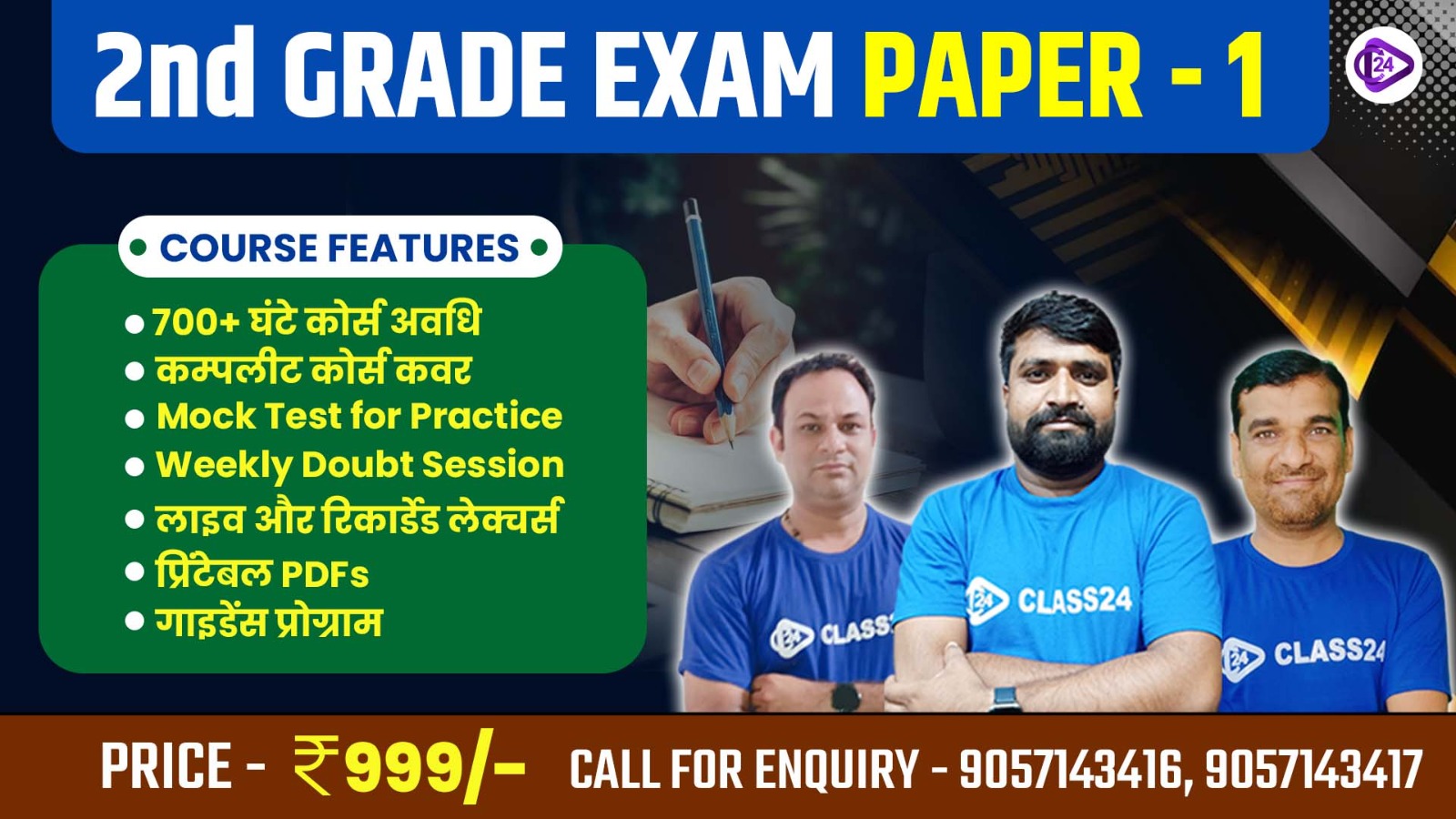
2nd Grade Exam Paper 1
RPSC 2nd Grade Paper 1 Complete Course covering Teaching Aptitude, Psychology, Rajasthan GK, History, Geography, Polity, Hindi, English, Maths, Reasoning, Current Affairs and General Knowledge.

RPSC 2nd Grade Exam Paper 1- A Focused Path to Becoming a Senior Teacher
Clearing RPSC 2nd Grade Teacher exam starts with one non-negotiable step: mastering Paper 1. Unlike Paper 2, which changes based on your subject stream, Paper 1 is common to every aspirant, which means everyone is competing on the exact same ground. A weak Paper 1 score can pull down your overall rank even if your subject paper goes well, so getting this part right isn't optional, it's the foundation your whole selection rests on.
The 2nd Grade Exam Paper 1 course is built around this reality. Instead of treating General Studies as an afterthought, it gives every topic- from Rajasthan's history to teaching psychology- the depth it actually needs to move your score from average to competitive.
Why Paper 1 Deserves Serious Attention
Many aspirants pour all their energy into their subject paper and treat Paper 1 as something to "cover later." That approach usually backfires, because Paper 1 tests a wide spread of topics, and wide-spread topics need early, consistent practice, not last-minute cramming.
- Common to all streams – Every 2nd Grade aspirant, regardless of subject specialization, is evaluated on the same Paper 1 content.
- Directly affects final merit – Marks from Paper 1 are added to your subject paper score, so it has real weight in your final rank.
- Covers both academic and pedagogical knowledge – It's not just facts; it also tests how well you understand teaching itself.
- Rewards structured revision – Because the syllabus spans many subjects, a clear study plan matters more here than in any single-subject paper.
What This Course Covers
This course is built around the complete Paper 1 syllabus, broken into logical groups so you can study with focus instead of jumping between unrelated topics.
Teaching & Psychology-Based Subjects
- Teaching Aptitude – Classroom management, teaching methods, and situational questions based on real classroom scenarios.
- Psychology – Child development, learning theories, and behavioral concepts that regularly appear in the exam.
- ICT & School Management – Basic educational technology and administrative concepts, now a standard part of nearly every teacher recruitment paper.
Rajasthan & General History
- Indian History – A structured walk through ancient, medieval, and modern India's key events.
- History – General historical topics frequently repeated across teacher recruitment exams.
- Rajasthan Art and Culture – In-depth coverage of Rajasthan's traditions, festivals, and heritage, a section that consistently carries significant weight.
Geography & Polity
- Rajasthan Geography and Geography – Physical features, climate, resources, and map-based practice questions.
- Polity – A clear, exam-focused understanding of the Constitution and governance structure.
Language Subjects
- Hindi – Grammar, comprehension, and language application questions.
- English – Core grammar rules and language proficiency practice.
- Sanskrit – Grammar and translation-based preparation for aspirants opting for Sanskrit.
Quantitative & General Ability Subjects
- Maths and Science – Foundational numerical and scientific concepts framed the way the exam actually tests them.
- Reasoning and Quantitative Aptitude – Logical thinking and calculation speed built through regular practice.
- Current Affairs – Updated regularly so your knowledge doesn't go stale before exam day. You can track ongoing updates through the Current Affairs section.
- General Knowledge – Broad-based topics that quietly show up across nearly every part of the paper.
Paper 1 vs Paper 2: Knowing the Difference
Understanding how the two papers differ helps you plan your time better instead of mixing preparation for both into one undefined routine.
| Feature | Paper 1 | Paper 2 |
|---|---|---|
| Applicability | Common for all aspirants | Varies by subject stream |
| Core Focus | General Studies, Teaching Aptitude, Psychology | Subject-specific academic content |
| Preparation Style | Broad coverage across many topics | Deep, subject-focused study |
| Impact on Merit | Adds directly to final score | Adds directly to final score |
Both papers count equally toward your final selection, so neither can be treated as the "lighter" one.
How to Prepare Smartly for Paper 1
- Start with teaching-related subjects early – Psychology and Teaching Aptitude take time to internalize, so don't leave them for the last month.
- Give Rajasthan-specific topics dedicated time – Rajasthan Art & Culture and Rajasthan Geography usually demand more precise, detailed recall than general topics.
- Build a daily habit for language subjects – Small, consistent practice in Hindi, English, or Sanskrit beats occasional long study sessions.
- Practice with full-length tests regularly – Simulated exam conditions reveal weak areas that casual reading often hides.
A Realistic Study Roadmap
- Phase 1: Build a strong base in Teaching Aptitude, Psychology, and ICT & School Management.
- Phase 2: Move through Indian History, Rajasthan Art & Culture, Geography, and Polity in sequence.
- Phase 3: Strengthen language skills and General Knowledge alongside Reasoning and Quantitative Aptitude.
- Phase 4: Take full-length mock tests, review mistakes, and revise weak sections before the exam.
This phased approach keeps the wide Paper 1 syllabus from feeling scattered, giving each subject a proper place in your preparation timeline.
Explore More
If you're preparing for RPSC 2nd Grade Teacher or related Rajasthan exams, these pages might also be useful:
- RPSC 2nd Grade Teacher Exam Details
- Rajasthan CET 2026 Test Series
- Rajasthan Patwari Mock Test Series
- Computer Anudeshak Paper 1 Test Series 2026
- RPSC Coaching in Jaipur
- All Rajasthan Exams Test Series
Conclusion
RPSC 2nd Grade Paper 1 isn't a paper you can wing with general reading, it rewards aspirants who treat every subject with equal seriousness, from Teaching Aptitude to Current Affairs. With structured coverage, subject-wise depth, and a clear preparation roadmap, this course is built to help you walk into the exam hall confident that no part of the syllabus has been left to chance.
What’s included
Live Classes
Watch online coaching classes by our top educators.
Top Educators
Learn from some of the top educators in the country.
Batches
Curated collections to streamline your learning experience toward your goal.
Courses
Learn every subject in detail from your top educator.
Playlist
Watch online coaching classes by our top educators.
Practice
Enhance your exam readiness with personalized adaptive practice tests.
Get success in your hand. Start study anytime anywhere.
The journey becomes simple and enjoyable when you start taking interest in it. And through our app "Class24", we will be your trusted partners in developing that interest.