

Daily Quizzes
Mock Tests
No tests attempted yet.
Select Category
SSC MTS Exam Pattern 2026: Session-Wise Paper Pattern, Marking Scheme, PET/PST & Syllabus
The SSC MTS Exam Pattern 2026 explains the latest Computer-Based Test (CBT) structure, including Session-I and Session-II, subject-wise marks distribution, exam duration, negative marking, and the PET/PST requirements for Havaldar posts. Candidates can also check the complete marking scheme, syllabus, selection process, and preparation strategy to perform well in the upcoming SSC MTS 2026 Exam.

Get in Touch with Class24 for All Your Needs!
SSC MTS Exam Pattern 2026 is what every Class 10 pass aspirant needs to understand before the Staff Selection Commission opens applications, which is expected sometime in July 2026. The exam runs as a single Computer-Based Test split into two mandatory sessions, and it applies equally to Multi-Tasking Staff and Havaldar candidates. Missing either session, no matter how well the other one goes, means automatic disqualification from the whole process.
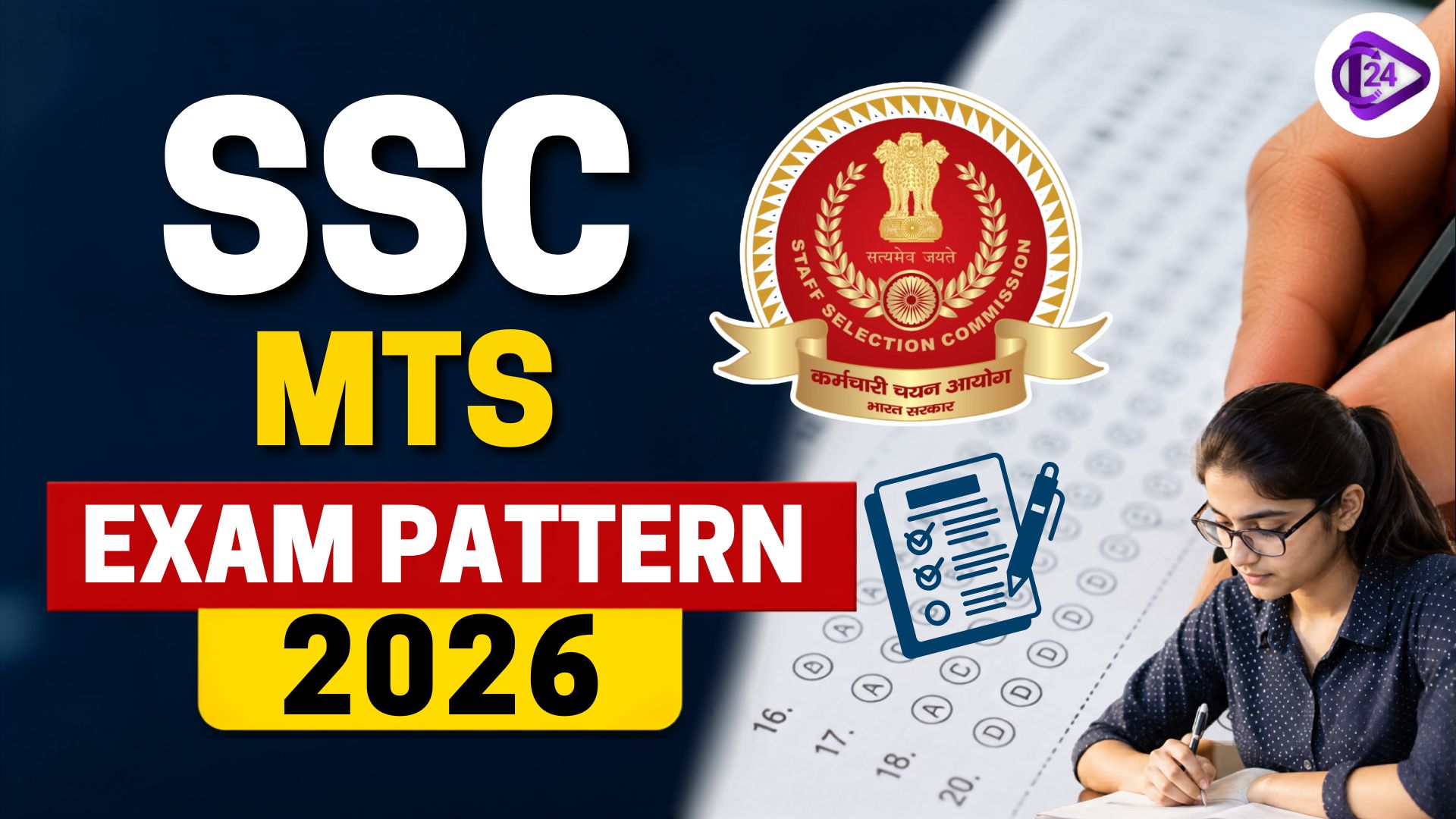
There's more to this exam than just the paper pattern, though. SSC MTS Exam Pattern 2026 also covers subject-wise marks distribution, the negative marking rule that only kicks in during Session II, and the PET/PST stage that Havaldar aspirants need to clear separately. This article walks through every part of it, the session-wise structure, topic-wise syllabus, physical test standards, and the exam date calendar, so preparation can start well before the notification month arrives.
SSC MTS Exam Pattern 2026 – Overview
Before getting into session-wise details, here's a snapshot covering the exam name, conducting body, total marks, and mode, the basics every candidate should have clear from day one.
| Particulars | Details |
|---|---|
| Exam Name | SSC MTS (Multi-Tasking Staff) & Havaldar 2026 |
| Conducting Authority | Staff Selection Commission (SSC) |
| Level of Exam | Matriculation Level (10th Pass) |
| Mode of Examination | Online – Computer-Based Test (CBT) |
| Number of CBT Sessions | 2 Sessions – Session-I and Session-II (Both Mandatory) |
| Type of Questions | Objective Type – Multiple Choice Questions (MCQs) |
| Total Number of Questions | 90 Questions (40 in Session-I + 50 in Session-II) |
| Total Marks | 270 Marks (120 in Session-I + 150 in Session-II) |
| Negative Marking | Yes – 1 mark deducted per wrong answer in Session-II only |
| Language of Exam | Bilingual – English and Hindi (plus regional languages) |
| Exam Duration | 90 Minutes Total (45 Minutes for Each Session) |
| Additional Stage (Havaldar Only) | PET (Physical Efficiency Test) & PST (Physical Standard Test) – Qualifying |
SSC MTS 2026 Exam Dates – Complete Schedule

Keeping track of the SSC MTS Exam Pattern 2026 timeline matters just as much as knowing the paper itself. The notification is expected in July 2026, and the table below lists how the rest of the cycle is likely to unfold.
| Event | Expected Date |
|---|---|
| Notification Release | July 2026 |
| Online Application Begins | July 2026 |
| Last Date to Apply | 31 July 2026 |
| Correction Window | August 2026 |
| Admit Card Release | Before exam date |
| CBT Exam (Paper 1) | September–November 2026 |
| PET/PST (Havaldar Only) | After CBT result |
| Result Declaration | To be notified |
SSC MTS 2026 CBT Exam Pattern
Both sessions of the SSC MTS Exam Pattern 2026 run on the same day, back to back, and both need to be attempted to stay in the race. The pattern is identical for MTS and Havaldar applicants, since everyone sits the same written paper.
SSC MTS 2026 Session-I Exam Pattern (No Negative Marking)
| Subject | No. of Questions | Marks | Duration |
|---|---|---|---|
| Numerical & Mathematical Ability | 20 | 60 | |
| Reasoning Ability & Problem Solving | 20 | 60 | 45 minutes |
| Total | 40 | 120 |
Session-I carries zero penalty for wrong answers, which means every single question is worth attempting even on a guess. The Numerical Ability half checks basic arithmetic and calculation speed, while the Reasoning half tests logical and sequential thinking, and since neither costs marks for a miss, this is usually the more scoring of the two sessions if approached with confidence.
SSC MTS 2026 Session-II Exam Pattern (With 1 Mark Negative Marking)
| Subject | No. of Questions | Marks | Duration |
|---|---|---|---|
| General Awareness | 25 | 75 | |
| English Language & Comprehension | 25 | 75 | 45 minutes |
| Total | 50 | 150 |
Session-II works differently, every wrong answer costs 1 mark, so guesswork here can actually hurt the final score. General Awareness draws from static GK, current affairs, history, geography, and government schemes, while English tests grammar, vocabulary, and comprehension. Candidates should only attempt what they're reasonably confident about in this half.
SSC MTS 2026 Subjects – Topic-Wise Details
Cracking the SSC MTS Exam Pattern 2026 comes down to four subjects, and none of them go beyond what's already been covered up to Class 10. Below is the topic wise list for each one.
Numerical & Mathematical Ability
- Simplification
- HCF & LCM
- Ratio & Proportion
- Number System
- Time, Work & Wages
- Speed, Time & Distance
- Average
- Percentages
- Profit, Loss & Discount
- Simple & Compound Interest
- Mensuration (Basic Level)
Reasoning Ability & Problem Solving
- Coding-Decoding
- Blood Relations
- Direction & Distance
- Number Series & Alphabet Series
- Odd One Out
- Venn Diagram
- Analogy
- Classification
- Calendar & Clock
- Syllogism (Basic)
- Non-verbal Reasoning (Visual Patterns)
General Awareness
- Current Affairs (National & International – last 6–12 months)
- Indian History & Freedom Struggle
- Indian Geography & Environment
- Indian Polity & Constitution
- Government Schemes & Policies
- Economy & Budget
- Sports, Awards, and Honours
- Important Dates & Events
- General Science (Physics, Chemistry, Biology – Basics)
English Language & Comprehension
- Synonyms & Antonyms
- Fill in the Blanks
- Spotting Errors
- Reading Comprehension
- Sentence Correction
- Sentence Rearrangement
- One Word Substitution
- Cloze Test (Basic)
- Idioms & Phrases
- Active & Passive Voice (Basic Level)
SSC MTS Physical Test (PET & PST) – Only for Havaldar Post
The SSC MTS Exam Pattern 2026 adds one extra stage for Havaldar aspirants that regular MTS candidates don't need to worry about. This physical round is purely qualifying, no marks get added to merit, but failing it does mean losing the Havaldar seat even after clearing the CBT.
SSC MTS 2026 – Physical Efficiency Test (PET)
| Gender | Task | Time Limit |
|---|---|---|
| Male | 1600 meters walking | 15 minutes |
| Female | 1 km walking | 20 minutes |
SSC MTS 2026 – Physical Standard Test (PST)
For Male Candidates
| Requirement | Standard |
|---|---|
| Height | 157.5 cm (relaxable for ST, Gorkhas, Garhwalis, Assamese, etc.) |
| Chest | 76–77 cm unexpanded, with minimum 5 cm expansion |
For Female Candidates
| Requirement | Standard |
|---|---|
| Height | 152 cm (relaxable by 2.5 cm for specified categories) |
| Weight | 48 kg (relaxable for specified categories) |
Why Understanding the SSC MTS Exam Pattern 2026 Matters
Knowing the SSC MTS Exam Pattern 2026 inside out isn't just extra reading, it directly shapes how preparation should be structured for both sessions.
- Helps build a focused, session-wise preparation plan instead of studying everything equally
- Gives clarity on time limits and question weightage for each subject
- Makes the negative marking rule and its impact on strategy completely clear
- Cuts down exam-day nerves since the actual paper structure is already familiar
- Allows mock tests to be practiced in a format that mirrors the real exam
- Improves the overall chance of clearing both sessions and reaching document verification
SSC MTS Exam Pattern 2026: Conclusion
SSC MTS Exam Pattern 2026 isn't complicated once it's broken down, two sessions, four subjects, 270 marks, and one clear rule: attempt everything in Session-I, be selective in Session-II. Havaldar aspirants have the added PET/PST stage to prepare for alongside the written paper. With the notification expected in July 2026 and the exam likely between September and November 2026, there's still time to build a solid preparation plan around this exact pattern before the official dates are out.
| Important Link |
|---|
| SSC MTS Recruitment 2026 |
| SSC MTS Notification 2026 |
| SSC MTS In Hand Salary |
SSC MTS Exam Pattern 2026: FAQs
Recent Quizzes

Recent Articles

Our Courses






Post a Comment
Your email address will not be published. Required fields are marked *