


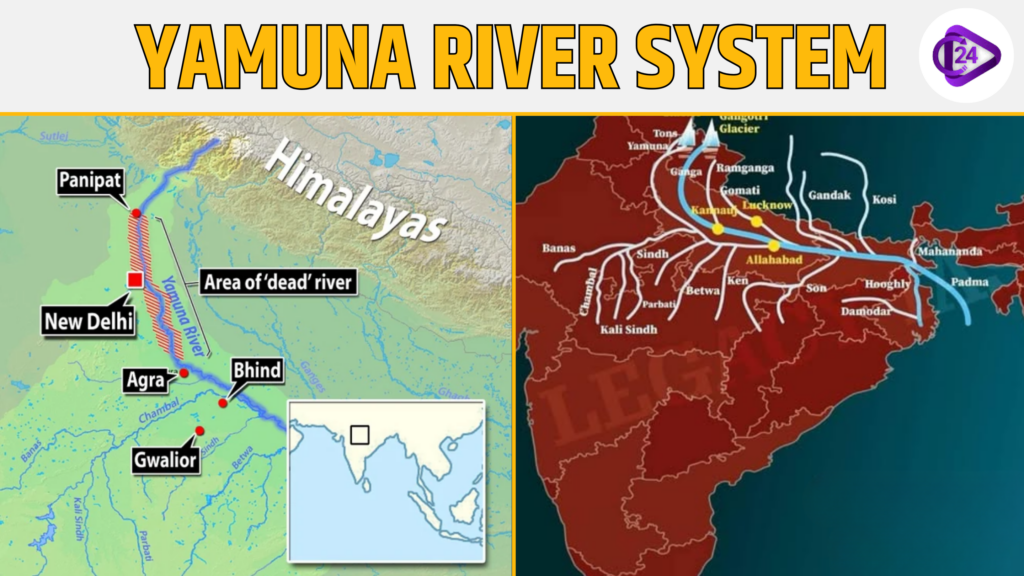
The Yamuna River system is one of the most important river systems in northern India, playing a crucial role in the hydrology of the Ganga Basin. Originating from the Yamunotri Glacier in the lower Himalayas of Uttarakhand, the river flows for about 1,376 km through diverse physiographic regions before joining the Ganga at Prayagraj. Its extensive tributary network, including peninsular rivers like Chambal and Betwa, significantly enhances its discharge, making it vital for irrigation, urban water supply, and the regional economy.
Yamuna River System Origin
The Yamuna River originates from the Yamunotri Glacier in the Bandarpoonch range of the lower Himalayas in Uttarakhand, at an elevation of around 6,300 meters. The source lies near the sacred Yamunotri temple, making it both geographically and culturally significant. Initially, the river flows through steep mountainous terrain as a swift, narrow stream before entering the plains near Dakpathar. Being glacier-fed, it maintains a perennial flow, supplemented by monsoon rainfall, which makes it an essential component of the Ganga river system.
Yamuna River Tributaries
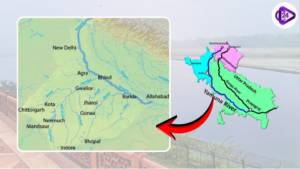
The Yamuna River possesses a well-developed tributary system that significantly enhances its discharge, drainage area, and economic importance. These tributaries originate from both the Himalayan region and the Peninsular Plateau, reflecting diverse geological and hydrological characteristics. Most major tributaries join the Yamuna from the right bank, especially from the semi-arid and plateau regions, contributing seasonal as well as perennial flows.
Tons River
The Tons River is the largest tributary of the Yamuna in terms of water volume. It originates from the Garhwal Himalayas near the Bandarpunch range and meets the Yamuna near Kalsi in Uttarakhand. Being glacier-fed, it ensures a perennial supply of water.
Chambal River
The Chambal River originates from the Vindhya Range in Madhya Pradesh. It flows through deep ravines across Madhya Pradesh and Rajasthan before joining the Yamuna in Uttar Pradesh. It is known for relatively low pollution levels and significant hydroelectric projects.
Betwa River
The Betwa River rises from the Vindhyan plateau near Bhopal. It flows through Madhya Pradesh and Uttar Pradesh, passing historic towns like Orchha, before merging with the Yamuna. It is important for irrigation and regional water supply.
Ken River
The Ken River originates from the Kaimur Hills in Madhya Pradesh. It flows through the Bundelkhand region and joins the Yamuna near Chilla. The river is known for the Ken-Betwa river linking project.
Sind River
The Sind River originates in the Malwa Plateau of Madhya Pradesh. It flows northward through Madhya Pradesh and Uttar Pradesh before joining the Yamuna. It is primarily rain-fed and seasonal.
Hindon River
The Hindon River originates in the Shivalik Hills in Uttar Pradesh. It flows through western Uttar Pradesh, including industrial regions, before joining the Yamuna near Noida. It faces significant pollution issues.
Kali River
The Kali River originates in the Muzaffarnagar district of Uttar Pradesh. It flows through the fertile plains and joins the Hindon, indirectly contributing to the Yamuna system.
Rind River
The Rind River is a smaller tributary flowing through Uttar Pradesh. It is a seasonal river that supports local agriculture and drainage.
Sengar River
The Sengar River originates in the plateau region and flows through Uttar Pradesh before merging with the Yamuna. It is mainly rain-fed.
Kwari River
The Kwari River rises in Madhya Pradesh and flows through the Chambal basin before joining the Yamuna system. It contributes to the overall drainage of central India.
Asan River
The Asan River originates near Dehradun and joins the Yamuna near Dakpathar. It is relatively small but important for local hydrology.
States & Cities Through Which Yamuna River Flows
The Yamuna River flows through diverse physiographic regions, starting from the Himalayan terrain and moving into the fertile Indo-Gangetic plains. It plays a vital role in irrigation, urban water supply, and agriculture across northern India before joining the Ganga at Prayagraj.
States Yamuna River Flows:
- Uttarakhand
- Himachal Pradesh
- Haryana
- Delhi
- Uttar Pradesh
Cities Through Which Yamuna River Flows
The Yamuna River flows through several important urban centers in northern India, supporting dense populations, agriculture, and industrial activities. These cities depend on the river for water supply, transportation, and economic development, although many also face challenges related to pollution and river management.
Major Cities Yamuna River Flows:
- Yamunotri
- Dehradun (nearby region)
- Yamunanagar
- Panipat
- Sonipat
- Delhi
- Mathura
- Agra
- Etawah
- Prayagraj
Major Dams on Yamuna River
| Dam Name | Location (State/City) | River | Project | Purpose |
| Lakhwar Dam | Uttarakhand | Yamuna River | Lakhwar-Vyasi Project | Hydropower, irrigation, water supply |
| Dakpathar Barrage | Uttarakhand | Yamuna River | Yamuna Hydel Scheme | Hydropower, water regulation |
| Hathni Kund Barrage | Haryana (Yamunanagar) | Yamuna River | Western & Eastern Yamuna Canal System | Irrigation, water distribution |
| Okhla Barrage | Delhi | Yamuna River | Agra Canal Project | Irrigation, water supply |
| Wazirabad Barrage | Delhi | Yamuna River | Delhi Water Supply Scheme | Drinking water supply |
| Matatila Dam | Uttar Pradesh / Madhya Pradesh | Betwa River | Matatila Project | Irrigation, hydropower |
| Rajghat Dam | MP/UP Border | Betwa River | Rajghat Project | Irrigation, water supply |
| Gandhi Sagar Dam | Madhya Pradesh | Chambal River | Chambal Valley Project | Hydropower, irrigation |
| Rana Pratap Sagar Dam | Rajasthan | Chambal River | Chambal Valley Project | Power generation |
| Jawahar Sagar Dam | Rajasthan | Chambal River | Chambal Project | Hydropower |
| Kota Barrage | Rajasthan | Chambal River | Chambal Project | Irrigation |
| Gangau Dam | Madhya Pradesh | Ken River | Ken Basin Project | Irrigation |
| Barwa Sagar Dam | Uttar Pradesh | Betwa River | Local Irrigation Project | Irrigation |
The Importance of the Yamuna River and Challenges
The Yamuna River is one of the most important rivers in northern India, playing a crucial role in agriculture, urban water supply, and economic development. As the largest tributary of the Ganga River, it irrigates vast areas of fertile land in Haryana and Uttar Pradesh, supporting major crops like wheat and sugarcane. Cities such as Delhi, Mathura, and Agra depend heavily on their water for domestic and industrial needs. The river also holds deep cultural and religious significance in Indian society.
Key Challenges Faced by the Yamuna River
Despite its importance, the Yamuna faces serious environmental challenges. Rapid urbanisation has led to severe pollution, especially in the Delhi stretch, due to untreated sewage and industrial waste. Excessive water extraction reduces its natural flow, while encroachment on floodplains disrupts its ecosystem. Seasonal variability, declining groundwater levels, and weak waste management further worsen the condition. Effective conservation, strict pollution control, and sustainable river basin management are essential to restore its health.
Conclusion – Yamuna River System
The Yamuna River System is a crucial component of India’s river network, supporting agriculture, urban settlements, and economic activities across northern and central regions. Its extensive tributary system and strategic confluence with the Ganga River enhance its hydrological importance. However, increasing pollution, over-extraction, and ecological degradation pose serious challenges. Sustainable management, effective conservation policies, and public awareness are essential to preserve the Yamuna River system for future generations and ensure long-term environmental and water security.