


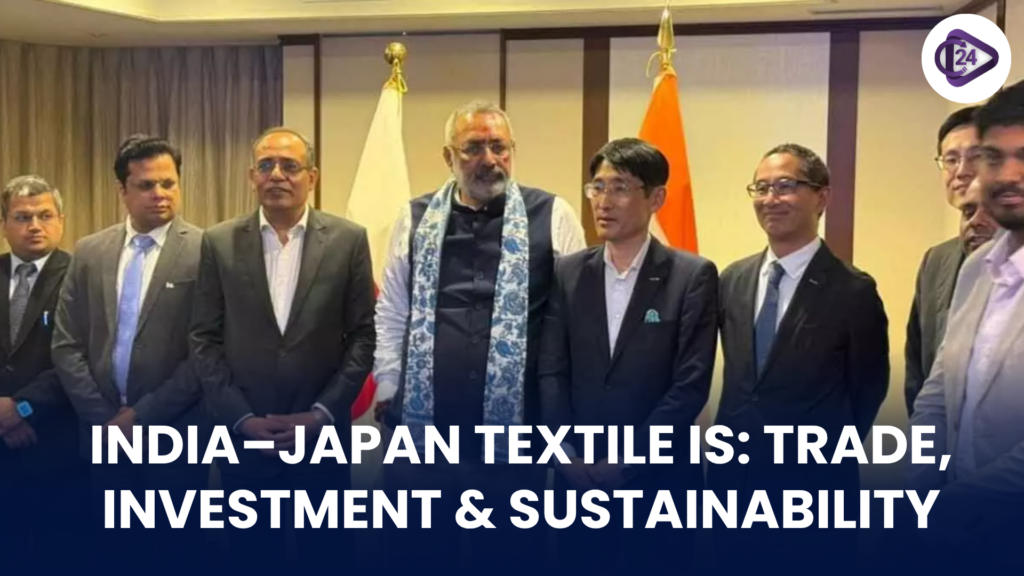
India–Japan Textile Collaboration: Trade, Investment & Sustainability

India and Japan, whose economic partnership agreement, that is, Comprehensive Economic Partnership Agreement (CEPA) was signed in 2011, have further extended cooperation in the field of textile through trade and investment as well as in the dimension of skill development and sustainability. The bilateral activity is one of the moves...

India–Japan Textile Collaboration: Trade, Investment & Sustainability

India and Japan, whose economic partnership agreement, that is, Comprehensive Economic Partnership Agreement (CEPA) was signed in 2011, have further extended cooperation in the field of textile through trade and investment as well as in the dimension of skill development and sustainability. The bilateral activity is one of the moves to make India more competitive in the global value chains and help the Japanese invest in the Indian textile infrastructure.

Context

  • India and Japan who have signed the final economic partnership agreement, in other words Comprehensive Economic Partnership Agreement (CEPA) in 2011 have not only expanded cooperation in the area of textile through trade and investment but also in the aspect of developing skills and sustainability.

Key Points

Current Trade Status

  • The exports of India textile and apparel to Japan(2024) stood at 354 million dollars.

  • The overall imports of textile and apparel to Japan: World, $30,873 million

  • Gap in trade: Nevertheless, with the positive effect that CEPA has brought, India enjoys a share of less than 2% in the textile import market in Japan, which is indicative of unexplored potential.

Important Activities and Trends

1. CEPA (Comprehensive Economic Partnership Agreement) -2011

  • The target is to minimize the tariff and non-tariff barriers.

  • Tries to make the trade process streamlined and eliminates structural problems.

  • Favors further opening up of the Japanese market to Indian exporters.

2. Recent high-level Delegation to Japan (2025)

  • Events organised with major Japanese companies in:

    • Apparel

    • Textile machinery

    • Technical textiles

    • Fabric processing

  • Japanese companies were asked to invest in PM MITRA Parks in India to get plug-and-play textile infrastructure in India.

Flagship Indian Government Schemes to Boost Textile Sector

Scheme

Objective

PM MITRA Parks

Create world-class integrated textile infrastructure with common services, utilities, and sustainability

PLI Scheme for Textiles

Promote large-scale manufacturing in MMF fabric, MMF apparel, and technical textiles

RoDTEP & RoSCTL

Provide tax and duty refunds to encourage textile exports

SAMARTH Scheme

Skill development in textiles, especially for women and youth

Sustainability Push ESG Taskforce

  • The Ministry of Textiles has come up with an ESG Taskforce.

  • Goal: Assist the Indian textile industry to shift to production with sustainability and resources efficiency.

  • Focus on:

    • Green technologies

    • Water-efficient dyeing

    • Practices of a circular economy

  • Consultations of stakeholders are undertaken regularly to discuss problems of adopting ESG norms.

India- Japan Capacity Building in Quality Management

  • Human resource development projects in India are organized by Association of Overseas Technical Cooperation and Sustainable Partnerships (AOTS) under the ministry of economy, trade and industry (METI) of Japan.

  • The Japanese System of Quality Evaluation is the main focus.

  • Indian textile officers were trained in hubs such as:

    • Mumbai

    • Kolkata

    • Jaipur

    • Tirupur

Bilateral Textile Trade Problems

  • Japanese non-tariff barriers are mostly in technical specifications, and quality standards.

  • Inability and ignorance of branding and market awareness of Indian textile products to the Japanese.

  • The small Indian exporters encounter challenges due to language and procedures.

  • Specifically, not much investment has taken place by Japanese companies in the Indian textile manufacturing sector to date.

The Strategical significance of Japan in Indian Textile policy

  • Japan is a market with high value where there is an importance of quality and sustainability.

  • As the cost of production in China is increasing and it is facing population problems, India is potentially well placed as an attractive alternative supply partner.

  • Cooperation is in tandem with the Indian ideology of export growth with Atmanirbhar Bharat.

Way Forward

  • Promote bilateral institutional dialogue by creating the Japan-India Textile Cooperation Forum.

  • Encourage the sharing of high-tech textiles joint ventures and R&D.

  • Establish a rapid customs system of clearing of textile products to Japan.

  • Create a brand of Textile India-Japan assuring quality exportation.

  • Encourage ESG certification standards based on Japanese standards.

Conclusion

India-Japan textile relationship can be seen as an economic policy convergence of sustainability issues and commercial opportunities between the two nations. India will be able to capture a major pie of Japan's textile imports using well-established agreements such as CEPA and new platforms such as PM MITRA. Both countries have sustainability and skill development as their common principles, and a sustainable textile relationship could thus be constructed.


Rising Global Tensions 2026: Opportunities & Risks for India’s Economy
IMD Issues Big Warning: More Heatwave Days, Higher Minimum Temperatures
Artemis II Mission: NASA’s First Crewed Lunar Flyby in 50 Years Explained
India Hosts IONS Maritime Exercise 2026 in Kochi Port
India’s Major Share in Global Maternal Deaths
Japan Launches World’s First Freight-Only Bullet Train: Revolutionising High-Speed Logistics
01 April 2026
30 March 2026
28 March 2026
23 March 2026
20 March 2026
19 March 2026
18 March 2026
17 March 2026
16 March 2026
14 March 2026

Start Learning Today with Class24

Buy a course

SSC

Railway

Banking

Teaching Exams

Rajasthan Exams

K12 Courses

Class24 Mobile Application

Class24 also has a mobile application so that it becomes easily accessible and convenient. This can be downloaded on an Android device. Users have appreciated this app and the content provided as 4.1 out of 5 is its rating in the App Store. People loved it because Class24 is giving content which is extremely rich in every sense. The app comprises a wide variety of features for smooth learning:

  • User-Friendly Interface: The app is categorized into various sections so that students can navigate and access various resources with ease.
  • Offline Access: The study materials can be downloaded and the student can access them even when not connected to the internet.
  • Inbuilt eBook Reader: There is a lightning-fast reader for eBooks within the app, so reading is seamless.
  • Progress Tracking: The app tracks student’s progress in preparation and keeps them organized and focused.

Courses and Subjects Offered

The total syllabus will be covered, and there are in-depth practice materials so as to give deep preparation in the courses designed to each one of them. All the subjects come under the aegis of courses offered by Class24 to meet different needs of various aspirants such as:

Preparation Tips for All Exams

Preparation tips for all exams mentioned below:

  • Previous Year Papers: Try to attempt at least 5-10 years of question papers to know the pattern of questions, how much difficulty one would face while answering, and how many frequently asked topics were in the examination.
  • Take Mock Tests: Attempt Mock Tests regularly in order to time and accuracy. You may analyze the performance and make an improvement for weak areas.
  • Focus on Time Management: Solve questions in the given time to make a habit of having speed and efficiency. Allocate time sensibly between Paper 1 and Paper 2, while appearing in the examination.
  • Current Affairs: For Current Affairs and TET exams, be updated about current affairs, teaching aptitude, and general awareness.
  • Regular Revision: Spend your daily and weekly time for revisions to not forget concepts and formulas. Use flashcards or do self-summary notes for quick revisions.
  • Understand the Exam Pattern and Syllabus: Understand the pattern of your exam paper and syllabus very well. Both Current Affairs and CSIR NET examinations are two-tier ones and involve both Paper 1, which consists of general aptitude and Paper 2 that involves specific aptitude subjects.
  • Make a Study Plan: Divide the preparation time into three phases of concept building, revision, and mock tests. Allocate more time to weaker areas while maintaining equilibrium with stronger sections.
  • Online Coaching or Study Groups: Enroll in online coaching programs like Class24 to get proper guidance and a structured approach to the study. Study groups will be useful to discuss doubts and share resources.
  • Stay Consistent and Motivated: Maintain a steady study schedule. Stay motivated by making small achievable goals.
  • Use Quality Study Materials: Suggested study material refers to a textbook, a set of previously published question papers, and web sources such as Class24.

Conclusion

Class24 is a one stop solution for aspirants preparing for Current Affairs, CSIR NET, SET, UP PGT English, UP TGT PGT, UPHESC Assistant Professor, TET, IGNOU B.Ed and other competitive exams. There are structured courses, live classes, mock tests along with the guidance of experts to assist candidates in achieving success in their respective fields.

Get success in your hand. Start study anytime anywhere.

The journey becomes simple and enjoyable when you start taking interest in it. And through our app “Class24”, we will be your trusted partners in developing that interest.

Daily Quizzes
Mock Tests
Ongoing

No ongoing tests right now.