

Pakistan-Afghanistan Conflict Highlights: Security Challenges and Diplomatic Efforts

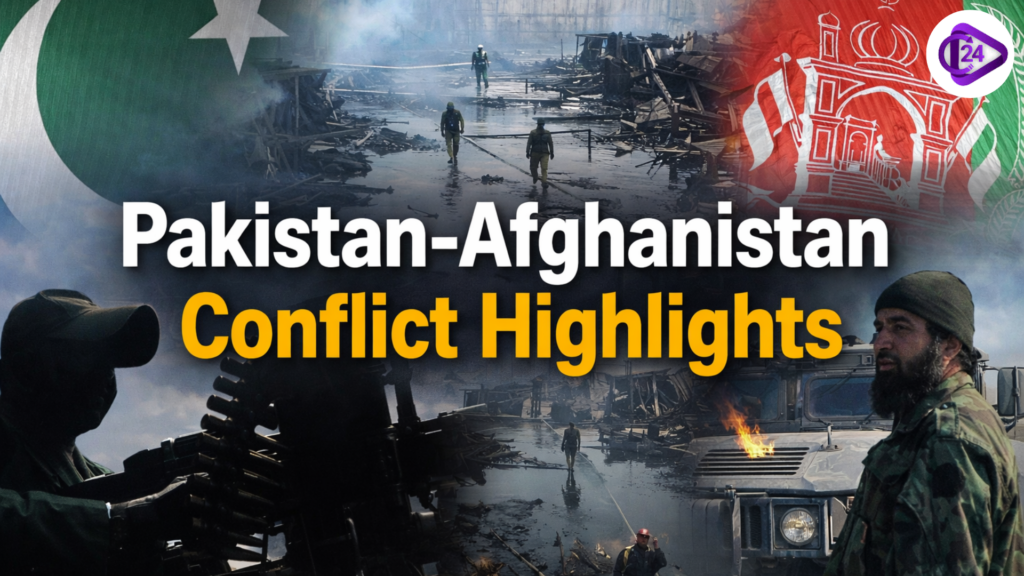
The conflict between Pakistan and Afghanistan has escalated sharply in 2026, creating one of the most pressing security challenges in South Asia. Tensions intensified after Pakistan launched airstrikes inside Afghan territory, claiming they targeted militant bases along the Durand Line. Afghan authorities strongly reject these claims, arguing that strikes have...

Pakistan-Afghanistan Conflict Highlights: Security Challenges and Diplomatic Efforts

The conflict between Pakistan and Afghanistan has escalated sharply in 2026, creating one of the most pressing security challenges in South Asia. Tensions intensified after Pakistan launched airstrikes inside Afghan territory, claiming they targeted militant bases along the Durand Line. Afghan authorities strongly reject these claims, arguing that strikes have hit civilian areas, including hospitals and residential zones, raising concerns about violations of sovereignty and international law. Hundreds of civilians have reportedly died or been injured, and thousands have been displaced. This crisis has also raised alarm among regional and global actors, including the United Nations, which has called for restraint and thorough investigations. Meanwhile, China and other diplomatic actors have attempted to mediate, urging both countries to engage in dialogue and prevent further escalation. The situation reflects longstanding mistrust, unresolved security disputes, and challenges in counter‑terrorism cooperation between Islamabad and Kabul.

Key Security and Diplomatic Highlights of Pakistan-Afghanistan Conflict

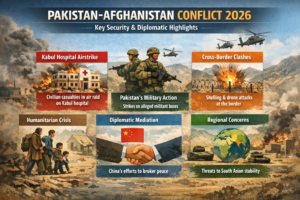
  • Kabul Hospital Airstrike: In March 2026, the Omid Addiction Treatment Hospital in Kabul was struck by air raids, reportedly killing hundreds. Afghan authorities described this as a civilian-targeted attack, while Pakistan asserted that militant infrastructure was targeted.
  • Pakistan’s Military Stance: Pakistan has characterised its operations as an “open war” against militants operating from Afghan soil, particularly targeting groups like the Tehrik‑i‑Taliban Pakistan (TTP). Afghanistan has denied harbouring militants and condemned repeated cross-border strikes.
  • Cross-Border Clashes: There have been exchanges of fire, including drone strikes and artillery incidents, along the disputed border. Civilians living near the border are facing increased risk and displacement.
  • Humanitarian Impact: Tens of thousands of people have been displaced due to fighting. Trade, transport, and access to essential services have been disrupted, worsening economic and social hardships.
  • Diplomatic Efforts: China has played a mediating role, urging both Pakistan and Afghanistan to stop hostilities and engage in talks. International organisations, including the UN, have called for investigations into civilian casualties and emphasised adherence to humanitarian law.
  • Regional Implications: The ongoing conflict threatens broader South Asian stability. Neighbouring countries are monitoring the situation closely, highlighting the urgent need for effective border management and counter-terrorism cooperation.

Diplomatic Developments between India and Afghanistan

India and Afghanistan share a long-standing strategic partnership, underpinned by historical, cultural, and economic ties. Over the past two decades, India has emerged as one of Afghanistan’s largest development partners, investing in infrastructure projects such as the Zaranj–Delaram highway, Salma (Afghan-India Friendship) Dam, and numerous healthcare and educational initiatives. These projects have strengthened bilateral cooperation and enhanced regional stability.

In recent years, India has actively engaged with Afghanistan through diplomatic channels, supporting the Intra-Afghan peace talks and maintaining a technical presence in Kabul despite political uncertainties. Even after the Taliban’s takeover in 2021, India has emphasised humanitarian assistance and continued dialogue to safeguard its strategic interests.

Bilateral relations also focus on trade and connectivity, with initiatives like the Chabahar Port corridor, linking Afghanistan to India via Iran, promoting economic integration and regional connectivity. Both nations have prioritised counter-terrorism cooperation, peace-building, and capacity development to address security challenges.

These ongoing diplomatic developments between India and Afghanistan reflect India’s commitment to a stable and prosperous Afghanistan, highlighting the importance of continued collaboration in security, trade, and humanitarian domains.
IISc Professor Arpita Patra Summits World’s Highest Volcano

Conclusion – Pakistan-Afghanistan Conflict Highlights

The Pakistan–Afghanistan conflict underscores persistent regional security challenges, cross-border tensions, and humanitarian concerns. Civilian casualties and militant activities have escalated hostilities, prompting international calls for restraint. Diplomatic efforts, including mediation by China and advocacy by the United Nations, remain crucial to de-escalation, stability, and fostering long-term peace between both nations while safeguarding regional strategic interests.


Rising Global Tensions 2026: Opportunities & Risks for India’s Economy
IMD Issues Big Warning: More Heatwave Days, Higher Minimum Temperatures
Artemis II Mission: NASA’s First Crewed Lunar Flyby in 50 Years Explained
India Hosts IONS Maritime Exercise 2026 in Kochi Port
India’s Major Share in Global Maternal Deaths
Japan Launches World’s First Freight-Only Bullet Train: Revolutionising High-Speed Logistics
01 April 2026
30 March 2026
28 March 2026
23 March 2026
20 March 2026
19 March 2026
18 March 2026
17 March 2026
16 March 2026
14 March 2026

Start Learning Today with Class24

Buy a course

SSC

Railway

Banking

Teaching Exams

Rajasthan Exams

K12 Courses

Class24 Mobile Application

Class24 also has a mobile application so that it becomes easily accessible and convenient. This can be downloaded on an Android device. Users have appreciated this app and the content provided as 4.1 out of 5 is its rating in the App Store. People loved it because Class24 is giving content which is extremely rich in every sense. The app comprises a wide variety of features for smooth learning:

  • User-Friendly Interface: The app is categorized into various sections so that students can navigate and access various resources with ease.
  • Offline Access: The study materials can be downloaded and the student can access them even when not connected to the internet.
  • Inbuilt eBook Reader: There is a lightning-fast reader for eBooks within the app, so reading is seamless.
  • Progress Tracking: The app tracks student’s progress in preparation and keeps them organized and focused.

Courses and Subjects Offered

The total syllabus will be covered, and there are in-depth practice materials so as to give deep preparation in the courses designed to each one of them. All the subjects come under the aegis of courses offered by Class24 to meet different needs of various aspirants such as:

Preparation Tips for All Exams

Preparation tips for all exams mentioned below:

  • Previous Year Papers: Try to attempt at least 5-10 years of question papers to know the pattern of questions, how much difficulty one would face while answering, and how many frequently asked topics were in the examination.
  • Take Mock Tests: Attempt Mock Tests regularly in order to time and accuracy. You may analyze the performance and make an improvement for weak areas.
  • Focus on Time Management: Solve questions in the given time to make a habit of having speed and efficiency. Allocate time sensibly between Paper 1 and Paper 2, while appearing in the examination.
  • Current Affairs: For Current Affairs and TET exams, be updated about current affairs, teaching aptitude, and general awareness.
  • Regular Revision: Spend your daily and weekly time for revisions to not forget concepts and formulas. Use flashcards or do self-summary notes for quick revisions.
  • Understand the Exam Pattern and Syllabus: Understand the pattern of your exam paper and syllabus very well. Both Current Affairs and CSIR NET examinations are two-tier ones and involve both Paper 1, which consists of general aptitude and Paper 2 that involves specific aptitude subjects.
  • Make a Study Plan: Divide the preparation time into three phases of concept building, revision, and mock tests. Allocate more time to weaker areas while maintaining equilibrium with stronger sections.
  • Online Coaching or Study Groups: Enroll in online coaching programs like Class24 to get proper guidance and a structured approach to the study. Study groups will be useful to discuss doubts and share resources.
  • Stay Consistent and Motivated: Maintain a steady study schedule. Stay motivated by making small achievable goals.
  • Use Quality Study Materials: Suggested study material refers to a textbook, a set of previously published question papers, and web sources such as Class24.

Conclusion

Class24 is a one stop solution for aspirants preparing for Current Affairs, CSIR NET, SET, UP PGT English, UP TGT PGT, UPHESC Assistant Professor, TET, IGNOU B.Ed and other competitive exams. There are structured courses, live classes, mock tests along with the guidance of experts to assist candidates in achieving success in their respective fields.

Get success in your hand. Start study anytime anywhere.

The journey becomes simple and enjoyable when you start taking interest in it. And through our app “Class24”, we will be your trusted partners in developing that interest.

Daily Quizzes
Mock Tests
Ongoing

No ongoing tests right now.