
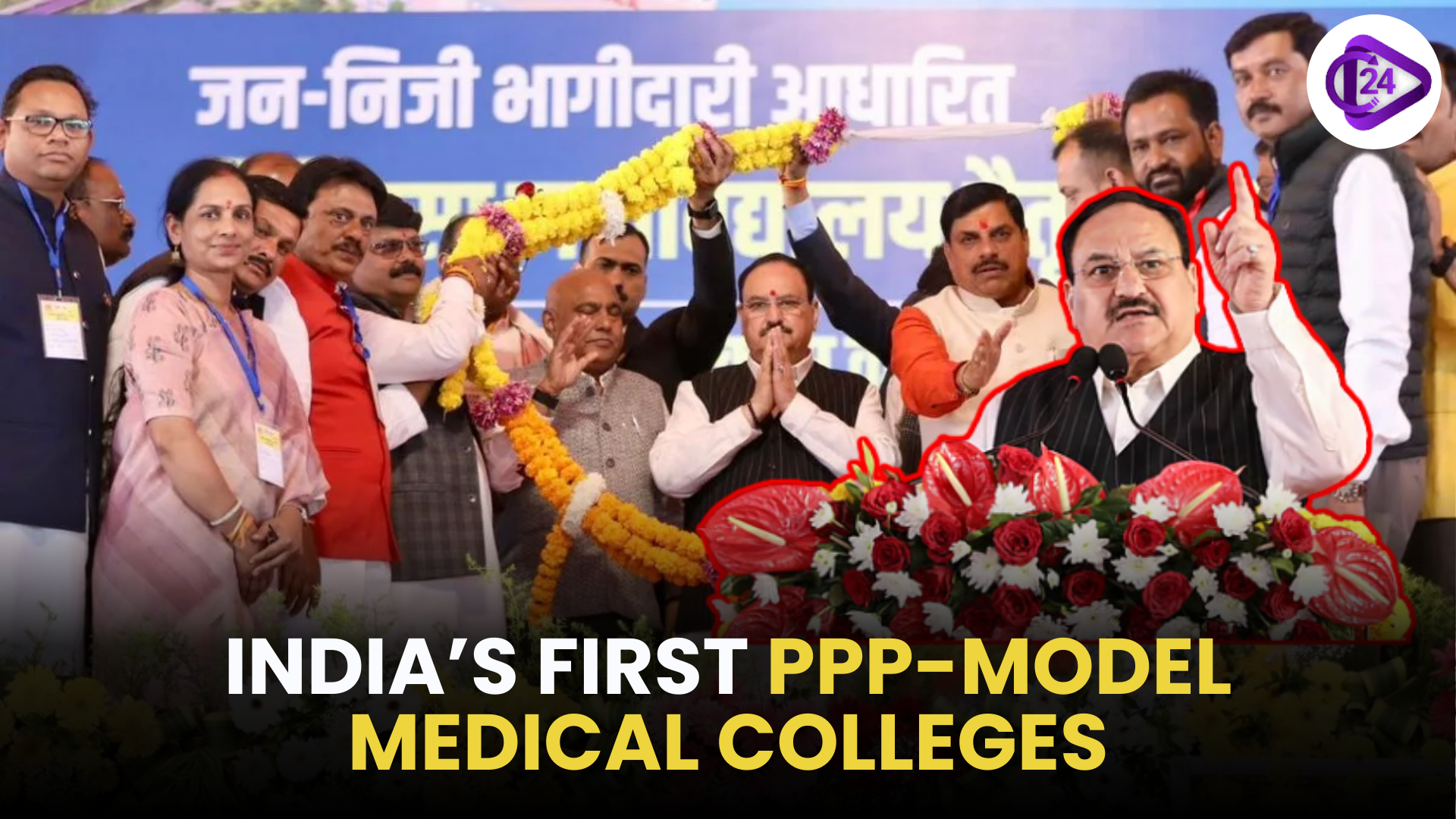
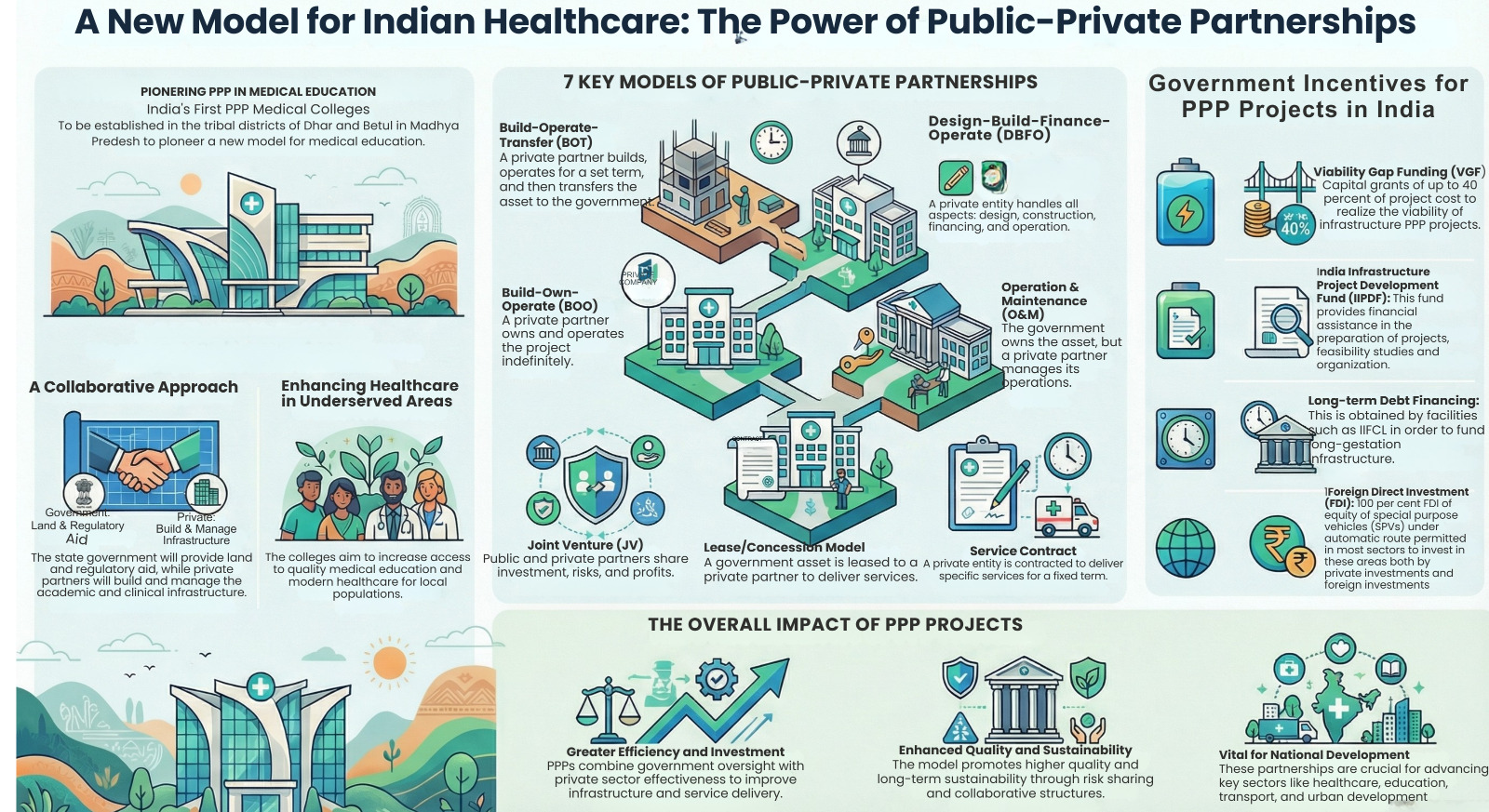
India is planning to open its first Public-Private Partnership (PPP) medical colleges in the tribal Dhar and Betul districts of Madhya Pradesh, a move historic for healthcare and medical education reform. Under this initiative, the state government will provide land and regulatory assistance, while the private partners will design, construct and manage the academic and clinical infrastructure. These colleges will be linked to the existing district hospitals and will be oriented towards increasing access to quality medical education and modern healthcare provision in underserved areas. The PPP approach is likely to empower the health workforce and enhance medical training and the delivery of care to patients throughout the state.
Types of Public-Private Partnership (PPP) Models
Build-Operate-Transfer (BOT): This is where the private partner constructs, operates under a set term and then hands over to the government.
Design-Build-Finance-Operate (DBBO): Design, construction, financing, and operation are all done by a private.
Build-Own-Operate (BOO): The project is owned and operated by a private partner on an indefinite basis.
Operation and Maintenance (O&M): The government is the owner of assets; the operations are handled by the private partner.
Joint Venture (JV): Investment, risks, and profits are shared between both the public and the private partners.
Lease/Concession Model: The government asset is leased to its private partner to give services.
Service Contract: Service Contract involves the delivery of certain services by a private entity on a fixed term basis.
Government Incentives for PPP Projects in India
Viability Gap Funding (VGF): Capital grants of up to 40 percent of project cost to realize the viability of infrastructure PPP projects.
India Infrastructure Project Development Fund (IIPDF): This fund provides financial assistance in the preparation of projects, feasibility studies and organization.
Long-term Debt Financing: This is obtained by facilities such as IIFCL in order to fund long-gestation infrastructure.
Foreign Direct Investment (FDI): 100 per cent FDI of equity of special purpose vehicles (SPVs) under automatic route permitted in most sectors to invest in these areas both by private investments and foreign investments.
Conclusion (PPP Projects in India)
Public-Private Partnership (PPP) projects that have made the infrastructure and service delivery more efficient through the involvement of the government and effectiveness of the private sector. PPPs increase investment, quality and sustainability with incentive, risk sharing and collaborative structures, which are important in industries such as health care, education, transport and urban development.