
Day: February 6, 2026

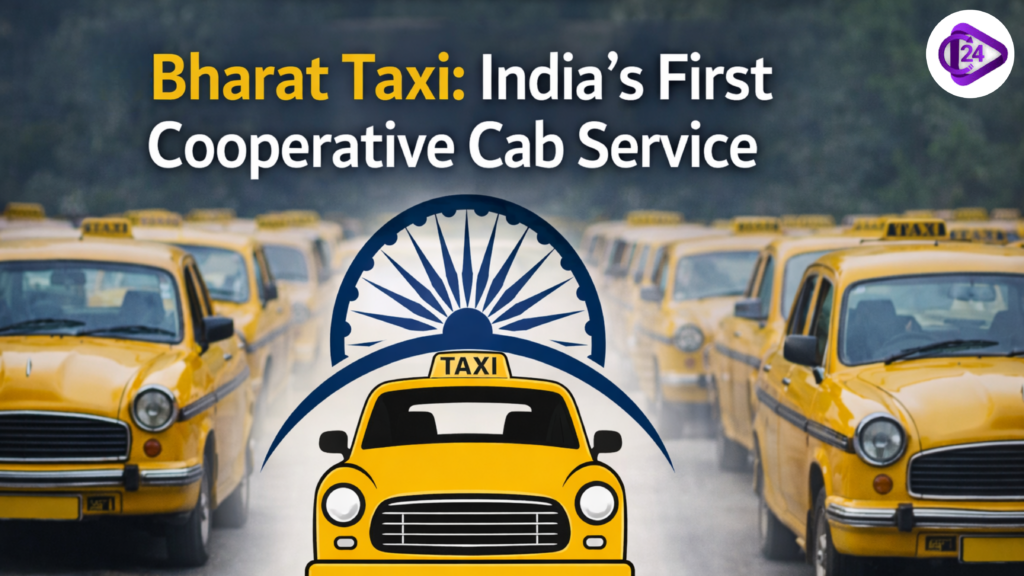
Bharat Taxi: India’s First Cooperative Cab Service To Be Launched Today

India is launching the first people-centred cab service, Bharat Taxi, which aims to be the first cooperative-based taxi company in the ride-hailing industry. The service is incorporated under the Multi-State Cooperative Societies Act, 2002, and is intended to make the drivers cooperative with the same, rather than being commission-based partners. Bharat Taxi uses zero-commission and no-surge pricing, which provides drivers with decent proceeds and fares that are affordable to passengers. The social security benefits will include insurance and retirement benefits to the drivers who will be referred to as Sarathis. The project is aimed at facilitating independence and transparency, all-inclusive development, and providing an indigenous alternative to the current private cab aggregators in India.

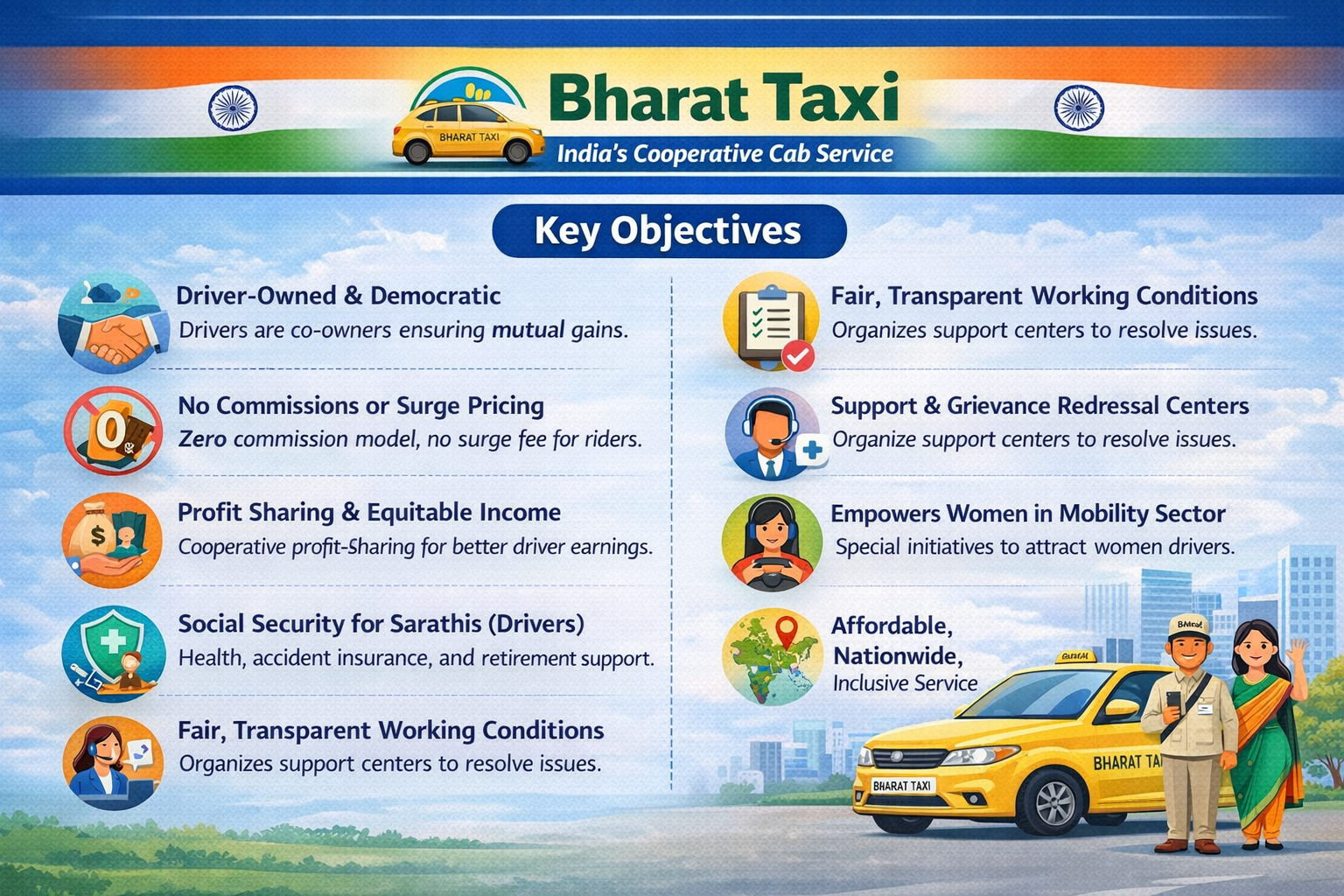
Key Objectives of Bharat Taxi Cab Service

  • To create a driver-focused collaborative ride-hailing application where drivers are part of it and co-owners to guarantee democratic inclusion and mutual gains.

  • To offer an indigenous, cooperative-based solution to the private cab aggregators with profit-motivated designs.

  • In order to exist on a zero commission and surge pole cost plan, allowing drivers to keep the largest possible income while providing the passengers with cheaper deals.

  • To provide equitable income distribution by means of direct profit sharing amongst the cooperative members.

  • To enable social security for drivers (Sarathis) through offering them health insurance, accident insurance and retirement assistance.

  • To advance fair working conditions and the dignity of labour among taxi drivers through organised welfare systems.

  • To put in place support and grievance redress centres to take care of operational assistance, safety, and emergency response.

  • To enable drivers to work on multiple platforms freely without the constraints of exclusivity, it is necessary to increase flexibility and livelihood.

  • To popularise women in the mobility sector through special initiatives to attract women drivers.

  • To develop the service across the country, including urban and semi-urban districts, by using cooperative networks.

  • To merge services with online public infrastructure to facilitate a smooth booking, payment and monitoring.

  • To correspond with the aims of the government schemes of livelihood and self-activity, including micro-credit and social support for small workers.

  • To create an open, participatory, and sustainable mobility system premised on both collaborative values and civic health.
Conclusion (Bharat Taxi)

Bharat Taxi is a revolution in the Indian ride-hailing ecosystem with a cooperative concept of driver-first. Its price is fair with zero commission, and great social security makes the initiative inclusive of growth, driver empowerment, and provides passengers with a transparent, affordable, and sustainable mobility alternative in the country.
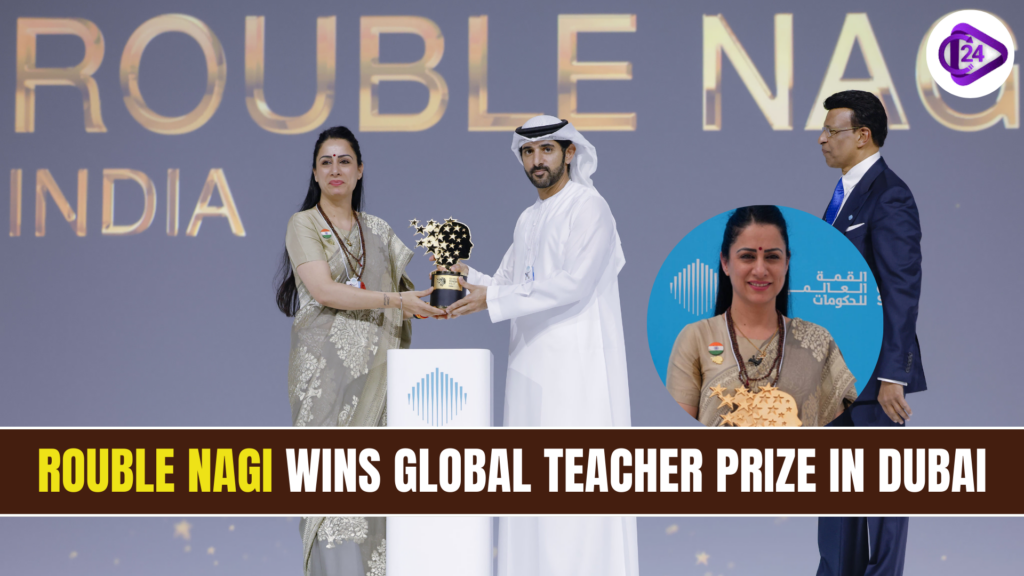
Rouble Nagi Wins GEMS Education Global Teacher Prize In Dubai

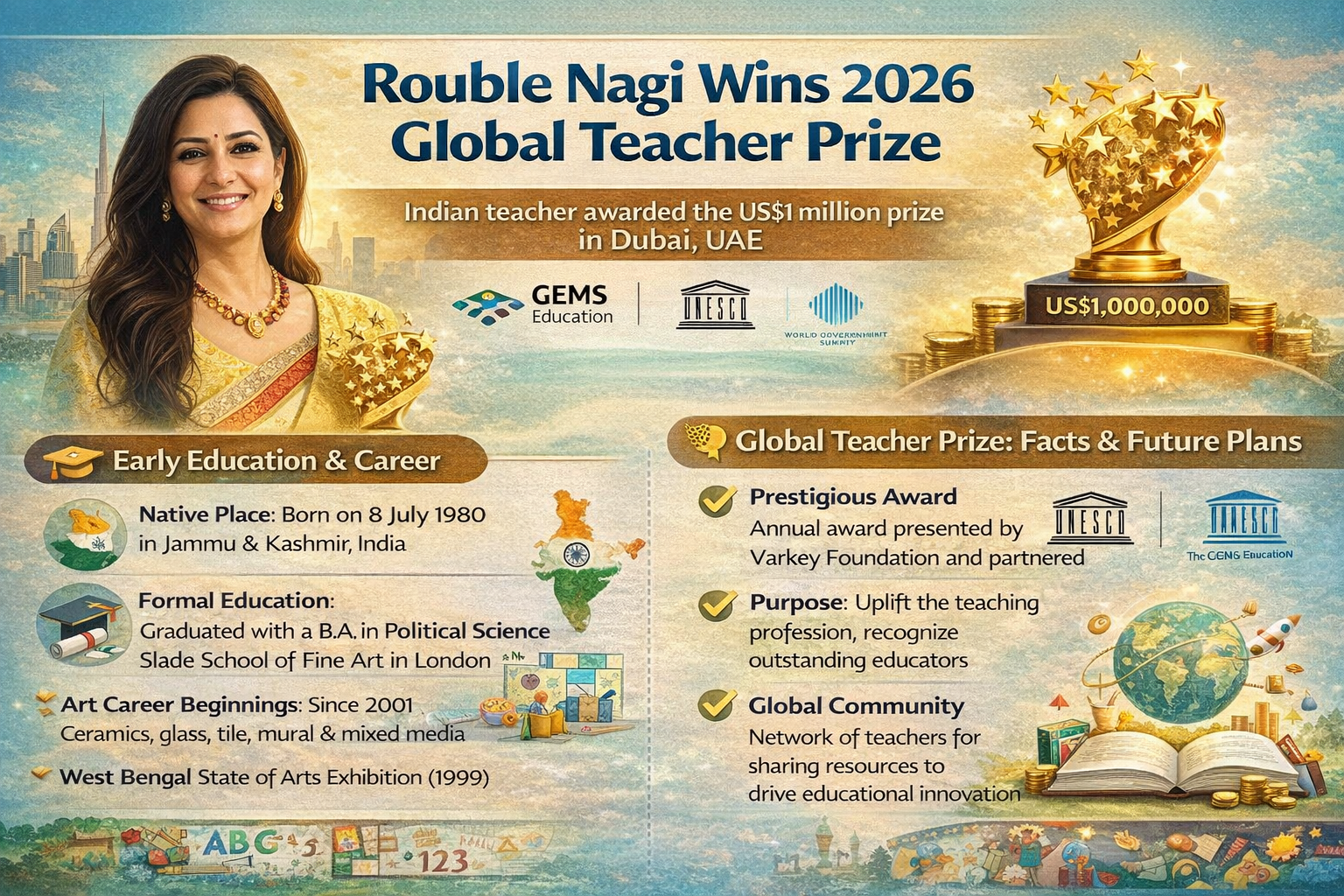
Indian teacher Rouble Nagi has claimed the highly coveted 2026 GEMS Education Global Teacher Prize, which is presented with the US$1 million prize in Dubai, the United Arab Emirates, at the World Government Summit. It is awarded by the Varkey Foundation and is partnered with UNESCO, and it is given to recognise significant contributions in the field of education, either locally or globally. Nagi was chosen among thousands of nominations in her creative work by the Rouble Nagi Art Foundation, which has created more than 800 learning centres and converted public walls into educational interactive and educational murals to educate marginalised children in India in literacy, numeracy, science, and life skills.

Early Education and Career of Rouble Nagi

Native Place: Rouble Nagi was born on 8 July 1980 in Jammu & Kashmir, India.

Formal Education:

  • She graduated with a B.A. in Political Science.

  • Nagi attended Slade School of Fine Art in London, where he studied Fine Art.

  • She had also studied European Art atthe  Sotheby Institute, London.

Art Career Beginnings:

  • Starting in 2001, Nagi started to experiment with ceramics, glass, tiles, murals, and mixed media.

  • She attended art exhibitions at a tender age, such as the West Bengal State of Arts Exhibition (1999).

Professional Development:

  • She is the founder of Rouble Nagi Design Studio, where she works with murals, sculptures, and other art activities in the streets.

  • Nagi gained global fame for her murals, installations, and exhibitions in more than 200 exhibitions in different parts of the world.

  • She is also a member of the Council of Design, India Design Council (IDC) member, who initiated the beautification of a city such as Misaal Mumbai.

Transition to Education:

Her slum and underserved community art work naturally progressed to education outreach work, and brought about learning centres and the application of interactive Learning Walls.

What is the Global Teacher Prize and Future Plan?

Annual Global Award: The Global Teacher Prize is a yearly award of US 1,000,000, given by the Varkey Foundation to a remarkable teacher who has made an exemplary achievement among the students and their community. It is among the most coveted awards in education all over the world.

Purpose: It is supposed to uplift the image of the teaching profession and the significance of teachers, as well as to give credit to the excellent work of professionals that leaves an influence on the learners and communities throughout the world.

Global Community: The prize encourages a global community of teachers in which winners and finalists will be able to network, exchange resources and bring about change.

Future Plans: The Varkey Foundation is broadening its reach with other such related initiatives, such as the Global Schools Prize, which promotes innovation in education and helps teachers to become more than just one in the classroom.

Conclusion (Rouble Nagi Wins GEMS Prize)

Rouble Nagi in the GEMS Education Global Teacher Prize is a strong statement about the non-classroom education. Her creative approach to learning, through the use of art to impart literacy and life skills, has changed the lives of marginalised communities, and serves to remind the world that it is through creativity, compassion and grassroots action that we can bring meaningful and inclusive educational change to the world.

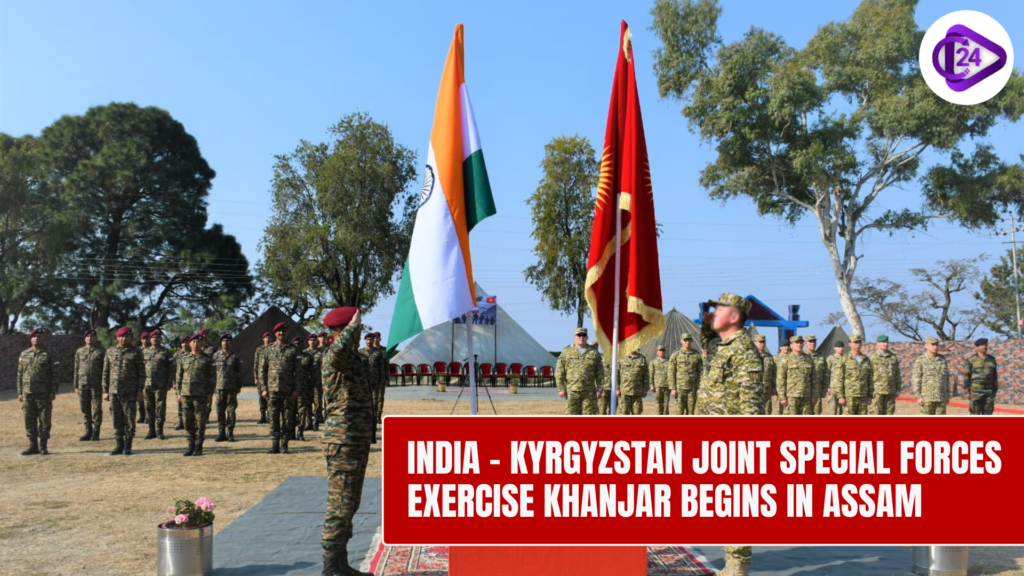
India and Kyrgyzstan’s Joint Military Exercise KHANJAR Begins in Assam

The exercise is organised in line with the years of the deep-rooted bilateral military partnership between both nations, the involvement of the elite element in the Parachute Regiment (Special Forces) of the Indian Army and the Kyrgyzstan ILBRIS Special Forces Brigade. The training aims to improve interoperability, coordination and joint operational proficiency in anti- or counter-terrorism, and in urban and mountainous terrain operations. To be held until 17 February 2026, KHANJAR underscores the enhancement of bilateral military relations and a serious commitment to the security of the region.

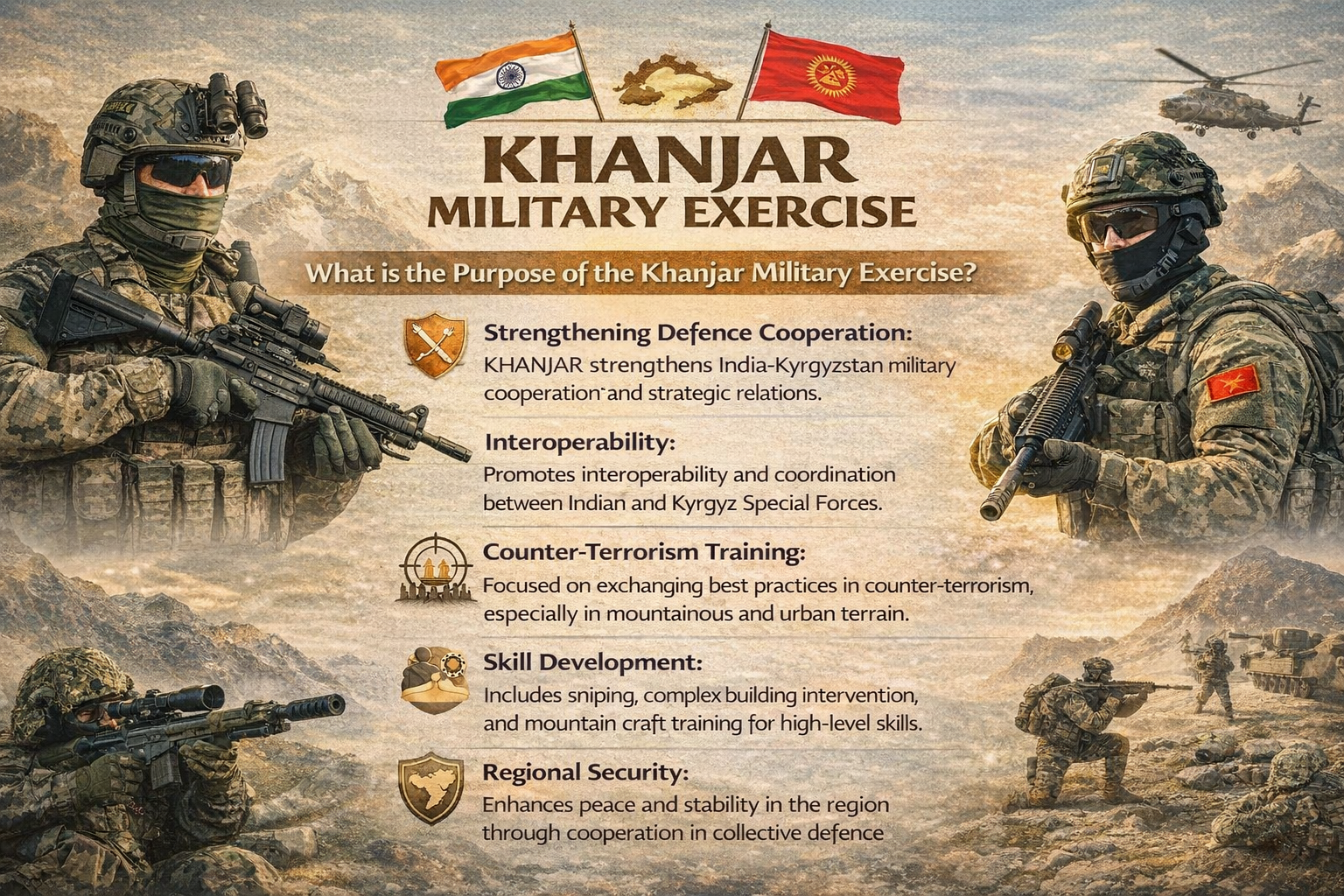
What is Purpose of the Khanjar Military Exercise?

Strengthening Defence Cooperation: KHANJAR is a special forces training program of the two countries, which will strengthen Indian-Kyrgyz military cooperation and strategic relationship.

Interoperability: It tries to promote interoperability and coordination between the Indian and Kyrgyz special forces by joint training and planning.

Counter-Terrorism Training: The drill is aimed at the exchange of the best practices in counter-terrorism activities, particularly in the mountainous and urban areas.

Skill Development: The sniping, complex building intervention and mountain craft are included in the training module to advance high-level intervention skills.

Regional Security: It strengthens peace, stability, and security in the region by the involvement of cooperation in collective defence.

Important Exercise 2025

Exercise Name (2025) Participating Country(ies) Region / Host Location
Ekuverin-XIII India – Maldives Maldives
Cyclone-III India – Egypt Rajasthan, India
Dharma Guardian-VI India – Japan Japan (Mount Fuji region)
Khanjar-XII India – Kyrgyzstan Kyrgyzstan
Tiger Triumph India – USA India (Tri-Service Exercise)
DUSTLIK India – Uzbekistan Uzbekistan / India
IMBAX India – Myanmar Myanmar
Nomadic Elephant India – Mongolia Mongolia
Shakti India – France France
Bold Kurukshetra India – Singapore Singapore
Bright Star India – Egypt Egypt
Yudh Abhyas India – USA USA
Maitree India – Thailand Thailand
Zapad India – Russia Russia
Indra (13th Edition) India – Russia Russia
AUSTRAHIND India – Australia Australia
Mitra Shakti India – Sri Lanka Sri Lanka
VINBAX India – Vietnam Vietnam
Africa-India Key Maritime Engagement (AIKEYME) India – Tanzania & African Nations Dar-es-Salaam, Tanzania

Conclusion (India and Kyrgyzstan’s Joint Military Exercise KHANJAR)

Joint Military Exercise KHANJAR involving India and Kyrgyzstan demonstrates the development of defence relations and confidence between the two countries. The exercise will also improve bilateral relationships and solidify a regional commitment to regional peace, stability, and an obligation to security by improving interoperability, counter-terrorism, and joint operational readiness.

US Congress Approves USD 200 Million for Baltic Military Assistance

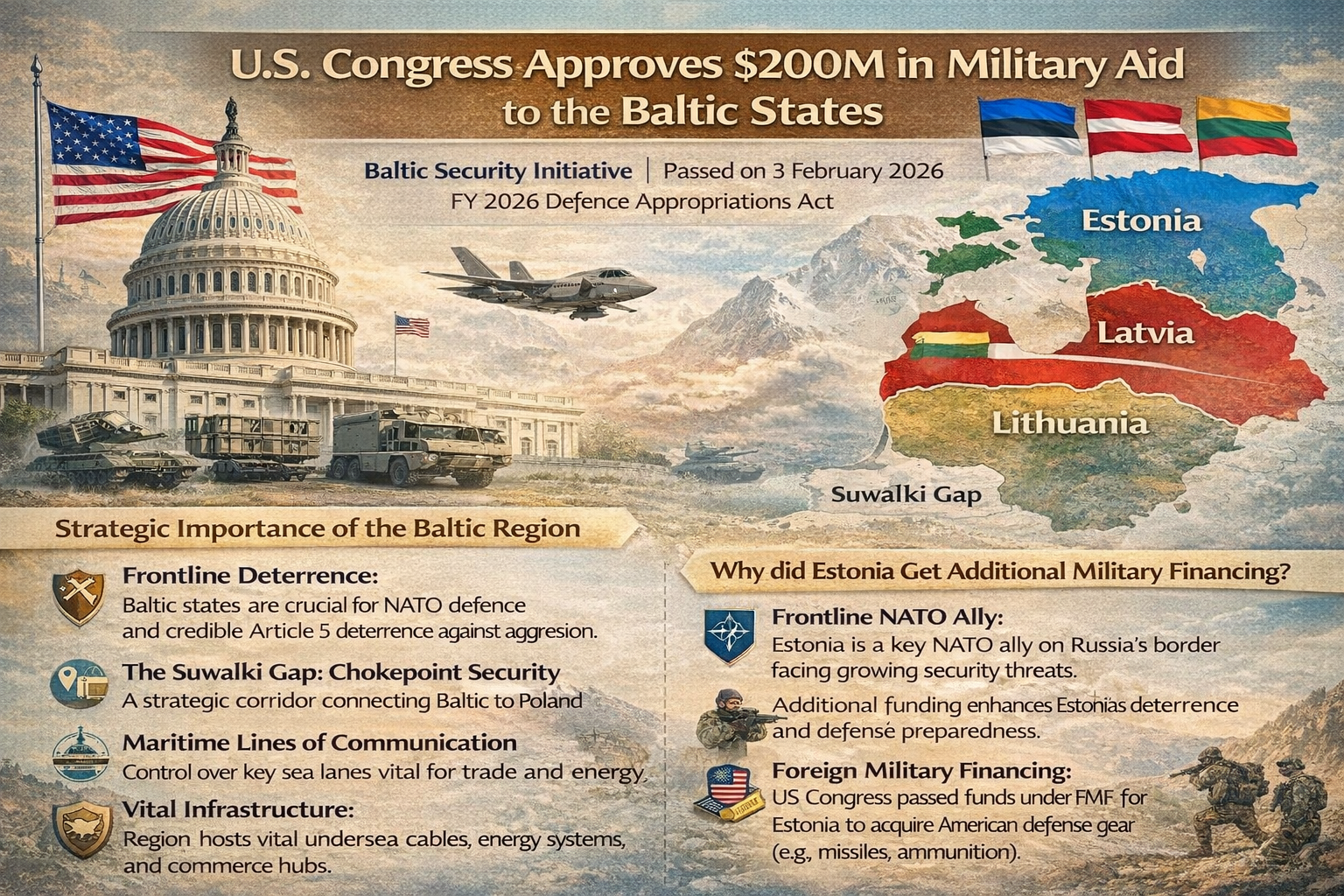
On 3 February 2026, the Congress of the United States passed USD 200 million of military aid to the Baltic states of Estonia, Latvia, and Lithuania in the Baltic Security Initiative (BSI) under the Fiscal Year 2026 Defence Appropriations Act. This investment is aimed at consolidating the defence abilities and integration of the Baltic states through the acquisition of the latest US military gear, as well as the improvement of air defence and other important infrastructures. The package takes a fresh commitment to European security and transatlantic defence cooperation by the US in the face of current challenges in the region.

Strategic Importance of the Baltic Region

Frontline Deterrence: Baltic states are a vital stronghold of collective defence to NATO, and it is the credibility of the article 5 against the possibility of aggression.

The Suwalski Gap: Chokepoint Security. A land route that links the Baltic to Poland and NATO as a whole is a key strategic route that can be used to rapidly reinforce the area in case of a threat.

Maritime Lines of Communication: The Baltic Sea dominates some of the important sea routes that are critical in trade, energy and movement of armies.

Vital Infrastructure: The area possesses key undersea cables, energy infrastructural systems, and accommodates a large amount of commerce, and it is a hub of economic and national security concerns.

Hybrid Threat Environment: Its geographical closeness to Russia and augmented hybrid hazards propose an enduring NATO troop presence and strength.

Why did Estonia Get Additional Military Financing?

  • Frontline NATO Ally: Estonia is located on the eastern side of NATO in proximity to Russia. It is a strategically critical ally that is exposed to increased security threats.

  • Deterrence Requirement: Extra finances would enhance the capability of Estonia to deter possible aggression through improving defence preparedness.

  • Foreign Military Financing: The US Congress passed additional funds under Foreign Military Financing to allow Estonia to acquire American defence equipment (ex. missiles, artillery ammunition).

  • NATO Capability Goals: More support is in line with Estonia and NATO's objective of strengthening defence interoperability and current military capabilities.

  • Regional Stability: It is used to prevent collective security and stability in the Baltic region.

Important PYQs Asked on the Baltic States

Exam Name Year Question Options Correct Answer
UPSC Prelims 2021 The Baltic Sea is connected to which ocean? (A) Arctic Ocean (B) Atlantic Ocean (C) Indian Ocean (D) Pacific Ocean (B) Atlantic Ocean
UPSC Prelims 2019 Which of the following countries are known as the Baltic States? (A) Finland, Sweden, Norway (B) Estonia, Latvia, Lithuania (C) Poland, Czech Rep., Slovakia (D) Denmark, Iceland, Norway (B)
SSC CGL 2020 Which sea lies between Scandinavia and mainland Europe? (A) Black Sea (B) Baltic Sea (C) Adriatic Sea (D) Caspian Sea (B)
SSC CHSL 2018 Estonia, Latvia and Lithuania together are called (A) Balkan States (B) Nordic States (C) Baltic States (D) Slavic States (C)
SSC GD 2022 Which of the following countries does NOT border the Baltic Sea? (A) Latvia (B) Estonia (C) Poland (D) Czech Republic (D)
CDS 2020 The Baltic States are located in which part of Europe? (A) Southern Europe (B) Western Europe (C) Northern Europe (D) Eastern Europe (C)
NDA 2021 How many countries are collectively called the Baltic States? (A) Two (B) Three (C) Four (D) Five (B)
RRB NTPC 2019 Lithuania is bordered by which water body? (A) Mediterranean Sea (B) North Sea (C) Baltic Sea (D) Black Sea (C)
State PSC 2022 Which one of the following is NOT a Baltic country? (A) Latvia (B) Lithuania (C) Estonia (D) Finland (D)
UPSC Prelims 2020 The Baltic Sea separates which two regions? (A) Europe & Asia (B) Scandinavia & mainland Europe (C) Europe & Africa (D) Asia & Africa (B)

Conclusion 

The Congress of the US funding the Baltic military support through USD 200 million strengthens the support American troops provide to NATO and European security. The move increases the deterrence of the region and the collective security provided to the region, as well as promoting stability within the NATO eastern flank by developing the defence capabilities of Estonia, Latvia and Lithuania.

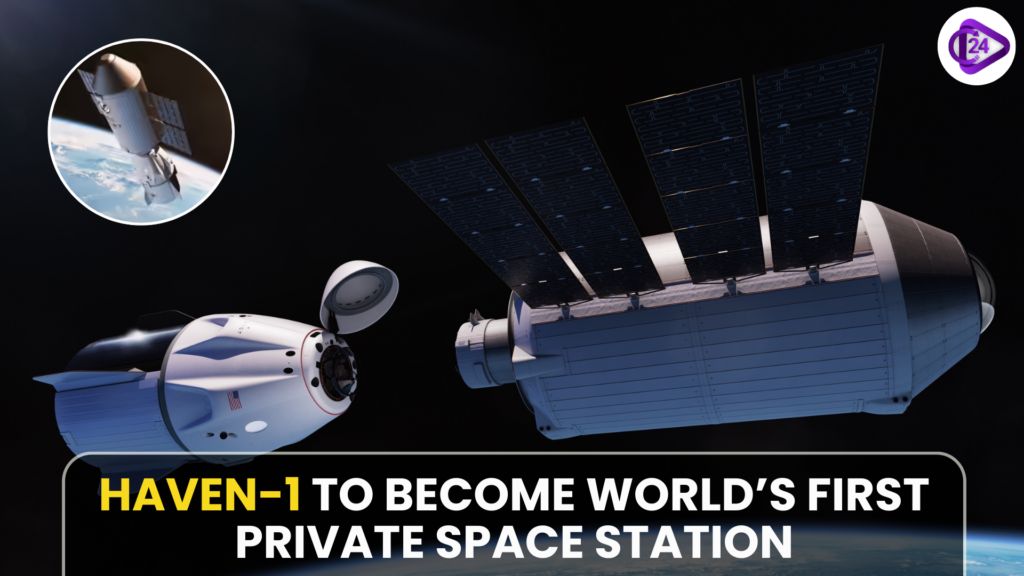
World’s First Private Space Station ‘Haven-1’ Getting Ready for 2027 Launch

Haven-1, created by U.S. aerospace manufacturer Vast Space, will become the first commercial low Earth orbit space station worldwide, marking the first large step toward the commercialization of low Earth orbit. The station is scheduled to launch on a SpaceX Falcon 9 rocket no earlier than May 2026, as a transition to privately run orbital infrastructure (instead of government-run platforms). It has been developed in line with NASA plans to retire the International Space Station in the latter part of this decade and provide business space destinations.

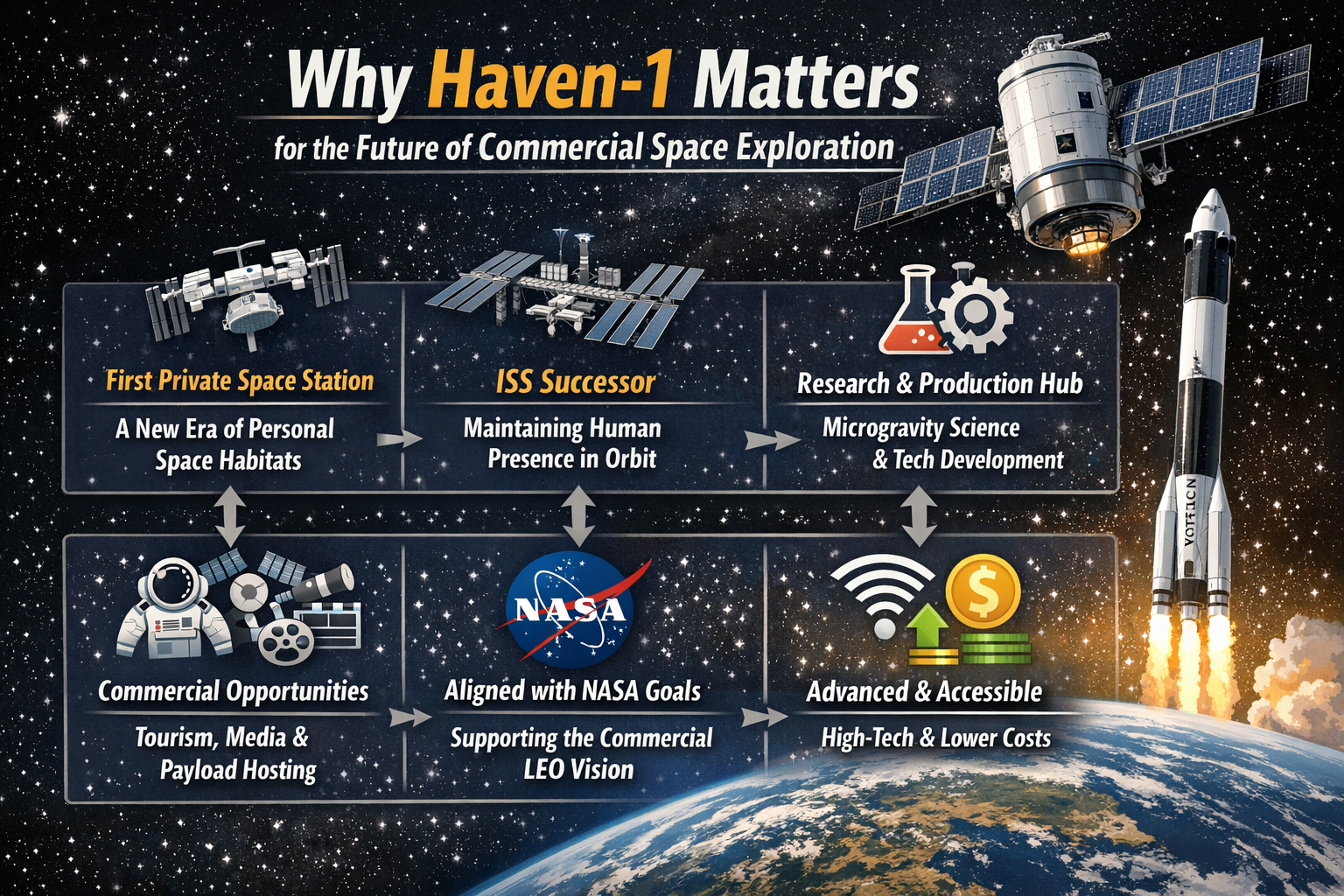
Why Haven-1 Matters for the Future of Commercial Space Exploration?

  • Introduction of the age of the personal space station: Haven-1 will be a prototype of the first fully commercial space station in the world. As a fully privately-owned individual and corporate enterprise, the space station will be based on the theory that government-controlled space platforms have been replaced by privately-owned space infrastructure.

  • Provides continuity following the ISS: With the International Space Station nearing retirement, Haven-1 will keep the human presence as well as research and commercial activity in orbit on the low Earth.

  • Enables business research and production: The station will be required in microgravity research and in-space production, and technology demonstration of private businesses, startups, and collaboration with global partners.

  • Opens new space business possibilities: Havens-1 offers short-term crewed travels, payload hosting, and commercial initiatives, including the media, outreach, and personal astronaut missions.

  • Favors the NASA commercial LEO concept: It is congruent with NASA's long-term plan to abandon its system of running space stations and buying services from commercial vendors.

  • Technology Advanced connectivity and facilities: Increased orbital connectivity: fast speeds allow real-time communications, remote experiment operations, and improved mission functions.

  • Lowers space accessibility: Private space operations and modular construction are able to reduce the cost as opposed to the other space stations run by the government.

Latest Previous Year Questions on Space Station

Exam Year Question Options Correct Answer
UPSC Prelims 2016 Who was the first human to travel into space? A) Neil Armstrong B) Yuri Gagarin C) John Glenn D) Alan Shepard B) Yuri Gagarin
SSC CGL 2019 Who was the first Indian to go to space? A) Kalpana Chawla B) Rakesh Sharma C) Sunita Williams D) Vikram Sarabhai B) Rakesh Sharma
SSC CHSL 2020 Who became the first woman to go to space? A) Sunita Williams B) Kalpana Chawla C) Valentina Tereshkova D) Sally Ride C) Valentina Tereshkova
RRB NTPC 2021 Who has spent the maximum total time in space? A) Scott Kelly B) Mikhail Kornienko C) Peggy Whitson D) Mikhail Gorbachev C) Peggy Whitson
UPSC Prelims 2018 Who holds the record for the longest single spaceflight? A) Scott Kelly B) Christina Koch C) Mikhail Kornienko D) Yuri Gagarin B) Christina Koch
SSC GD 2022 Sunita Williams belongs to which country? A) UK B) India C) USA D) Russia C) USA
State PSC 2017 How many days did Rakesh Sharma stay in space? A) 5 days B) 7 days C) 8 days D) 10 days C) 8 days
SSC MTS 2020 Who visited space the maximum number of times? A) Sunita Williams B) Peggy Whitson C) Yuri Gagarin D) Neil Armstrong B) Peggy Whitson
Defence Exams 2021 The International Space Station orbits the Earth approximately every: A) 60 min B) 90 min C) 120 min D) 180 min B) 90 minutes
RRB Group D 2019 ISS is located in which orbit? A) GEO B) Polar Orbit C) Low Earth Orbit D) Elliptical Orbit C) Low Earth Orbit

Conclusion (World’s First Private Space Station ‘Haven-1’)

Haven-1 is a new era in space exploration because it has become the first-ever privately used space station in the world. It is a future of commercial spaceflight, allowing research, innovation, and other missions in low Earth orbit, as well as the bridging of the post-International Space Station era.

Frequently Asked Questions (FAQs)

The current affairs cover recent national and international events related to UPSC, SSC, Banking, Railways, and State PCS.

You need to read about the current affairs daily, and revise them every week and every month to keep them longer in your memory.

Yes, Class24 provides free downloadable Daily Current Affairs PDFs for easy revision.

Yes, you can practice MCQs and quizzes to boost your exam preparation.

Absolutely. The content is written in simple, easy-to-understand bilingual language suitable for beginners.

Go to class24.com and click on the current affairs section directly, where you find everything that you need.

ssc-toppers

Start Learning Today with Class24

Related current affairs

Class24 offers free video lectures for smart preparation, covering CGL, CPO, CHSL, MTS, and GD exams. Learn from expert faculty, revise concepts easily, practice with PYQs, and improve speed and accuracy through high-quality, exam-focused video lessons anytime, anywhere.

Get success in your hand. Start study anytime anywhere.

The journey becomes simple and enjoyable when you start taking interest in it. And through our app “Class24”, we will be your trusted partners in developing that interest.

Daily Quizzes
Mock Tests
Ongoing

No ongoing tests right now.