

Day: February 17, 2026

National Large Solar Telescope (NLST)

National Large Solar Telescope (NLST) A state of the art ground based solar observatory that is being developed by the Indian Institute of Astrophysics (IIA). NLST will be a 2-metre class optical and near-infrared telescope that will allow high-resolution research on the magnetic fields and dynamic processes of the Sun and other energetic events like solar flares and sunspots. It will be situated in Merak on the Pangong Tso in the Ladakh region at a height of approximately 4,200 m, which has favourable weather conditions to view the solar activities. NLST will supplement the space-based solar mission Aditya-L1 of India, as well as strengthen solar physics research efforts in the country.

What is the National Large Solar Telescope?

  • The National Large Solar Telescope (NLST) is a proposed 2-metre class, earth based solar observatory of high resolution applications in the study of the atmosphere of the Sun.

  • The Indian Institute of Astrophysics (IIA) is working on it to answer major questions on the same subject of the solar magnetic fields and dynamics.

  • This telescope will be visible in the near-infrared and allow the telescope to be used for fine-scaled observations of the sunspots, flares, and other solar features.

  • The location will be located close to the Pangong Tso in Merak, Ladakh, at an altitude of approximately 4200 m to provide good observing conditions.

  • NLST will be an addition to the space-based solar mission Aditya-L1 of India, with the ground-based data.

Key Facts about the National Large Optical-Near Infrared Telescope

  • The National Large Optical-Near Infrared Telescope (NLOT) is a proposed astronomical telescope of 13.7 metres (aperture) and will be located on the ground near Hanle, Ladakh, India.

  • It will consist of a segmented primary mirror made of numerous mirror segments of hexagonal shape, and that will act as a single large mirror.

  • NLOT will monitor celestial objects in the optical and near-infrared spectra, and this will allow deep-sky observations.

  • The location on the Hanle gives a high altitude with dry air and clear skies and low light pollution, and this location is ideal for making precision observations.

  • The telescope will facilitate investigation into exoplanets, galaxy formation, stellar evolution, supernovae, and cosmology.

Recently Asked PYQs on Telescope

Exam Year Question Options Answer
SSC CGL 2017 In an astronomical telescope, the objective lens has a large aperture to: (A) Increase magnification
(B) Increase resolving power
(C) Reduce focal length
(D) Invert image
(B)
NDA 2019 The magnifying power of an astronomical telescope in normal adjustment is: (A) fo/fe
(B) fe/fo
(C) fo + fe
(D) fo – fe
(A)
NEET 2016 The length of an astronomical telescope in normal adjustment is: (A) fo – fe
(B) fo + fe
(C) fe/fo
(D) fo/fe
(B)
JEE Main 2020 If fo = 100 cm and fe = 5 cm, magnifying power is: (A) 5
(B) 10
(C) 20
(D) 25
(C)
UPSC CDS 2018 Reflecting telescope uses which mirror? (A) Convex
(B) Concave
(C) Plane
(D) Parabolic lens
(B)
RRB NTPC 2021 The main advantage of a reflecting telescope is: (A) High cost
(B) No chromatic aberration
(C) Small size
(D) Low magnification
(B)
SSC CHSL 2015 Which telescope uses lenses as the objective? (A) Reflecting
(B) Refracting
(C) Radio
(D) Cassegrain
(B)
JEE Advanced 2014 The resolving power of a telescope depends on: (A) Focal length
(B) Aperture of objective
(C) Eyepiece focal length
(D) Length of tube
(B)
NEET 2017 Resolving power is proportional to: (A) 1/D
(B) D
(C) f
(D) λ
(B)
SSC MTS 2022 Large aperture helps the telescope to: (A) Reduce weight
(B) Collect more light
(C) Reduce length
(D) Invert image
(B)

Conclusion (National Large Solar Telescope)

The National Large Solar Telescope (NLST) will greatly contribute to the research capacity of India in the solar fields by allowing an observation of the magnetic fields and dynamic processes happening in the Sun with high resolution. It will produce an offshoot of the Aditya-L1 mission planned in Ladakh and give India an edge in the field of advanced solar physics and ground-based astronomical research around the world.
Kerala Presents India’s First Elderly Budget

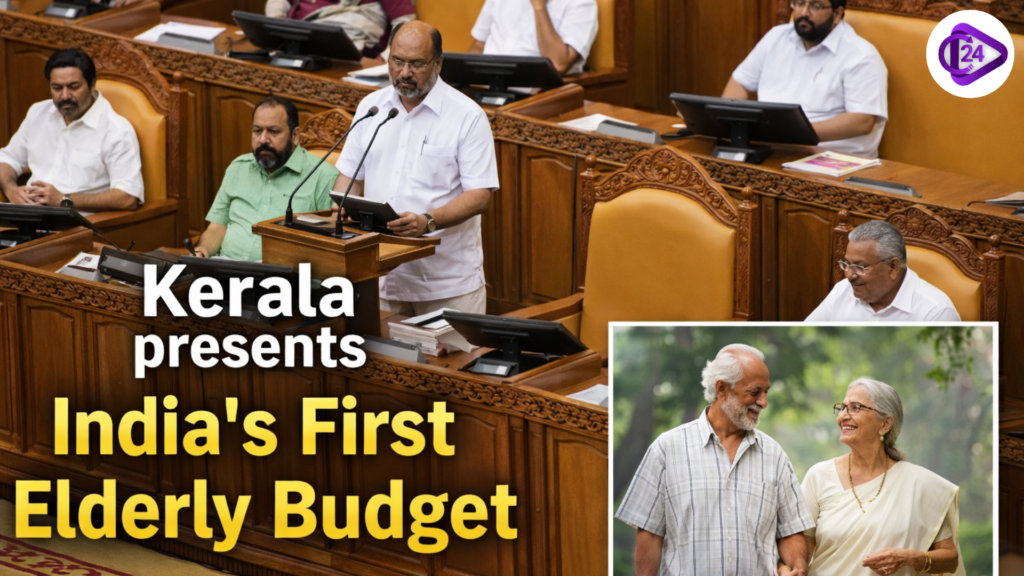
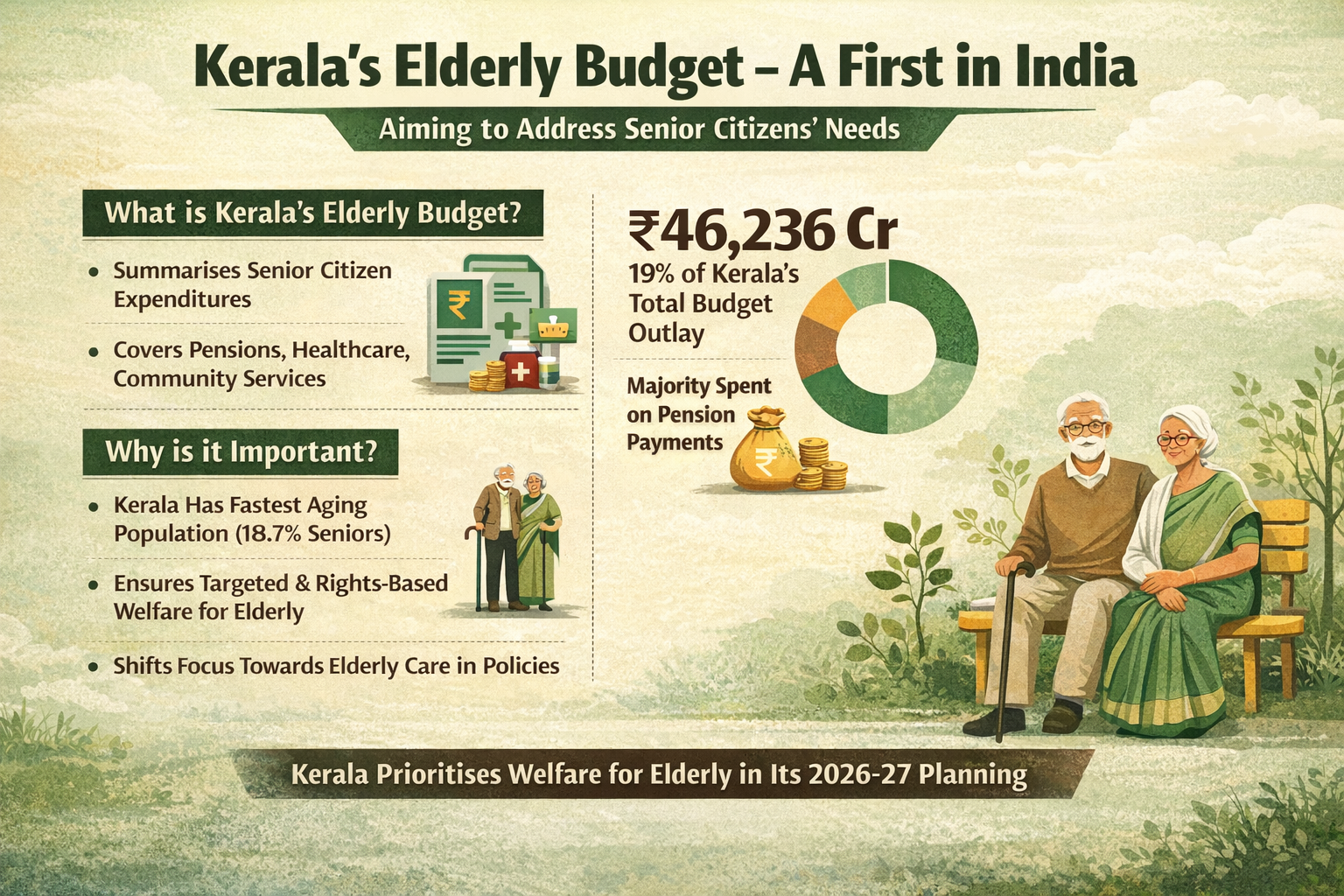
Kerala has been a history-maker by introducing the first elderly budget in India to meet the needs of the rapidly aging population. Since the elderly population makes up almost 18.7 percent of the state population, the separate budget document will bring together all the allocations made towards the welfare of the elderly, which include pensions, healthcare, and community support services. It also adds the criterion of correlating the devolution of local body funds with the percentage of senior citizens to achieve focused planning and services. The relocation highlights the prioritisation of Kerala in the care economy and rights-based welfare in its socio-economic planning for older adults.

What is the Elderly Budget?

  • Kerala is the first state in India to put forward a special state budget on the elderly as part of its state budget for 2026-27.

  • It is not an independent financial budget but a combined report of all expenditures directly benefiting the senior citizens.

  • The budget determines and categorises expenditures related to the elderly in pensions, health care, welfare, and community services.

  • It follows an organised pattern according to which schemes that are only applicable to the aging group are labelled Part A, and partially useful schemes are categorised as Part B.

  • The elderly budget covers approximately 46,236.52 crore, which is about 19 percent of the total budget expenditure of the state.

  • Almost two-thirds of this budget is associated with the payment of pensions, such as welfare pension and retirement benefits.

Why Does the Kerala Elderly Budget Matter?

  • There is a fast-growing aging population in Kerala, with senior citizens making up approximately 18.7 percent of the population, which is the largest in India.

  • This share is estimated to skyrocket in the next few years, eventually boosting the need for income support, long-term care, and healthcare services.

  • The Elderly Budget offers more transparency on the amount spent as well as the areas in which the money is used for the welfare of the elderly.

  • It is a change towards the traditional welfare policy to a policy on the rights-based and structured approach to aging.

  • The relocation has been a demonstration of demographic planning in general, which predicts future financial and social requirements of the ageing population.

Previous Year Questions on Budget and Kerala

Exam Year Question (with Options) Answer
UPSC CSE Prelims 2017 The Annual Financial Statement mentioned in the Constitution is under: (A) Article 110, (B) Article 112, (C) Article 114, (D) Article 266 (B)
SSC CGL 2019 The Union Budget of India is presented first in: (A) Rajya Sabha, (B) Lok Sabha, (C) Joint Session, (D) Both Houses together (B)
RRB NTPC 2021 Revenue Deficit occurs when: (A) Revenue receipts exceed revenue expenditure, (B) Revenue expenditure exceeds revenue receipts, (C) Capital expenditure exceeds capital receipts, (D) Fiscal deficit increases (B)
UPSC CSE Prelims 2020 A finance bill can be introduced in: (A) Rajya Sabha only, (B) Lok Sabha only, (C) Either House, (D) Joint Sitting (B)
Kerala PSC 2020 Which is the longest river in Kerala? (A) Bharathapuzha, (B) Pamba, (C) Periyar, (D) Kabini (C)
SSC CHSL 2016 Anamudi Peak is located in: (A) Tamil Nadu, (B) Karnataka, (C) Kerala, (D) Andhra Pradesh (C)
RRB Group D 2019 Silent Valley National Park is situated in: (A) Wayanad, (B) Palakkad, (C) Idukki, (D) Kannur (B)
UPSC CSE Prelims 2018 The Western Ghats run parallel to India’s: (A) Eastern Coast, (B) Western Coast, (C) Northern Plains, (D) Indo-Gangetic Plain (B)
SSC CPO 2018 Mohiniyattam is a classical dance form of: (A) Odisha, (B) Kerala, (C) Assam, (D) Manipur (B)
RRB NTPC 2020 Kathakali originated in: (A) Tamil Nadu, (B) Kerala, (C) Karnataka, (D) Andhra Pradesh (B)
UPSC CSE Prelims 2017 Kalaripayattu is associated with: (A) Gujarat, (B) Kerala, (C) Rajasthan, (D) Punjab (B)
SSC MTS 2022 The predominant soil type in Kerala is: (A) Black Soil, (B) Laterite Soil, (C) Alluvial Soil, (D) Desert Soil (B)

Conclusion (First Elderly Budget in Kerala)

The Kerala Budget on the Elderly is a positive move towards dealing with the elderly segment. The initiative can increase the transparency and targeted planning by consolidating welfare, pension, and healthcare allocations. It dictates a precedent of inclusive governance and age-responsive fiscal policy on sustainable social development at a national level.

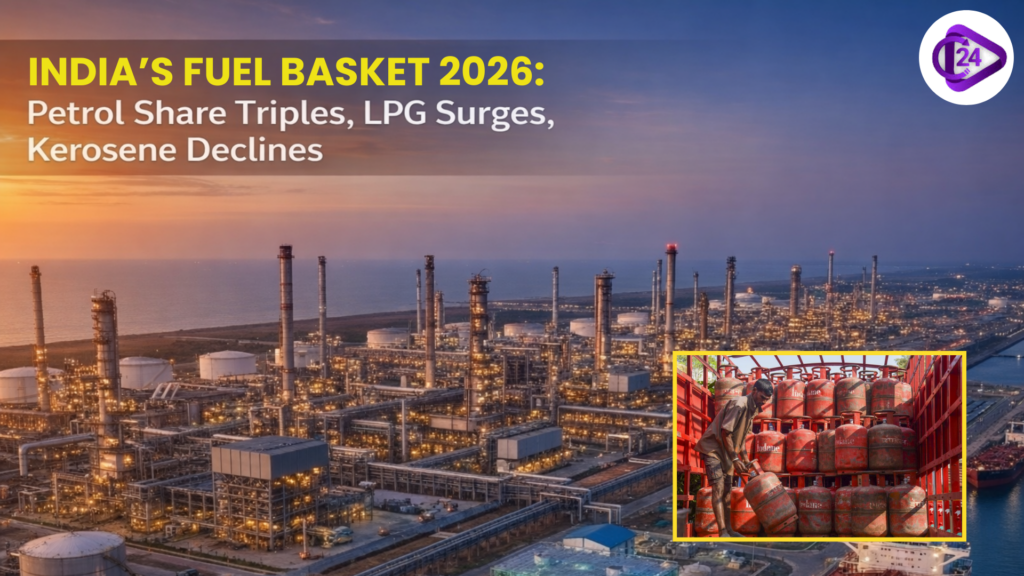
India’s Fuel Basket 2026: Petrol Share Triples, LPG Surges, Kerosene Declines

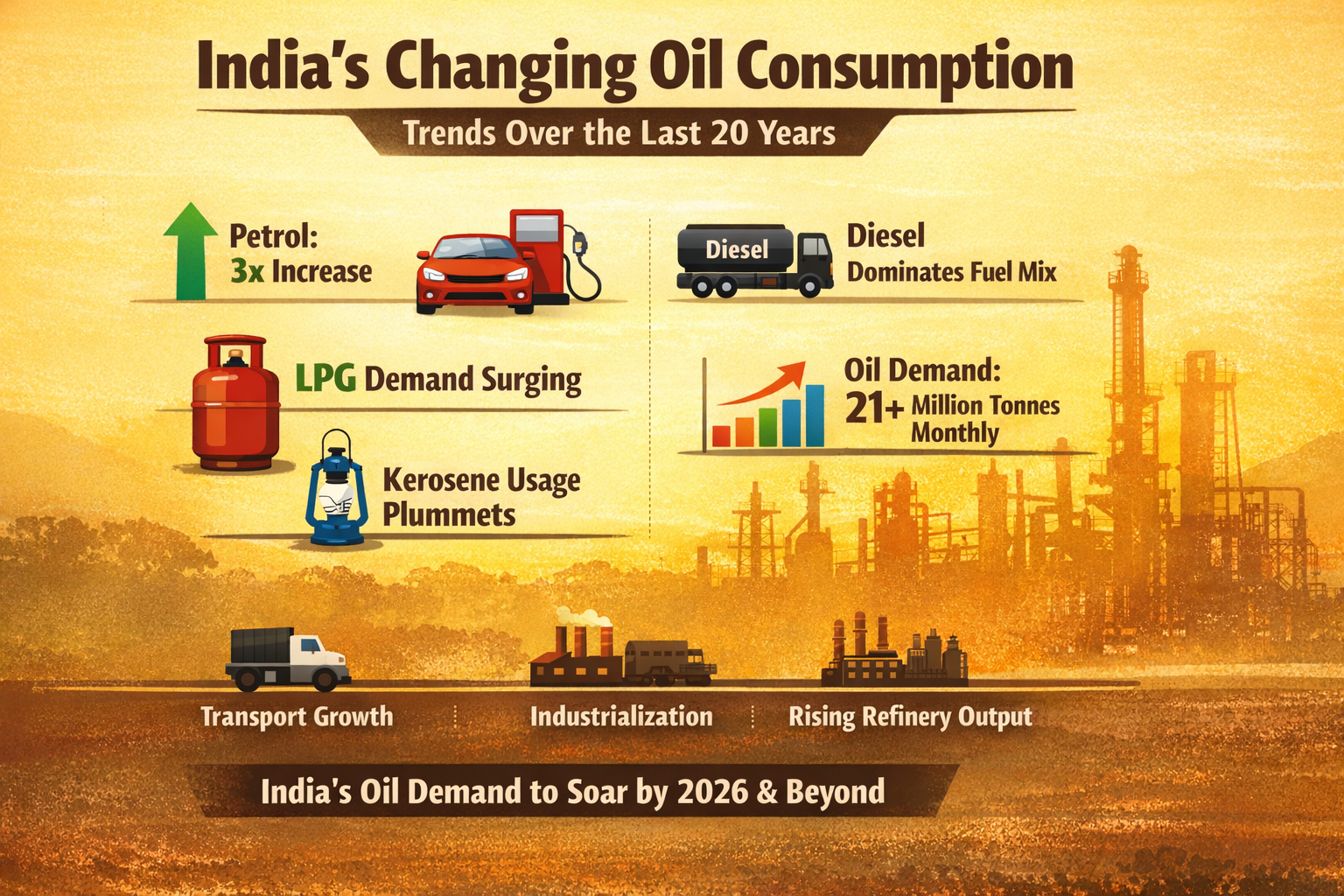
The consumption of petroleum in India has changed dramatically, as per numbers given by the Petroleum Planning and Analysis Cell (PPAC). In the last 20 years, the proportion of petrol in the fuel basket of the country has almost tripled, and today, the country consumes about 18 percent of oil consumption as a result of increased individual mobility and uptake of petrol engine products. Another fuel that has gone on a rampage is Liquefied Petroleum Gas (LPG) as a domestic and industrial fuel, whereas the demand for kerosene has plummeted to insignificant levels due to the transition to cleaner fuels, as well as LPG infiltration. Such changes highlight a greater change in the energy mix in India.

India Oil Demand Growth 2026: Key Highlights from Latest Data

  • The total oil consumption in India is still increasing, which is the manifestation of increasing economic activity and demand for transport fuels. As per the data by PPAC, the fuel consumption has been at an all-time high, with the total consumption of oil and petroleum products in India standing at more than 21 million metric tonnes in the last few months.

  • The demand for petrol has been increasing tremendously due to the growth in passenger vehicle usage and urban mobility, and the consumption is increasing year-by-year.

  • The diesel takes up the majority of the fuel mix in India because it is important in freight, agricultural, and industrial applications, but the percentage is rising in petrol.

  • The consumption of LPG is still on an upward trend, which is sustained by the clean cooking programmes and the transition of household energy to LPG, and the demand for this substance increases year by year.

  • The demand for kerosene has dropped considerably in the last 10 years as its place is taken up by other cleaner fuels, and the study has seen the fuel occupying very low proportions in the total fuel basket.

  • Energy agencies such as OPEC have projected that oil demand in India will keep rising at a faster rate than most of the leading economies, and the demand will reach high levels in 2026 and beyond.

  • Increasing demands are being caused by transport, industrialisation, infrastructure development, and increasing refinery throughputs to satisfy domestic and export demand.

Latest PYQs on Petrol, LPG & Kerosene

Exam Year Question (with Options) Answer
UPSC CSE Prelims 2012 Consider the following fuels: 1. LPG 2. Kerosene 3. Hydrogen. Which of the above are used as rocket fuel? (A) 1 only (B) 2 and 3 only (C) 3 only (D) 1, 2, and 3 (B)
SSC CGL 2018 LPG mainly consists of: (A) Methane & Ethane (B) Propane & Butane (C) Pentane & Hexane (D) Ethylene & Acetylene (B)
SSC CHSL 2017 Kerosene is obtained by: (A) Destructive distillation of coal (B) Fractional distillation of petroleum (C) Cracking (D) Polymerisation (B)
SSC MTS 2022 The foul smell in LPG is due to the addition of: (A) Methanol (B) Ethanol (C) Ethyl mercaptan (D) Acetone (C)
RRB NTPC 2019 Petrol is mainly a mixture of: (A) Alkanes (B) Alkenes (C) Alkynes (D) Alcohol (A)
RRB Group D 2020 LPG is stored in cylinders in: (A) Gaseous form (B) Solid form (C) Liquid form under pressure (D) Plasma state (C)
RRB ALP 2018 Octane number is associated with: (A) Diesel (B) Petrol (C) Kerosene (D) LPG (B)
SSC CPO 2019 The main constituent of LPG is: (A) Methane (B) Butane (C) Ethane (D) Acetylene (B)
UPSC CDS 2015 Kerosene belongs to which fraction of crude oil? (A) Light fraction (B) Middle fraction (C) Heavy fraction (D) Residue (B)
RRB NTPC 2021 Petrol has higher volatility because it contains: (A) Long-chain hydrocarbons (B) Short-chain hydrocarbons (C) Aromatics only (D) Alcohols (B)

Conclusion 

India will have a fuel basket that indicates a shift towards changing patterns of consumption. The growing mobility and uptake of cleaner cooking and the sharp drop in kerosene use point to growing demand for and a trend of petrol and LPG, and the energy transition. The changing blend highlights the importance of economic growth, urbanisation, and a slow transition of India towards more efficient and modern use of fuel.

Frequently Asked Questions (FAQs)

The current affairs cover recent national and international events related to UPSC, SSC, Banking, Railways, and State PCS.

You need to read about the current affairs daily, and revise them every week and every month to keep them longer in your memory.

Yes, Class24 provides free downloadable Daily Current Affairs PDFs for easy revision.

Yes, you can practice MCQs and quizzes to boost your exam preparation.

Absolutely. The content is written in simple, easy-to-understand bilingual language suitable for beginners.

Go to class24.com and click on the current affairs section directly, where you find everything that you need.

ssc-toppers

Start Learning Today with Class24

Related current affairs

Class24 offers free video lectures for smart preparation, covering CGL, CPO, CHSL, MTS, and GD exams. Learn from expert faculty, revise concepts easily, practice with PYQs, and improve speed and accuracy through high-quality, exam-focused video lessons anytime, anywhere.

Get success in your hand. Start study anytime anywhere.

The journey becomes simple and enjoyable when you start taking interest in it. And through our app “Class24”, we will be your trusted partners in developing that interest.

Daily Quizzes
Mock Tests
Ongoing

No ongoing tests right now.