
Day: February 9, 2026

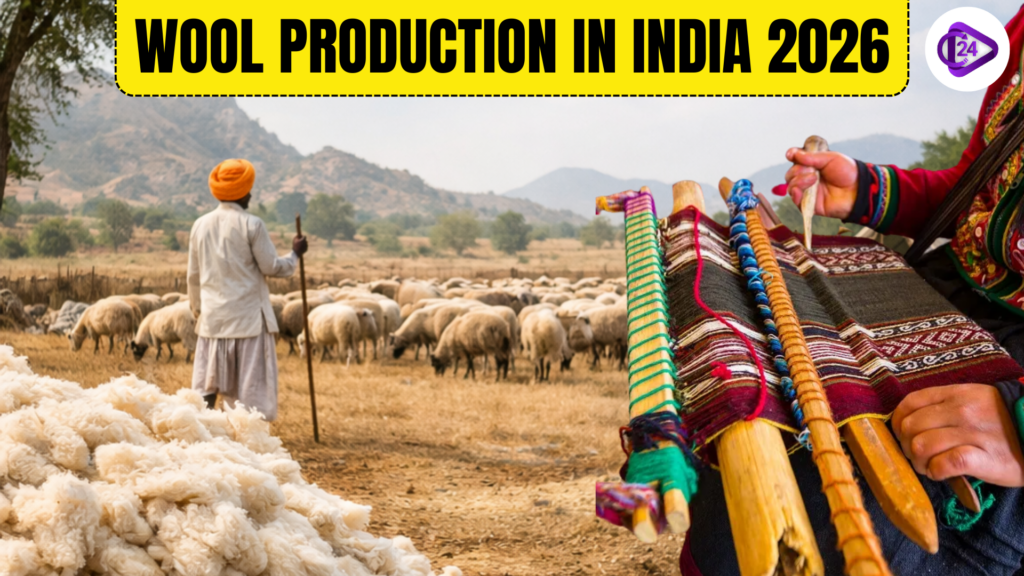
Wool production in India

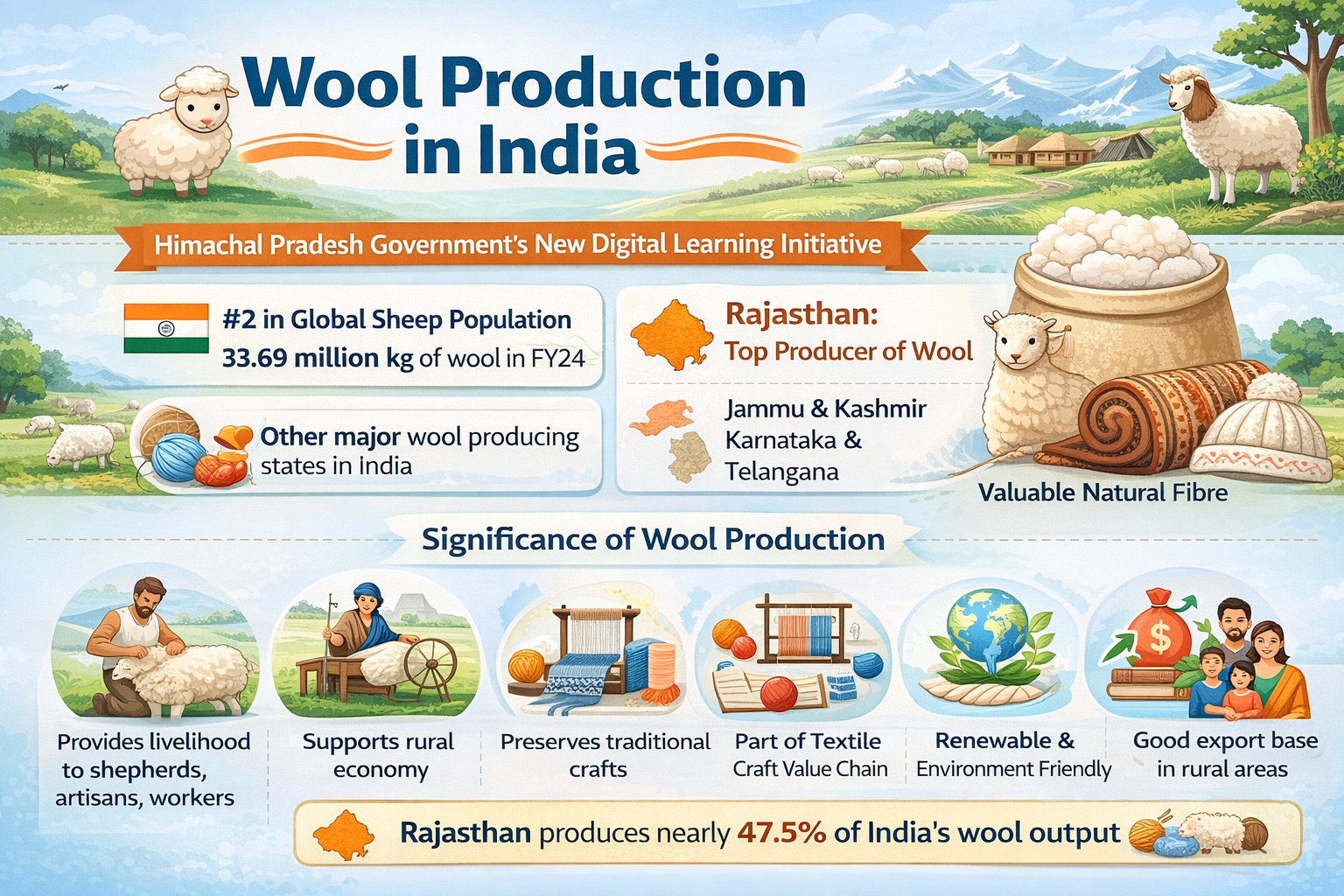
India is another major wool producer, which is a natural fibre used in winter clothing, carpets and industrial products. India is ranked as the second-largest sheep nation in the world and is one of the greatest wool-producing countries, producing approximately 33.69 million kg of wool in FY24. The wool and woollen industry is an industry that helps the rural population to survive and provides both organised and unorganised industries. The major wool-producing state is Rajasthan, which produces almost 47.5 percent of the total output of the country. Next comes Jammu & Kashmir and other states include Karnataka and Telangana. This notwithstanding, most of the time the domestic demand exceeds the production, necessitating imported finer wool.

Significance of wool production

  • Wool is a valuable natural fibre that finds application in winter wear, carpets, floor blankets, rugs and industrial fabrics.

  • India is also one of the countries with a high number of sheep in the world and hence wool production is a major component of the livestock industry in India.

  • The wool industry offers livelihood and employment to millions of people, particularly the shepherds, weavers, artisans and the workers in rural and semi-urban regions.

  • The production of wool helps the rural economy as it providesa stable income to the small and marginal farmers.

  • It contributes significantly to the conservation of traditional crafts such as carpet weaving, shawl making and handloom industries.

  • The industry is a part of the value chain in the textile sector, which aids in shearing, sorting, spinning, weaving, dyeing, and finishing.

  • Wool is renewable and biodegradable, thus making it an environmentally friendly fibre which is in line with the sustainable development objectives.

  • India has a good export base in the markets of woollen products, which have added to its export earnings.

  • The quality and productivity of wool is improved by the development of improved sheep breeds and modern processing.

  • Wool production will also contribute to decreasing migration, as there will be employment opportunities created in rural areas.

Highest Wool-Producing State in 2026

In 2026, Rajasthan is the largest wool-producing state in India, which sends the highest percentage of national wool production, as it is the state with a huge sheep population and its healthy climatic conditions.
Conclusion 

The production of wool in India is important to sustain the livelihood of the rural population, the livestock industry and the textile industry. The large sheep population, agro-climatic conditions that are varied, have ensured that India can develop high levels of wool production in terms of quality and quantity. The industry has the ability to create jobs, conserve traditional art, and conserve the utilisation of the natural resources. Nevertheless, there are still such problems as low productivity, poor quality of wool, and its reliance on the imports of fine wool. Wool production has the potential of enhancing competition with improved breeding methods, improved infrastructure and policy support, such that it can serve the rural Indian economy and textile development better.
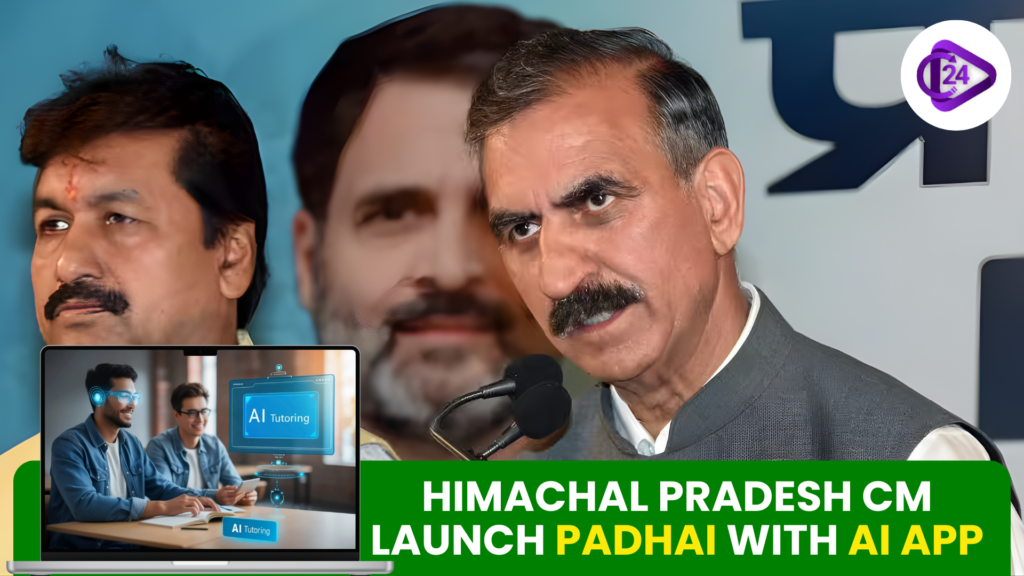
Himachal Pradesh CM launches ‘Padhai with AI’ app

The Padhai with AI (padhai) is an artificial intelligence digital learning platform formally introduced as the Padhai with AI by Himachal Pradesh Chief Minister Sukhvinder Singh Sukhu in Bilaspur district as a way of improving the education of students who are taking competitive exams. The project combines the latest AI technologies to offer on-demand academic counselling and equal learning chances to make the learning process entirely digital. When the platform was launched, the Chief Minister focused on the fact that education is a potent tool to enhance social development and that the new move will reinforce the education system of the state with technology and better resources to serve students.

What is padhai with the AI app and its benefits

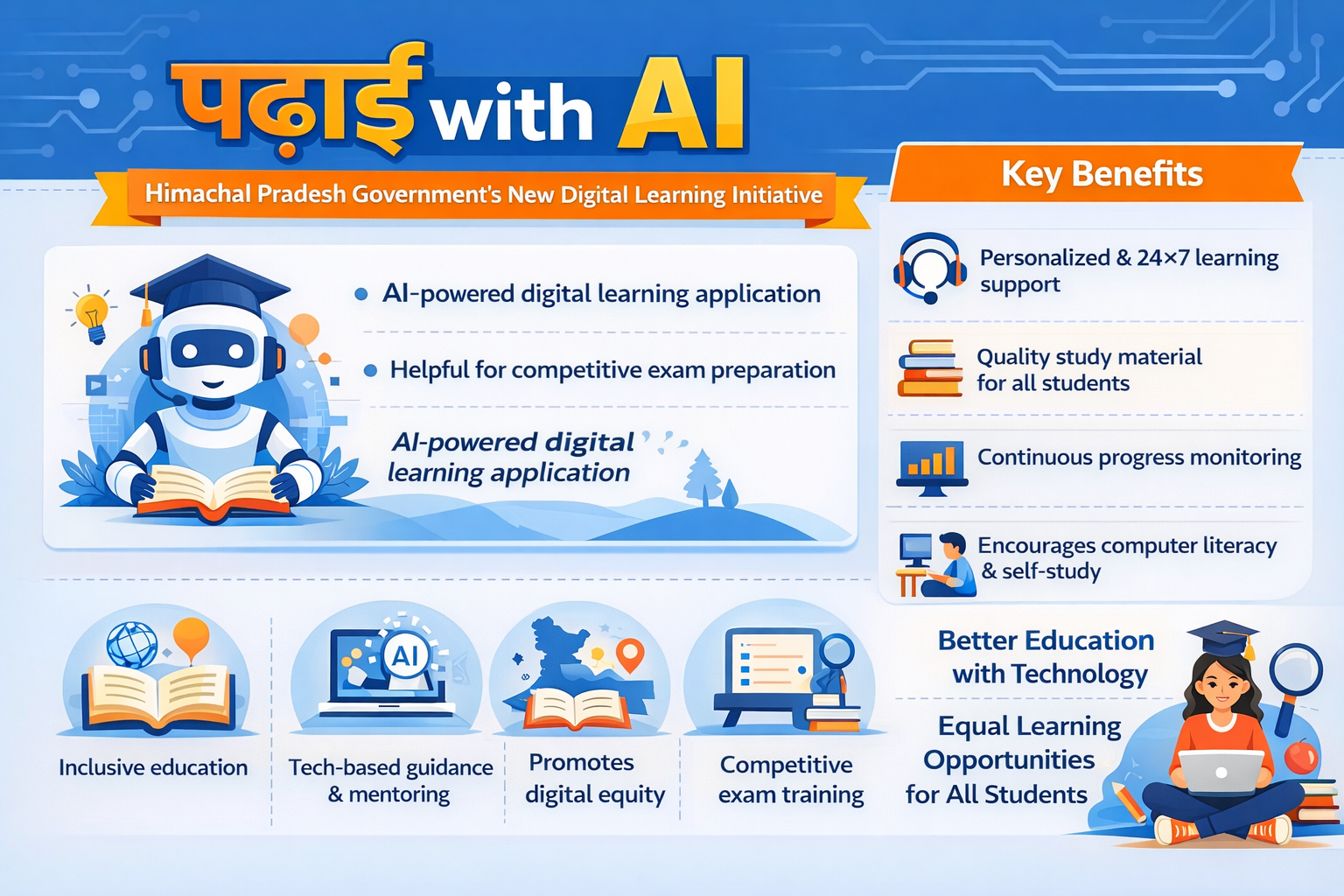
Padhain with AI is an artificial intelligence ran digital learning application initiated by the Himachal Pradesh government.

The application is dedicated to assisting students who study to pass competitive exams, particularly in state universities.

It offers a completely digital learning system that combines modern technology and learning.

The project is aimed at providing ongoing academic advising and counselling to students.

It is created to provide equal access to quality education, regardless of the place of the students and their origins.

The application applies AI to help students learn the subjects more efficiently and monitor their progress.

Benefits of the  Padhai with AI  App

  • Provides individual learning, which gives students the opportunity to learn at their own pace.

  • Offers twenty-four-hour educational support and enhances the continuity of learning.

  • Improves the training of competitive and entrance exams using systematic online materials.

  • Helps minimize educational inequalities by providing quality learning materials to every student.

  • Promotes self-education and computer literacy in students.

  • Helps teachers by supplementing the classroom instruction with technology-enhanced products.

  • Favours innovativeness in education and complies with the government's vision of digital and inclusive education.

  • Enhances the education system in general by introducing artificial intelligence to learning.

Conclusion

Padhai with AI app is a significant move towards changing the face of education in Himachal Pradesh by using technology. The project will combine the use of artificial intelligence and learning to make education more accessible, personalised, and effective for students, particularly those training to take competitive exams. The application facilitates the ongoing academic support, encourages self-directed learning and eliminates the educational disparities between urban and rural zones. It also promotes digital literacy and learning cultures among the students and teachers. Altogether, Padhai with AI is an expression of the desire by the government to be innovative, inclusive, and empower the education system so that learners are future-ready.

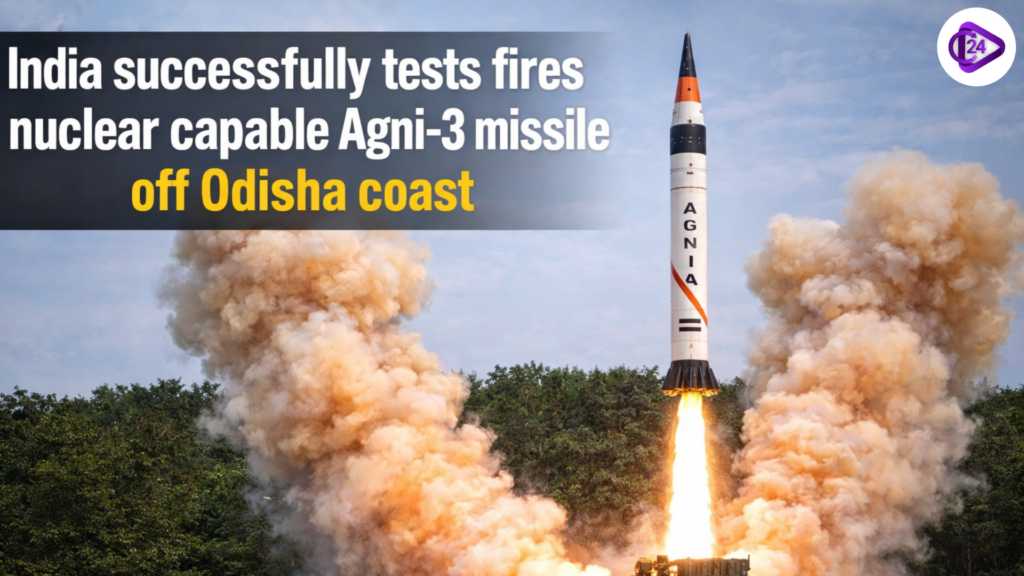
India Successfully Tests Fires Nuclear-Capable Agni-3 Missile off Odisha Coast

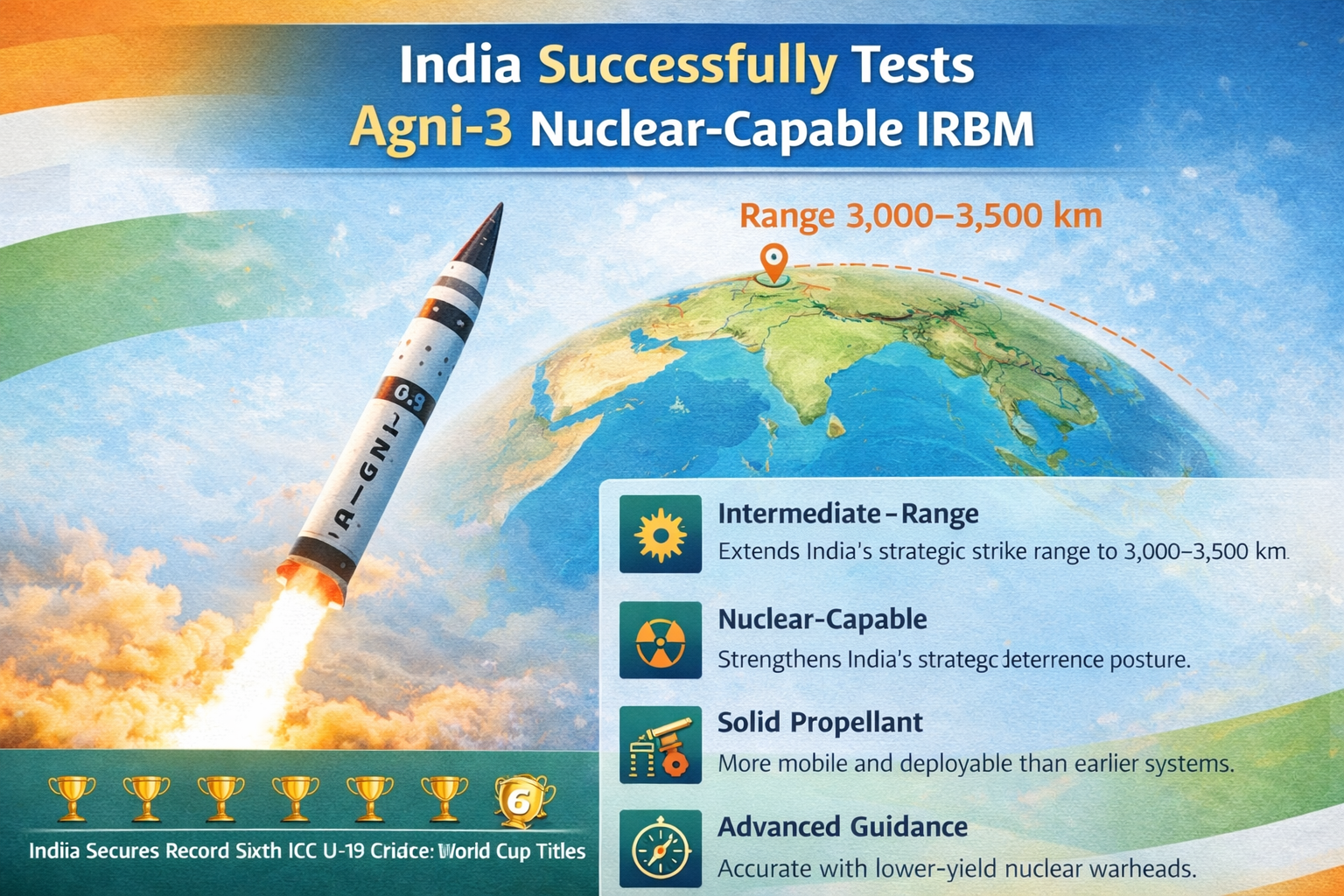
In an official statement, defence officials confirmed that India managed to test-launch its nuclear-capable Agni-3 intermediate-range ballistic missile from the Integrated Test Range at Chandipur in Odisha. The launch on February 6 confirmed all the operational and technical parameters under the control of the Strategic Forces Command that regulates the strategic missile arsenal of the country. The two-stage, solid-fuelled missile used in the announcement has taken a planned path and shows reliability and preparedness, according to the announcement of the press release as part of India's credible minimum deterrence posture. The successful test underscores the continued emphasis on building strategic deterrence and operational readiness.

Significance of Agni-3 Missile

  • It extends India’s strategic strike range to about 3,000–3,500 km, covering deep-lying targets in potential adversary territories.

  • Agni-3 is a nuclear-capable, intermediate-range ballistic missile that strengthens India’s strategic deterrence posture.

  • The successful validations of operational and technical parameters demonstrate the missile’s readiness and reliability.

  • Its range places critical strategic locations within reach, reinforcing credible minimum deterrence.

  • Featuring solid propellant and advanced guidance systems, Agni-3 is more mobile and deployable than earlier systems.

  • The missile enhances India’s second-strike capability by being road and rail-mobile, improving survivability.

  • Integration under the Strategic Forces Command ensures it is part of the country’s structured nuclear command and control.

  • Its deployment helps balance regional security dynamics, especially with nuclear-armed neighbours.

  • Agni-3’s accuracy increases its effectiveness with lower-yield warheads, allowing efficient deterrence.

  • It forms a crucial link between shorter-range systems like Agni-2 and longer-range platforms such as Agni-5 in India’s strategic arsenal.

Recently Asked PYQs: Agni Missile

Exam Year Question (MCQ) Options Correct Answer
UPSC Prelims (GS-I) 2013 Which of the following is a surface-to-surface ballistic missile developed by India? (A) Akash (B) Trishul (C) Agni-I (D) Nag (C) Agni-I
CDS (I) 2018 Agni-II missile is classified as which type of missile? (A) Short-range ballistic (B) Medium-range ballistic (C) Cruise missile (D) Anti-aircraft missile (B) Medium-range ballistic
NDA & NA 2020 The Agni-I missile uses which type of fuel? (A) Liquid (B) Cryogenic (C) Solid (D) Hybrid (C) Solid
UPSC CAPF (AC) 2022 Consider the following missiles: Agni-I, BrahMos, and Dhanush. Which of the above are ballistic missiles? (A) 1 only (B) 1 and 3 only (C) 2 and 3 only (D) 1, 2 and 3 (B) 1 and 3 only
SSC CGL 2019 The Agni-II missile has been developed by which organisation? (A) ISRO (B) HAL (C) DRDO (D) BARC (C) DRDO
SSC GD 2021 Which Agni missile has a longer range? (A) Agni-I (B) Agni-II (C) Same range (D) Depends on payload (B) Agni-II
State PSC (BPSC) 2019 Agni-II missile was first successfully tested in which year? (A) 1995 (B) 1997 (C) 1999 (D) 2001 (C) 1999
Air Force Group-X 2022 Agni-I belongs to which category of missiles? (A) Air-to-air (B) Surface-to-surface ballistic (C) Cruise missile (D) Anti-tank (B) Surface-to-surface ballistic

Conclusion (India Successfully Tests Agni-3 Missile)

Agni-3 recently is an indication that its local defence technology has matured and its reliability is not doubtful. The launch, which was conducted in accordance with well-established work rules and protocols, indicates reaffirming of a credible minimum deterrence stance by India and is likely to have been an expression of continued attention to the expansion of strategic preparedness and national security potential.

India Creates History, Wins Record Sixth ICC U-19 Cricket World Cup Title

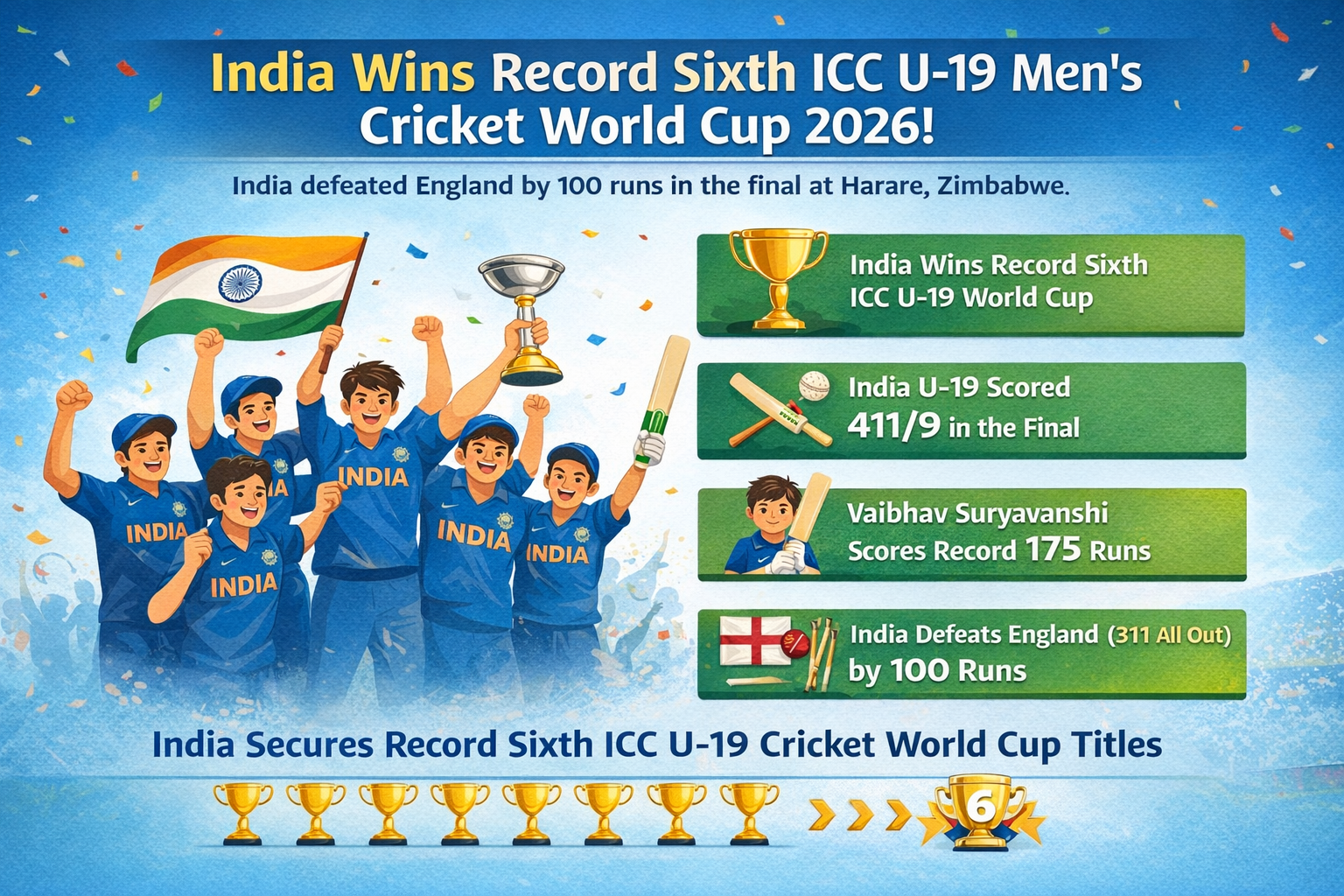
India has won the ICC Under-19 Men’s Cricket World Cup 2026 five times, but a record sixth time, beating England by a massive 100-run margin in the final at Harare in Zimbabwe. The India U-19 team had scored an overwhelming 411/9 with a phenomenal innings of 175 made by the teenager Vaibhav Suryavanshi, the highest individual score in a U-19 World Cup final, before overthrowing England with 311. This win leads India to become the dominant force in the age-group cricket, even though they are the most successful nation in the history of the tournament. The Board of Control for Cricket in India was also full of congratulations on their undefeated victories and for making history.

Highlights of ICC U-19 Cricket World Cup

  • India secured its sixth world medal in the Under-19 Men’s Cricket World Cup, sweeping England by 100 runs to win the match that was played at Harare.

  • India had an immense total of 411/9 in the final, one of the highest team aggregates in the history of the U-19 World Cup.

  • Highlights: Suryavanshi Vaibhav was in an extremely productive mood, with the highest individual score of 175 runs in an Under-19 World Cup final.

  • He made a blistering century in his innings and was the cornerstone of the overpowering India.

  • England bowled out at 311, this being very far below the target.

  • India had not been defeated during the tournament as a sign of the uniformity and richness of the squad.

  • Stable performance with good performances by both the batters and bowlers was also demonstrated by the Indian team.

  • India won their semifinal by a convincing margin, and this saw them earn a place in the final.

  • The tournament consisted of 16 teams as it took place in group stages, Super Six and knockout.

  • The presence of several young players in teams who impressed outlined how the event has helped in making future international stars.

Winner and Awards Name in the ICC U-19 Cricket World Cup

Award Category Winner / Details
Champions India U-19
Runners-up England U-19
Player of the Tournament Vaibhav Suryavanshi (India)
Player of the Final Vaibhav Suryavanshi (India)
Top Run-Scorer (Most Runs) Ben Mayes (England)
Top Wicket-Taker (Most Wickets) Manny Lumsden (England)

Conclusion (India, Wins Record Sixth ICC U-19 Cricket World Cup)

The victory of India in the sixth ICC Under-19 Cricket World Cup record is an epitome of its unrivalled strength in youth cricket. The win is an indication of a well-established development structure, well-organised performances and a predictable stream of up-and-coming stars who are destined to make their mark in the international arena.

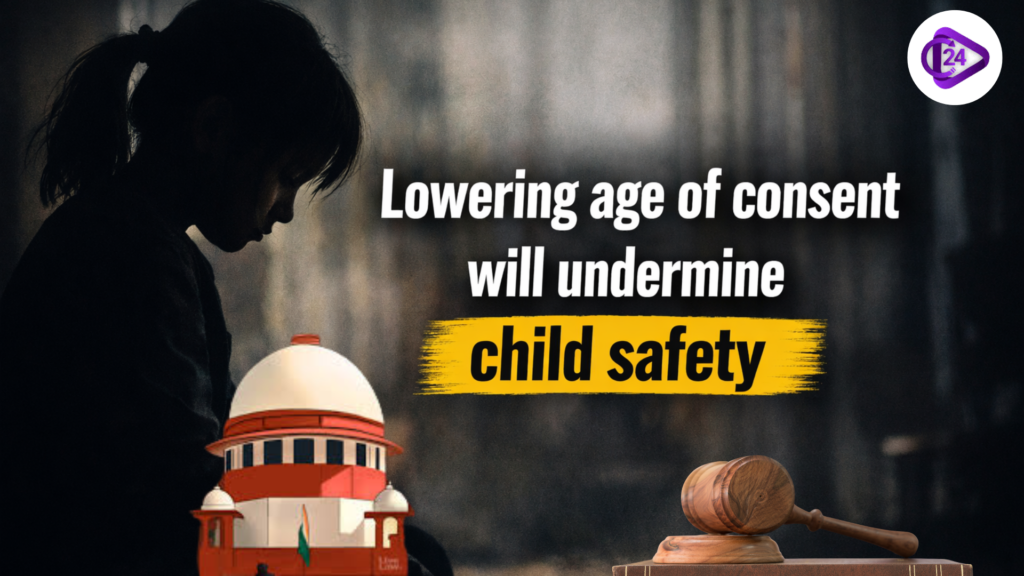
Lowering the Age of Consent Will Undermine Child Safety

The Government of India has made it clear in Parliament that any lowering of the age of consent below 18 years under the Protection of Children from Sexual Offences Act, 2012, may undermine its child protection systems. Officials said that lowering the legal age or adding exemptions would compromise child safety, increase chances of exploitation and lessen legal protection to prevent abuse and manipulation of minors, especially teenage girls. This perception was raised as a reaction to proposals including a so-called Romeo-and-Juliet clause, and the government emphasised that even weakening the consent laws could erode its resolve to protect children against sexual offences.

What are the Objects of Low Age Consent?

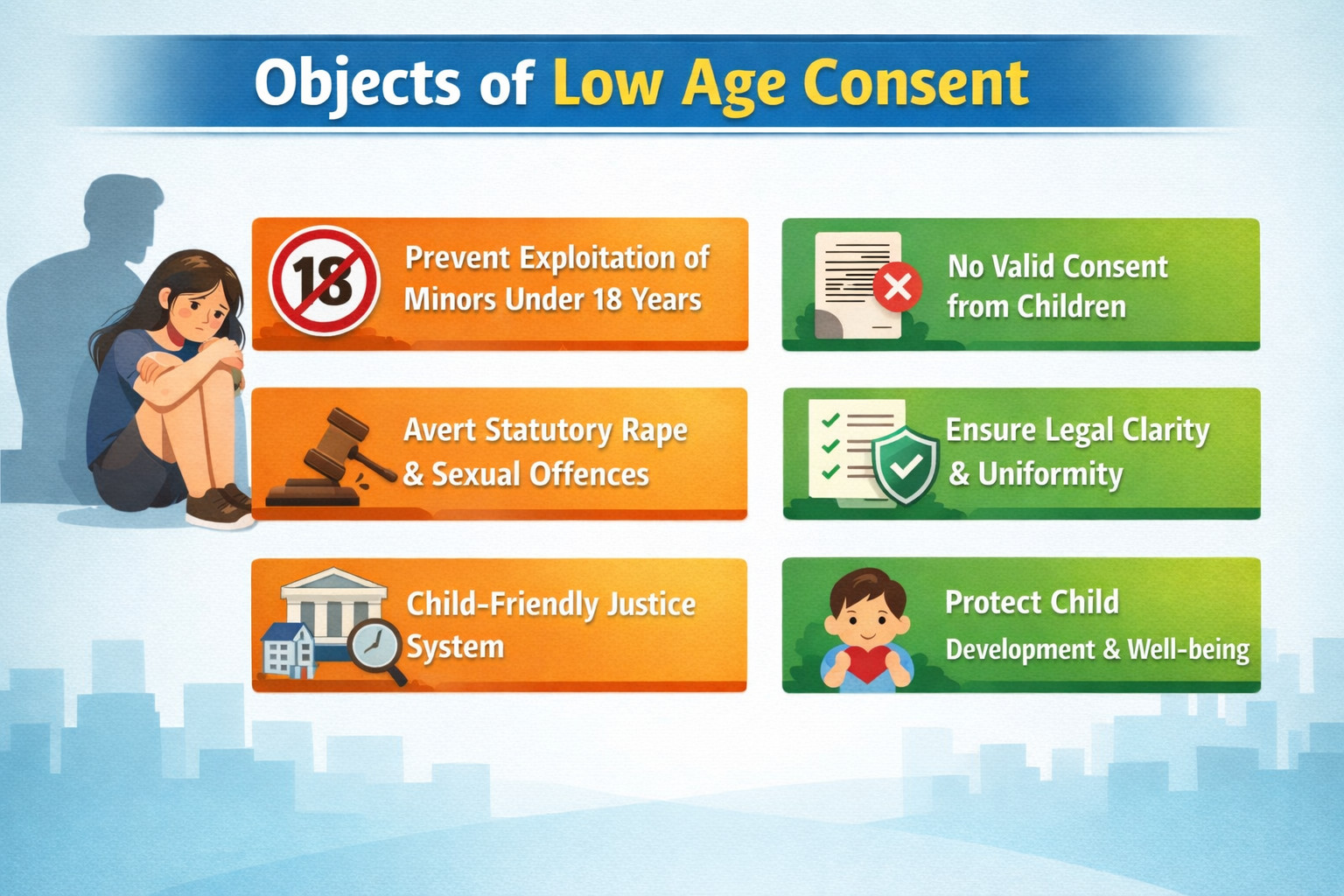
  • The age of consent has been stipulated to prevent the sexual abuse and exploitation of minors under 18 years, due to which their ability to consent to sexual activity should not be regarded as valid in the law.

  • According to the child protection law, anyone under the age of 18 is considered a child, and any consent made by a minor is not a legal contract.

  • The purpose of the provision is to avert statutory rape and other forms of sexual offences against children.

  • A concrete age of consent will lead to a legal norm that will avoid uncertainty and enforce uniformity.

  • It promotes a child-friendly justice that is protection-based, reporting, investigative and fast-trial aimed.

  • The law aims at protecting the physical, emotional and psychological growth of children.

  • The arguments put forward by the authorities to fight against lowering the age of consent have been that it will dilute the law that protects against exploitation.

Previous Year Questions on Child Marriage

Exam Year Question (MCQ) Options Correct Answer
UPSC Prelims 2014 Under the Prohibition of Child Marriage Act, 2006, a girl is considered a child if she is below the age of: (A) 16 years (B) 17 years (C) 18 years (D) 21 years (C) 18 years
UPSC Prelims 2020 The Prohibition of Child Marriage Act, 2006, replaced which earlier law? (A) Hindu Marriage Act (B) Dowry Prohibition Act (C) Child Marriage Restraint Act, 1929 (D) Indian Penal Code (C) Child Marriage Restraint Act, 1929
CDS 2019 The Child Marriage Restraint Act, 1929, is also known as: (A) Sharda Act (B) Sarda Act (C) Nehru Act (D) Malaviya Act (B) Sarda Act
NDA 2021 Which act prohibits child marriage in India? (A) Indian Penal Code (B) POCSO Act (C) Prohibition of Child Marriage Act, 2006 (D) Juvenile Justice Act (C) Prohibition of Child Marriage Act, 2006
SSC CGL 2018 Under the Prohibition of Child Marriage Act, 2006, a child marriage is: (A) Fully valid (B) Automatically void (C) Voidable at the option of the minor (D) A civil offence only (C) Voidable at the option of the minor
SSC GD 2020 Who can file a complaint to prevent or report a child marriage? (A) Only the victim (B) Parents only (C) Any person or organisation (D) Only the police (C) Any person or organisation
State PSC (UPPSC) 2016 Who is appointed at the district level to prevent child marriages? (A) Sub-Divisional Magistrate (B) Child Welfare Officer (C) Child Marriage Prohibition Officer (D) District Judge (C) Child Marriage Prohibition Officer

Conclusion 

By reducing the age of consent, the law would be undermined to teach children to protect against exploitation and abuse. Current legislation accepts the vulnerability of the minors and strives to provide safeguards and well-being. Any watering down of this will put at risk the normalisation of unequal power relations and the eradication of hard-acquired protection of children.

Frequently Asked Questions (FAQs)

The current affairs cover recent national and international events related to UPSC, SSC, Banking, Railways, and State PCS.

You need to read about the current affairs daily, and revise them every week and every month to keep them longer in your memory.

Yes, Class24 provides free downloadable Daily Current Affairs PDFs for easy revision.

Yes, you can practice MCQs and quizzes to boost your exam preparation.

Absolutely. The content is written in simple, easy-to-understand bilingual language suitable for beginners.

Go to class24.com and click on the current affairs section directly, where you find everything that you need.

ssc-toppers

Start Learning Today with Class24

Related current affairs

Class24 offers free video lectures for smart preparation, covering CGL, CPO, CHSL, MTS, and GD exams. Learn from expert faculty, revise concepts easily, practice with PYQs, and improve speed and accuracy through high-quality, exam-focused video lessons anytime, anywhere.

Get success in your hand. Start study anytime anywhere.

The journey becomes simple and enjoyable when you start taking interest in it. And through our app “Class24”, we will be your trusted partners in developing that interest.

Daily Quizzes
Mock Tests
Ongoing

No ongoing tests right now.