
Daily Quizzes
Mock Tests
No tests attempted yet.
Select Category
SSC important notice regarding schedule of exams

Enquire Now
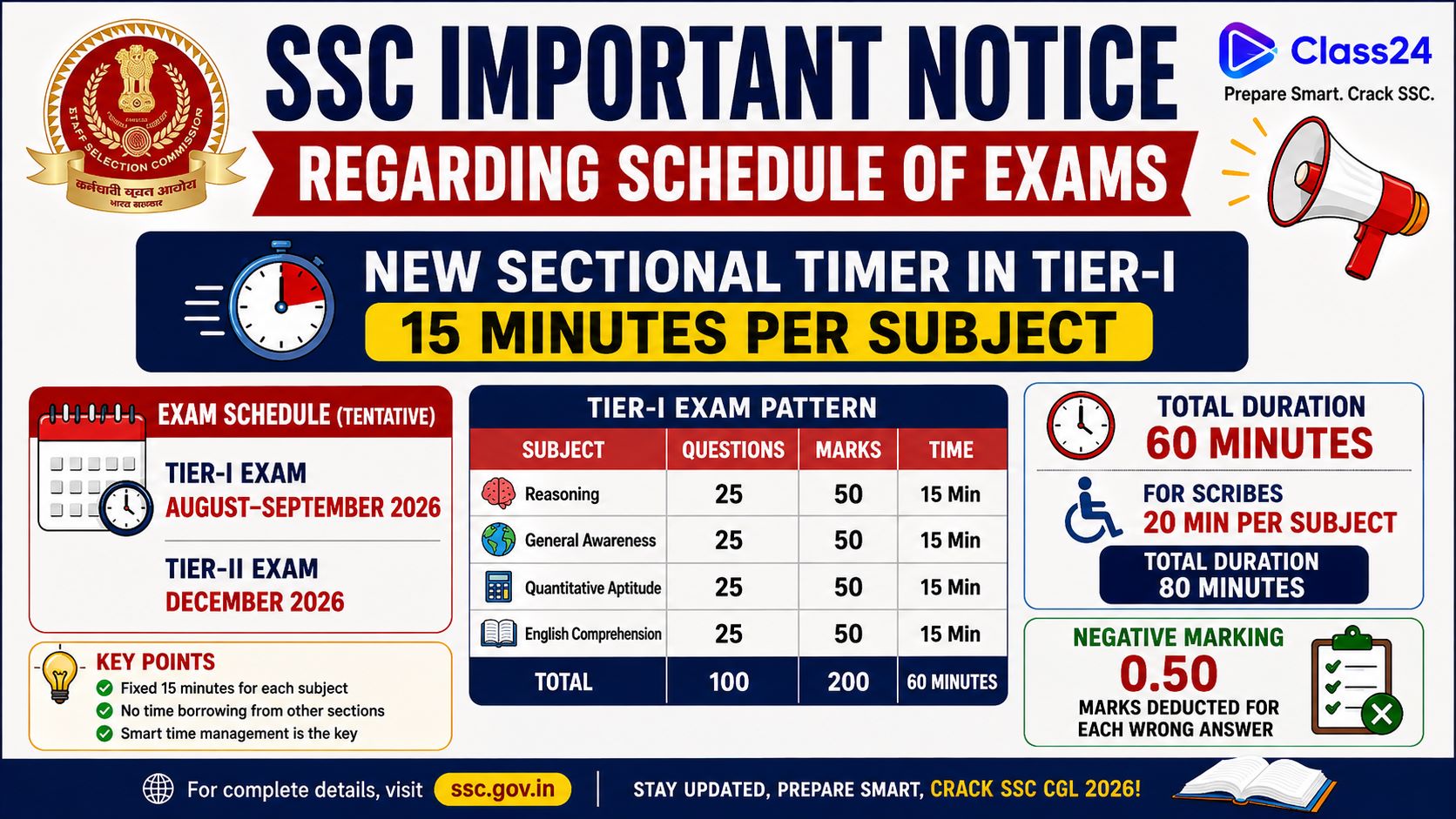
The Staff Selection Commission (SSC) has made an important change in the SSC CGL 2026 exam pattern. This year, candidates appearing for the Tier-I exam will have to attempt each subject within a fixed time limit. SSC has introduced a 15-minute sectional timer for each subject, which means candidates will no longer be able to freely divide the total 60 minutes between different sections.
This change can have a direct impact on how candidates attempt the paper. Those who usually save time in English or General Awareness and use it for Maths will now need to change their approach. Practising each subject within its allotted time will therefore be an important part of SSC CGL 2026 preparation.
SSC Important Notice Regarding Schedule of Exams 2026
SSC conducts the Combined Graduate Level Examination for recruitment to various Group B and Group C posts available in different ministries, departments and organisations of the Government of India.
For SSC CGL 2026, the Computer Based Examination will be held in two stages – Tier-I and Tier-II. According to the schedule mentioned in the notification, Tier-I is tentatively planned for August-September 2026, while Tier-II is expected to be conducted in December 2026.
Candidates should keep in mind that these dates are tentative. SSC has stated that if there is any change in the examination schedule, the information will be communicated through the Commission's website.
| Particulars | Details |
|---|---|
| Exam Name | SSC CGL 2026 |
| Conducting Body | Staff Selection Commission |
| Exam Mode | Computer Based Examination |
| Stages | Tier-I and Tier-II |
| Tier-I Schedule | August-September 2026 |
| Tier-II Schedule | December 2026 |
| Tier-I Questions | 100 |
| Maximum Marks | 200 |
| Exam Duration | 60 Minutes |
| Sectional Timing | 15 Minutes per Subject |
| Official Website | ssc.gov.in |
New Sectional Timer in SSC CGL 2026
One of the most important changes in the SSC CGL 2026 Tier-I exam is the introduction of sectional timing.
Tier-I has four subjects – General Intelligence and Reasoning, General Awareness, Quantitative Aptitude and English Comprehension. Candidates get 25 questions from each subject, making it a total of 100 questions for 200 marks.
The total exam time is still one hour, but SSC has divided this time equally among the four subjects. Candidates will get 15 minutes for each subject.
SSC CGL 2026 Section-Wise Timing
| Subject | Questions | Marks | Time |
|---|---|---|---|
| General Intelligence & Reasoning | 25 | 50 | 15 Minutes |
| General Awareness | 25 | 50 | 15 Minutes |
| Quantitative Aptitude | 25 | 50 | 15 Minutes |
| English Comprehension | 25 | 50 | 15 Minutes |
| Total | 100 | 200 | 60 Minutes |
Candidates eligible for a scribe under the conditions mentioned by SSC will get additional time. For such candidates, the sectional timing will be 20 minutes per subject instead of 15 minutes, taking their total exam duration to 1 hour and 20 minutes.
What Changes for Candidates After the Sectional Timer?
The new timer may look like a small change, but it can make a noticeable difference during the actual exam.
Until now, many candidates planned their paper according to their strongest subjects. Someone good at English or General Awareness could complete those sections quickly and use the saved time for lengthy Maths questions.
With fixed sectional timing, candidates will need to perform within the time available for that particular subject. This makes question selection more important.
For example, if a Maths question is taking too long, spending several minutes on it could reduce the number of easier questions you are able to attempt in that section. Candidates will need to learn when to solve a question and when to move ahead.
SSC CGL Tier-I Negative Marking
While working on speed, candidates should not forget about accuracy. SSC CGL Tier-I carries a negative marking of 0.50 marks for every incorrect answer.
The paper will have objective-type multiple-choice questions. Questions will be available in Hindi and English, except for the English Comprehension section.
Because both time and negative marking are involved, attempting more questions without checking accuracy may not always improve the score. Candidates should focus on questions they can solve confidently rather than making unnecessary guesses.
How Should Candidates Prepare for the New Timer?
Preparation should now include more section-wise timed practice. Instead of depending only on complete 60-minute mock tests, candidates can practise individual subjects with a 15-minute timer.
For Quantitative Aptitude, improving calculation speed and quickly identifying easy questions can save valuable time. In Reasoning, candidates should avoid spending too long on a single complicated problem.
General Awareness requires a slightly different approach. If you know an answer, attempt it and move ahead. Spending too much time trying to recall an unfamiliar fact may not be useful when only 15 minutes are available.
English preparation should also focus on maintaining both reading speed and accuracy.
Once candidates become comfortable with 15-minute sectional tests, they can move to full-length mocks following the same SSC CGL 2026 pattern.
SSC CGL 2026 Official Notice PDF
Candidates preparing for the examination should read the official SSC CGL 2026 notification carefully. The notification was issued on 21 May 2026 and contains the complete details of the examination, including the exam scheme, sectional timing, syllabus, eligibility, posts and other instructions.
Candidates should also regularly visit the SSC website for updates because the examination schedule mentioned in the notification is tentative.
SSC CGL 2026 Sectional Timer: What Candidates Should Remember
The sectional timer makes balanced preparation across all four subjects more important. Candidates who are comfortable with one or two sections but depend heavily on extra time for another subject may need to rethink their strategy.
The best way to adjust is to start practising under the same time pressure before the actual examination. Set a 15-minute timer, attempt one section and review how many questions you could solve accurately. With regular practice, candidates can identify where they are losing time and gradually improve their attempts.
For SSC CGL 2026, preparation will not be only about knowing the answers. Using those 15 minutes effectively in every section will also matter.
Frequently Asked Questions