

Daily Quizzes
Mock Tests
No tests attempted yet.
Select Category
Optimizing Your Professional Journey: MIM vs. MBA Abroad

Enquire Now
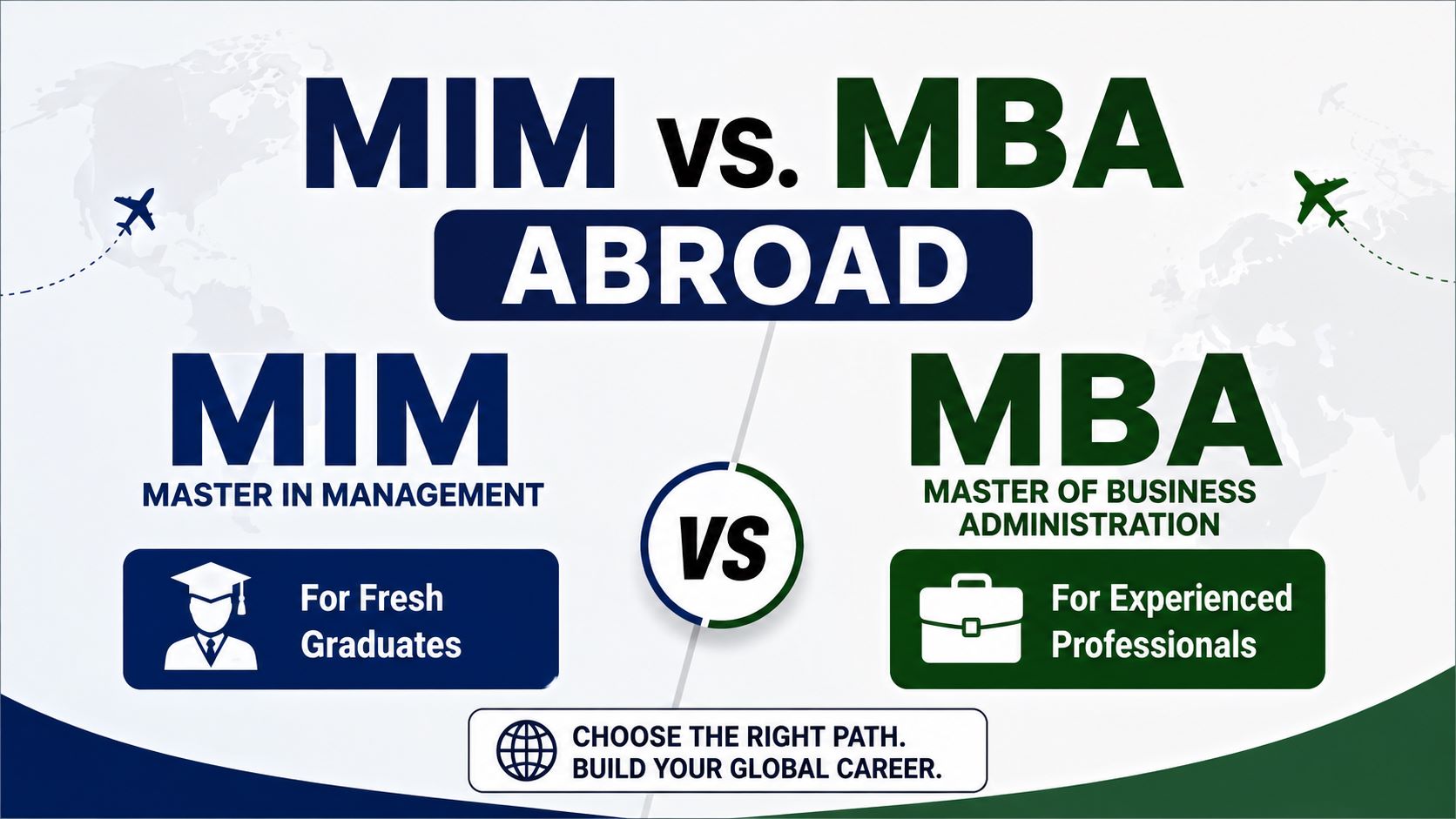
Choosing the right postgraduate degree can shape the direction of your career for years to come. For students and professionals planning to study abroad, two popular management programs often come into consideration: Master in Management (MIM) and Master of Business Administration (MBA).
At first glance, both degrees may seem similar because they focus on business, management, leadership, and career development. However, they are designed for people at different stages of their professional journey. Your work experience, career goals, budget, and preferred specialization can all influence which program is the better choice.
Understanding the difference between MIM vs. MBA abroad can help you make a decision that supports both your immediate career plans and long-term professional growth.
What is a Master in Management (MIM)?
A Master in Management (MIM) is primarily designed for recent graduates and young professionals who want to develop a strong foundation in business and management.
Students entering an MIM program generally have limited professional experience. This makes it an attractive option for graduates from engineering, science, humanities, commerce, or other academic backgrounds who want to begin a career in management.
The curriculum usually covers subjects such as finance, marketing, economics, strategy, operations, organizational behaviour, and entrepreneurship. Many universities also allow students to choose electives or specializations according to their career interests.
One of the biggest advantages of an MIM is that you don't need to wait several years after graduation to pursue a management degree. You can start developing business skills relatively early in your career.
What is an MBA?
A Master of Business Administration (MBA) is generally intended for professionals who already have meaningful work experience and want to move into senior, managerial, leadership, or specialized business roles.
Unlike an MIM, an MBA classroom often includes professionals from different industries and career backgrounds. As a result, learning is not limited to textbooks and lectures. Students also learn from the professional experiences of their classmates through discussions, case studies, projects, and networking.
MBA programs commonly cover areas such as leadership, strategy, finance, marketing, operations, entrepreneurship, and business analytics.
An MBA can be particularly valuable for professionals looking for career advancement, a transition into management, a change of industry, or even an entrepreneurial path.
MIM vs. MBA Abroad: Key Differences
Although both programs teach business and management skills, their target audiences are quite different.
| Factor | MIM | MBA |
|---|---|---|
| Best suited for | Recent graduates and young professionals | Experienced professionals |
| Work experience | Usually little or limited experience | Typically requires meaningful work experience |
| Career stage | Early career | Mid-career |
| Main focus | Management fundamentals | Leadership and advanced management |
| Cost | Generally lower than an MBA | Generally more expensive |
| Career objective | Enter business and management roles | Career advancement or transition |
| Networking | Mostly early-career professionals | Experienced professionals across industries |
These differences mean that neither degree is automatically "better." The right choice depends largely on where you currently stand in your career.
When Should You Choose an MIM Abroad?
An MIM can be a suitable option if you have recently completed your bachelor's degree and want to build management expertise without spending several years gaining work experience first.
For example, an engineering graduate who wants to move into consulting, marketing, finance, or business strategy may consider an MIM to gain formal business knowledge.
It can also appeal to students who want international exposure early in their careers. Studying alongside people from different countries can help develop communication skills, cultural awareness, and a broader understanding of global business.
However, students should carefully examine the employment outcomes of individual programs rather than choosing solely on the basis of the degree name.
When Does an MBA Make More Sense?
An MBA generally makes more sense when you already have professional experience and know what you want from the next stage of your career.
Suppose you have worked for several years in technology but now want to enter product management or business strategy. An MBA could provide the management knowledge, professional network, and recruiting opportunities needed to support that transition.
Similarly, professionals seeking leadership positions or planning to build their own businesses may find an MBA valuable.
Because MBA programs can involve a significant financial investment, you should consider tuition fees, living expenses, scholarships, expected salary outcomes, and the opportunity cost of leaving employment before making a decision.
Career Opportunities After MIM and MBA
MIM graduates commonly explore entry-level and early-career opportunities in consulting, finance, marketing, business development, operations, analytics, and management.
MBA graduates may pursue more experienced positions in consulting, investment banking, technology, product management, corporate strategy, operations, entrepreneurship, and general management.
Career outcomes, however, vary considerably depending on the university, country, previous experience, specialization, job market, and individual skills.
This is why researching employment reports and speaking with alumni can be more useful than relying only on rankings.
MIM or MBA: How to Make the Right Choice?
Start with your current career stage.
If you are a recent graduate with little work experience, an MIM may provide an earlier route into the business world. If you already have several years of professional experience and want to accelerate, redirect, or expand your career, an MBA may be the more appropriate option.
Also think beyond the degree itself. Consider the country where you want to work, post-study work opportunities, program duration, tuition fees, scholarships, alumni network, internships, recruiting companies, and expected return on investment.
Final Thoughts
The MIM vs. MBA abroad decision is ultimately about timing and career direction rather than choosing which degree is more prestigious.
An MIM can help young graduates establish a foundation in management and begin their professional journey, while an MBA can help experienced professionals develop leadership capabilities and pursue the next stage of their careers.
Before applying, define what you want your degree to achieve. Once your career objective is clear, choosing between an MIM and MBA becomes much easier.
Frequently Asked Questions