

Daily Quizzes
Mock Tests
No tests attempted yet.
Select Category
Cognizant introduces generative AI for firms

Enquire Now
Generative AI has quickly become an important area of interest for businesses looking to improve productivity, develop new solutions, and rethink how everyday work gets done. Cognizant entered this space with Cognizant Neuro AI, an enterprise-wide platform designed to help organisations adopt generative AI in a more structured way.
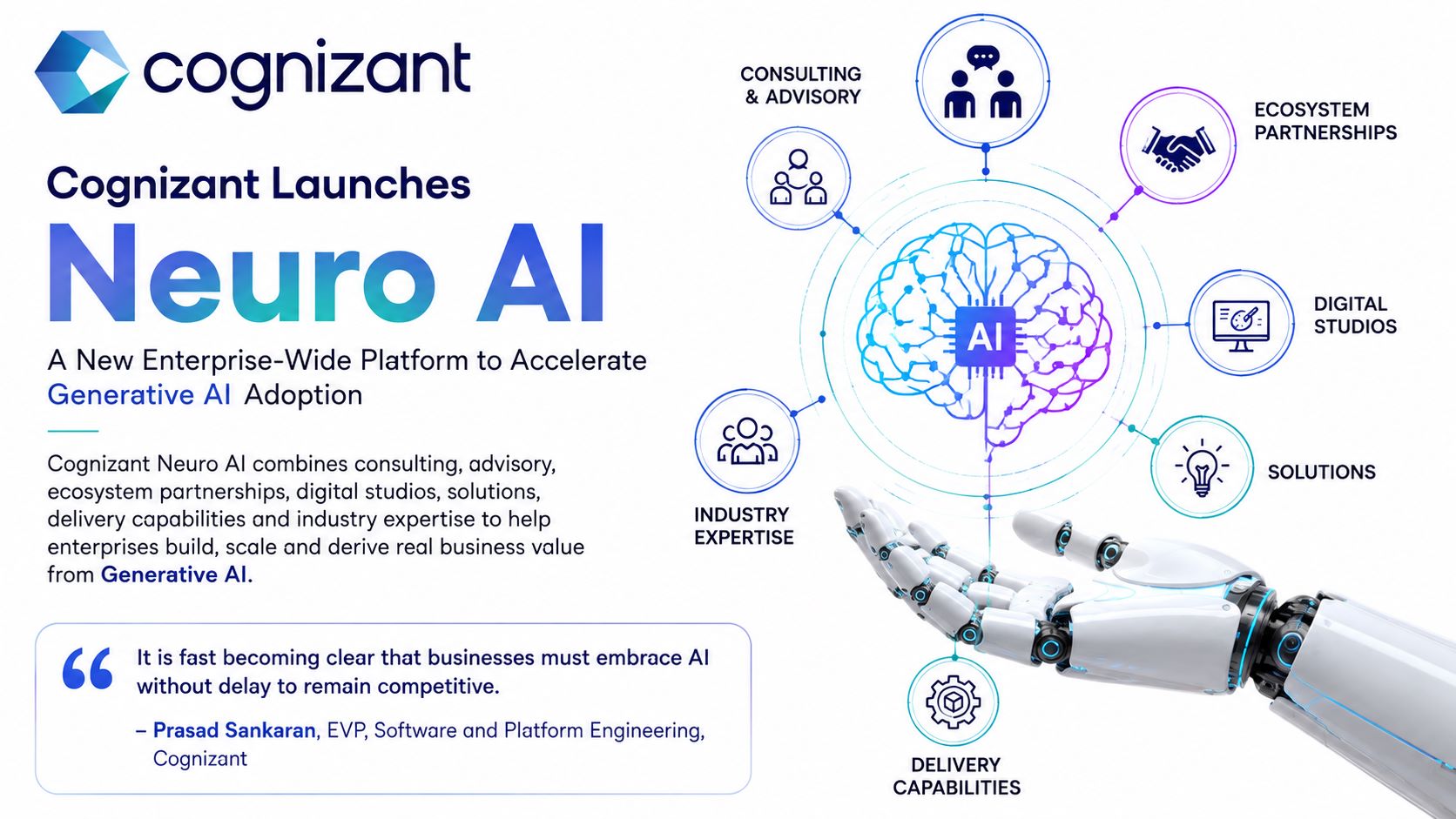
According to the original announcement, Cognizant Neuro AI brings together the company's consulting and advisory capabilities, ecosystem partnerships, digital studios, solutions, delivery capabilities, and industry expertise. The aim is to help enterprises move from simply exploring generative AI to identifying practical business applications.
For companies, however, adopting generative AI is not simply about gaining access to an AI tool. They also need to consider where AI can create value, how it fits into existing operations, and what risks need to be addressed. Cognizant Neuro AI was introduced with these broader enterprise requirements in mind.
What is Cognizant Neuro AI?
Cognizant Neuro AI is an enterprise-focused platform introduced to accelerate the adoption of generative AI technology. It combines Cognizant's technology capabilities with consulting, partnerships, industry knowledge, and delivery expertise.
Instead of approaching generative AI as an isolated technology project, the platform is intended to provide businesses with a more comprehensive path to adoption.
The original announcement highlighted several capabilities associated with the platform:
- Consulting and advisory services
- Ecosystem partnerships
- Digital studios
- Enterprise solutions
- Delivery capabilities
- Support from industry experts
This approach is particularly relevant for organisations that are interested in generative AI but may not yet know where or how it should be introduced within their operations.
Why Did Cognizant Introduce Neuro AI?
Businesses were beginning to explore generative AI across different functions, but moving from experimentation to meaningful business use presented a different challenge. Cognizant positioned Neuro AI as a way to make that transition more systematic.
Prasad Sankaran, EVP of Cognizant's Software and Platform Engineering, said at the time that businesses needed to embrace AI to remain competitive.
The company also indicated that Neuro AI was aimed at improving return on investment (ROI) potential, minimising risks, and helping businesses reach better solutions faster.
In practical terms, these goals address three questions that businesses commonly face when considering AI:
- Where can generative AI provide useful business value?
- How can organisations manage the risks associated with its adoption?
- How can AI projects move from ideas to usable business solutions?
Key Features of Cognizant Neuro AI
Cognizant Neuro AI brings different enterprise capabilities together rather than focusing exclusively on the underlying AI technology. The following table summarises the major elements mentioned in the original announcement and their intended role.
| Feature | Role in Generative AI Adoption |
|---|---|
| Consulting | Helps businesses understand potential AI opportunities |
| Advisory | Supports planning and decision-making around AI adoption |
| Ecosystem Partnerships | Brings external technology and expertise into AI projects |
| Digital Studios | Supports development and experimentation with digital solutions |
| Enterprise Solutions | Helps translate AI opportunities into practical applications |
| Delivery Capabilities | Supports implementation of planned AI initiatives |
| Industry Experts | Adds sector-specific understanding to AI projects |
Together, these capabilities show that Cognizant was approaching generative AI adoption as a broader business transformation challenge rather than simply providing access to an AI model.
How Cognizant Neuro AI Can Help Enterprises
The usefulness of generative AI depends heavily on how effectively it is connected with actual business requirements. A company may have access to powerful technology but still struggle to determine where it should be applied.
Cognizant Neuro AI was designed to address this gap by combining technical capabilities with business and industry expertise.
Identifying Relevant AI Opportunities
Not every process needs generative AI. Businesses first need to identify areas where the technology could realistically improve an existing workflow, service, or business outcome.
Consulting and industry expertise can help organisations evaluate potential use cases before investing heavily in implementation.
Moving from Ideas to Solutions
Experimentation is relatively easy compared with deploying an AI solution across a large organisation.
An enterprise platform can help connect the early stages of identifying an opportunity with solution development and eventual delivery.
Managing Adoption Risks
Cognizant specifically highlighted minimising risks as one of Neuro AI's objectives. This is important because enterprise adoption can involve business, operational, and implementation considerations beyond the performance of the technology itself.
The original announcement did not provide detailed information about specific risk-management mechanisms, so these should not be assumed beyond the company's stated objective of minimising risk.
Improving ROI Potential
Businesses usually need a clear reason to invest in a new technology. Generative AI projects therefore need to be evaluated in terms of the value they may create rather than simply because AI is popular.
Cognizant stated that Neuro AI aims to increase ROI potential. A structured approach can help companies prioritise projects with clearer business relevance.
Cognizant Neuro AI and Enterprise Generative AI Adoption
Enterprise adoption of generative AI involves more than selecting an AI application. Organisations need to connect the technology with existing processes, employees, systems, and business objectives.
The table below illustrates how the different stages of enterprise adoption can relate to the capabilities highlighted for Cognizant Neuro AI.
| Adoption Stage | Main Requirement | Relevant Neuro AI Capability |
|---|---|---|
| Exploration | Understand where AI may be useful | Consulting and Advisory |
| Planning | Select suitable business opportunities | Industry Expertise |
| Development | Turn ideas into working solutions | Digital Studios and Solutions |
| Integration | Connect solutions with business operations | Delivery Capabilities |
| Expansion | Extend successful initiatives | Enterprise-wide Approach |
This structure helps explain why Cognizant described Neuro AI as an enterprise-wide platform. Its intended scope goes beyond a single AI experiment or individual department.
Why Generative AI Matters for Businesses
Generative AI can produce and work with different forms of information, including text and other digital content. For businesses, its importance comes from the possibility of applying these capabilities to existing processes and services.
Potential enterprise applications can vary considerably by organisation and industry. They may include areas such as assisting employees with information, supporting content-related workflows, improving knowledge access, or helping teams work with large amounts of business information.
However, a potential use case does not automatically guarantee a useful outcome. Companies still need to evaluate cost, accuracy, implementation requirements, risk, and expected value.
This is why an enterprise AI strategy should begin with the business problem rather than with the technology itself.
What Makes the Neuro AI Approach Different?
Based on Cognizant's original announcement, the main emphasis of Neuro AI was its combination of multiple capabilities under one enterprise approach.
Rather than positioning the platform solely around a particular generative AI model, Cognizant highlighted:
- Business consulting
- Technology expertise
- Industry specialists
- Ecosystem partnerships
- Digital development capabilities
- Enterprise delivery
This suggests that the company's focus was on helping clients through the broader adoption process.
For an enterprise, that distinction matters. A generative AI model may provide technical capabilities, while successful adoption requires decisions about what to build, why to build it, and how to deploy it effectively.
Benefits Businesses May Look for from Generative AI
Organisations exploring platforms such as Cognizant Neuro AI are ultimately interested in measurable business outcomes. The exact benefits will depend on the use case, industry, implementation quality, and organisation involved.
Common objectives businesses may consider include:
- Reducing repetitive work
- Helping employees access information faster
- Supporting faster development of business solutions
- Improving selected digital workflows
- Finding new ways to use organisational knowledge
- Supporting customer or employee experiences
- Increasing productivity in appropriate processes
These are potential applications of enterprise generative AI generally; the original source does not state that Cognizant Neuro AI guarantees each of these outcomes.
What Should Companies Consider Before Adopting Generative AI?
Businesses should avoid adopting generative AI simply because competitors are doing so. A more useful starting point is identifying a genuine problem and determining whether AI is an appropriate solution.
Before beginning an enterprise AI project, organisations can consider:
- What specific problem are we trying to solve?
- What measurable outcome would make the project successful?
- What information or systems will the solution require?
- What risks need to be managed?
- How will employees use the technology?
- How will the organisation evaluate its performance?
- Can the solution be expanded if the initial project succeeds?
Answering these questions can help companies distinguish between an interesting AI experiment and a useful business investment.
Cognizant Neuro AI: Key Takeaways
Cognizant introduced Neuro AI as an enterprise-wide platform intended to accelerate the adoption of generative AI. Its approach combines consulting, advisory services, ecosystem partnerships, digital studios, solutions, delivery capabilities, and industry expertise.
The announcement also focused on three major business objectives: increasing ROI potential, minimising risk, and reaching better business solutions faster.
For enterprises, the broader message is that adopting generative AI requires more than selecting a technology. Organisations need a clear use case, an implementation strategy, appropriate expertise, and a way to measure whether the technology is actually creating value.
Conclusion
The introduction of Cognizant Neuro AI reflected the growing importance of generative AI for enterprise technology strategies. Cognizant positioned the platform as a comprehensive approach for organisations looking to move from AI exploration toward practical adoption.
By bringing together consulting, advisory, partnerships, digital studios, solutions, delivery capabilities, and industry expertise, Neuro AI was designed to support different stages of enterprise AI adoption. Its long-term value for an organisation, however, ultimately depends on selecting the right business problems and turning AI capabilities into measurable outcomes.
- Download Class24 App for Updated Current Affairs, Free Topic-Wise Quizzes, and Free Mini Mocks
- Download Free Study Material Here
Let's connect with CLASS24
🚀 Download the Class24 App here:
Frequently Asked Questions