
Day: March 17, 2026

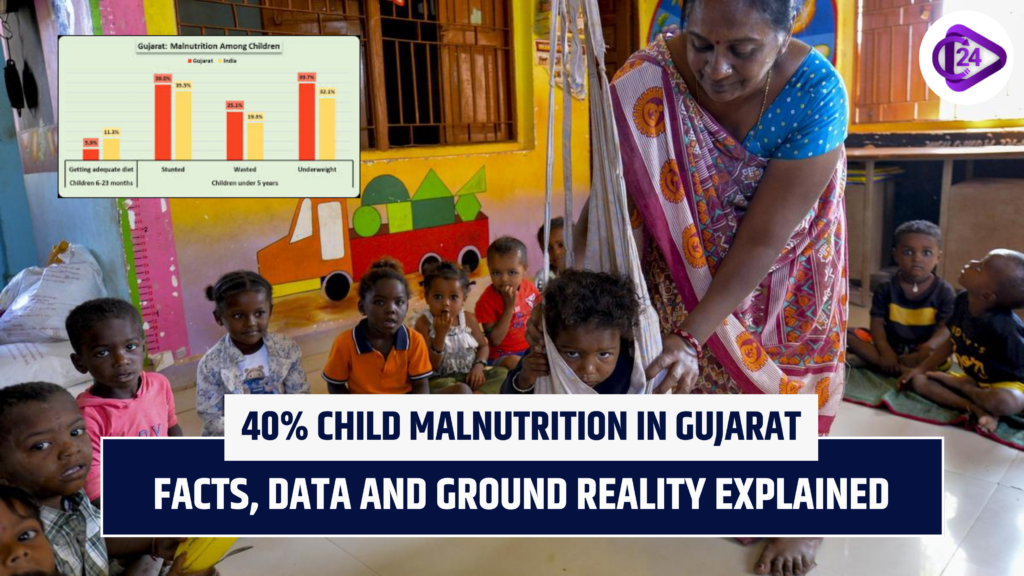
40% Child Malnutrition in Gujarat: Facts, Data and Ground Reality Explained

Child malnutrition remains a critical public health concern in Gujarat, despite significant economic growth and development. Reports and surveys, including findings from the National Family Health Survey, have highlighted worrying trends in undernutrition, stunting, and wasting among children. The claim that 40% of children are malnourished has sparked debate, drawing attention to gaps in healthcare access, maternal nutrition, and social inequalities. Understanding the real data, underlying causes, and regional disparities is essential to assess the situation accurately and design effective interventions for improving child health outcomes.

Key Facts and Ground Reality of Child Malnutrition in Gujarat

  • Malnutrition includes stunting (low height), wasting (low weight), and underweight conditions

  • Data from the National Family Health Survey indicate significant levels of child undernutrition in Gujarat

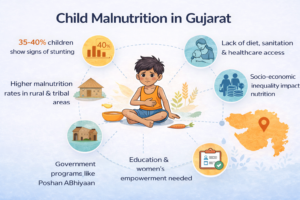
  • Around 35–40% children show signs of stunting, reflecting chronic malnutrition

  • Wasting levels remain high, indicating acute nutritional deficiencies

  • Rural and tribal regions face higher malnutrition rates compared to urban areas

  • Maternal health and nutrition directly impact child growth and development

  • Lack of a balanced diet, sanitation, and healthcare access contributes to the issue

  • Government schemes like Poshan Abhiyaan aim to reduce malnutrition

  • Integrated Child Development Services provides supplementary nutrition and health services

  • Awareness gaps regarding child feeding practices and breastfeeding persist

  • Socio-economic inequality plays a major role in nutrition outcomes

  • Improvements seen in some indicators, but progress remains uneven

  • Need for data-driven policy implementation and monitoring

  • Focus on nutrition-sensitive interventions like sanitation, education, and women’s empowerment

  • Tackling malnutrition requires a multi-sectoral approach involving health, education, and welfare sectors

Important Nutrition Schemes in India

Scheme Name Launched By Year Key Objective
Integrated Child Development Services (ICDS) Govt. of India 1975 Supplementary nutrition, preschool education, maternal & child care
Mid-Day Meal Scheme (PM POSHAN) Govt. of India 1995 Improve the nutrition of schoolchildren.
Poshan Abhiyaan Govt. of India 2018 Reduce stunting, wasting & anaemia.
National Nutrition Policy Govt. of India 1993 Improve overall nutritional status
Anaemia Mukt Bharat Govt. of India 2018 Reduce anaemia among women & children
Pradhan Mantri Matru Vandana Yojana Govt. of India 2017 Financial support for pregnant women
Scheme for Adolescent Girls Govt. of India 2010 Nutrition support for adolescent girls
National Food Security Act Govt. of India 2013 Food security & subsidised grains
Eat Right India Food Safety and Standards Authority of India 2018 Promote safe & healthy food habits
POSHAN 2.0 Govt. of India 2021 Strengthen the nutrition delivery system

Asked about Malnutrition Diseases

Disease Deficiency Key Symptoms
Kwashiork Protein deficiency Swollen belly, oedema, skin changes
Marasmus Protein + calorie deficiency Severe wasting, thin body
Anemia Iron deficiency Fatigue, pale skin
Rickets Vitamin D deficiency Weak bones, bowed legs
Scurvy Vitamin C deficiency Bleeding gums
Night Blindness Vitamin A deficiency Poor vision at night
Goitre Iodine deficiency Swollen thyroid gland
Beriberi Vitamin B1 deficiency Weak muscles, nerve issues

India Overtakes China as Largest Exporter of Cotton Products to the US

Conclusion (40% Child Malnutrition in Gujarat)

Child malnutrition in Gujarat remains a serious concern despite policy efforts. While schemes and data show gradual improvement, challenges like regional inequality, poor maternal health, and awareness gaps persist. A focused, multi-sectoral approach with effective implementation, monitoring, and community participation is essential to achieve sustainable nutrition outcomes and ensure healthier future generations.

Balirajgarh Fort

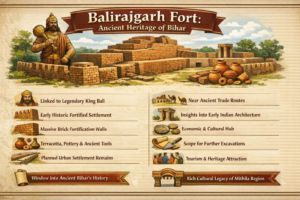
Balirajgarh Fort is an important archaeological and historical site located in the Madhubani district of Bihar. Believed to date back to ancient times, the fort is associated with the legendary King Bali and holds immense cultural and historical significance. Spread across a vast area, its ruins reflect the architectural style and urban planning of early civilisations in the region. Excavations by the Archaeological Survey of India have revealed fortifications, pottery, and other artefacts, indicating a well-developed settlement. Today, it stands as a symbol of Bihar’s rich heritage and attracts historians, researchers, and tourists alike.

Historical and Archaeological Significance of Balirajgarh Fort

  • Believed to be linked with the mythological King Bali from ancient Indian traditions

  • Identified as a major fortified settlement from the early historic or pre-Mauryan period

  • Excavations conducted by the Archaeological Survey of India revealed massive brick fortification walls

  • Fort walls extend over several kilometres, indicating strong defence planning

  • Discovery of terracotta objects, pottery, beads, and ancient tools

  • Evidence of planned urban settlement with drainage and structural remains

  • Suggests the existence of a prosperous and organised civilisation in the region

  • Located near ancient trade routes, highlighting its economic importance

  • Provides insights into early Indian architecture and construction techniques

  • Associated with the cultural history of the Mithila region

  • Potential site for further archaeological discoveries and research

  • Plays a key role in understanding ancient Bihar’s political and social structure

  • Attracts historians, archaeologists, and heritage enthusiasts

  • Scope for development as a major tourism and heritage site in Bihar

List of Important Forts of India

Fort Name Location Built By / Dynasty Year / Period UNESCO Status (Year)
Red Fort Delhi Shah Jahan 1638–1648 Yes (2007)
Agra Fort Uttar Pradesh Akbar 1565–1573 Yes (1983)
Amber Fort Rajasthan Raja Man Singh I 1592 Yes (2013 – Hill Forts)
Mehrangarh Fort Rajasthan Rao Jodha 1459 No
Chittorgarh Fort Rajasthan Maurya rulers (later Sisodias) 7th century Yes (2013 – Hill Forts)
Kumbhalgarh Fort Rajasthan Rana Kumbha 1443 Yes (2013 – Hill Forts)
Jaisalmer Fort Rajasthan Rawal Jaisal 1156 Yes (2013 – Hill Forts)
Gwalior Fort Madhya Pradesh Various dynasties 8th century No
Golconda Fort Telangana Kakatiya dynasty 13th century No
Daulatabad Fort Maharashtra Muhammad bin Tughlaq (developed) 14th century No
Raigad Fort Maharashtra Chhatrapati Shivaji Maharaj 1674 No
Shivneri Fort Maharashtra Yadava dynasty 12th century No
Bangalore Fort Karnataka Kempe Gowda I 1537 No
Bekal Fort Kerala Shivappa Nayaka 1650 No
Murud-Janjira Fort Maharashtra Siddis 17th century No
Kangra Fort Himachal Pradesh Katoch dynasty Ancient (4th century BCE) No
Lohagarh Fort Rajasthan Maharaja Suraj Mal 1733 No

India Builds World’s 1st Autonomous Shipyard in Andhra

Conclusion – Balirajgarh Fort

Balirajgarh Fort stands as a valuable link to India’s ancient past, reflecting early urban planning and cultural richness. Continued archaeological research and preservation efforts can unlock deeper historical insights. Promoting it as a heritage site will not only protect its legacy but also boost tourism and awareness about Bihar’s significant contribution to India’s history.

World Bank Approves $300 mn Loan to UP for Clean Air Transition

The World Bank has approved a $300 million loan to support Uttar Pradesh’s transition toward cleaner air and sustainable urban development. This initiative aims to tackle rising air pollution levels in one of India’s most populous states, where rapid urbanisation and industrial growth have significantly impacted air quality. The project focuses on strengthening air quality management systems, promoting cleaner technologies, and enhancing institutional capacity. It aligns with India’s broader climate commitments and public health goals, ensuring long-term environmental sustainability while improving the quality of life for millions of residents across urban centres.

Key Highlights of the Clean Air Transition Project

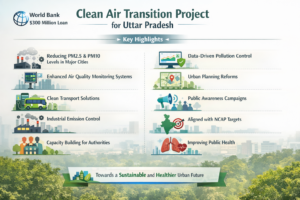
  • Focus on reducing PM2.5 and PM10 pollution levels in major cities of Uttar Pradesh

  • Strengthening air quality monitoring infrastructure with advanced data systems

  • Promoting clean transport solutions, including electric mobility and public transport upgrades

  • Encouraging industrial emission control technologies and cleaner production methods

  • Capacity building of state and local authorities for better policy implementation

  • Integration of data-driven decision-making for real-time pollution control

  • Supporting urban planning reforms to reduce congestion and emissions

  • Enhancing public awareness campaigns on air pollution and health impacts

  • Alignment with India’s National Clean Air Programme (NCAP) targets

  • Expected improvement in public health outcomes, reducing respiratory diseases

  • Long-term goal of achieving sustainable and climate-resilient urban growth in Uttar Pradesh

Most Important PYQs on World Bank and Air Pollution

Exam Year Question Options Answer
UPSC Civil Services Prelims 2020 Which of the following are objectives of the World Bank? (a) Poverty reduction (b) Infrastructure funding (c) Military financing (d) Climate support a, b, d
UPSC Civil Services Prelims 2015 The World Bank & IMF are known as Bretton Woods Institutions. Which statement is correct? (a) Formed after WWI (b) Formed after WWII (c) UN agencies (d) Only for Europe b
UPSC Civil Services Prelims 2018 What is the role of IBRD? (a) Loans to poor countries (b) Loans to middle-income countries (c) Grants only (d) Trade regulation b
UPSC Civil Services Prelims 2021 Which factors contribute to air pollution in India? (a) Vehicular emissions (b) Crop burning (c) Industrial pollution (d) All of the above d
UPSC Civil Services Prelims 2017 Sources of PM2.5 include: (a) Vehicles (b) Industries (c) Dust (d) All d
UPSC Civil Services Prelims 2019 H-CNG fuel reduces which emissions? (a) CO₂ only (b) Hydrocarbon only (c) CO₂ + Hydrocarbon (d) None c
UPSC Civil Services Prelims 2023 Direct Air Capture technology is used for: (a) Carbon sequestration (b) Fuel production (c) Industrial reuse (d) All d
RPSC RAS Prelims 2021 Major cause of air pollution in Rajasthan cities? (a) Transport (b) Dust storms (c) Industry (d) All d
SSC CGL Examination 2020 Which gas causes smog? (a) CO₂ (b) SO₂ (c) Ozone (d) Nitrogen c
State PCS Examination 2022 AQI is based on which pollutants? (a) PM2.5 (b) NO₂ (c) SO₂ (d) All d
UPSC Civil Services Prelims 2024 PM2.5 refers to: (a) Gas (b) Liquid pollutant (c) Fine particulate matter (d) Ozone layer c
UPSC Civil Services Prelims 2022 The World Bank report on climate risk mentions: (a) Flood risk only (b) Heat stress (c) No impact (d) Only agriculture b

Odisha Tops NITI Aayog Fiscal Health Index 2026

Conclusion – World Bank Supports UP’s Fight Against Air Pollution

The World Bank support marks a significant step in Uttar Pradesh’s fight against air pollution. By strengthening governance, promoting clean technologies, and improving urban planning, the initiative can deliver long-term environmental and public health benefits. Effective implementation and continuous monitoring will be crucial to achieving cleaner, more sustainable air and to setting a model for other states.

Frequently Asked Questions (FAQs)

The current affairs cover recent national and international events related to UPSC, SSC, Banking, Railways, and State PCS.

You need to read about the current affairs daily, and revise them every week and every month to keep them longer in your memory.

Yes, Class24 provides free downloadable Daily Current Affairs PDFs for easy revision.

Yes, you can practice MCQs and quizzes to boost your exam preparation.

Absolutely. The content is written in simple, easy-to-understand bilingual language suitable for beginners.

Go to class24.com and click on the current affairs section directly, where you find everything that you need.

ssc-toppers

Start Learning Today with Class24

Related current affairs

Class24 offers free video lectures for smart preparation, covering CGL, CPO, CHSL, MTS, and GD exams. Learn from expert faculty, revise concepts easily, practice with PYQs, and improve speed and accuracy through high-quality, exam-focused video lessons anytime, anywhere.

Get success in your hand. Start study anytime anywhere.

The journey becomes simple and enjoyable when you start taking interest in it. And through our app “Class24”, we will be your trusted partners in developing that interest.

Daily Quizzes
Mock Tests
Ongoing

No ongoing tests right now.