

Day: April 2, 2026

UDAN 2.0 Revamp: Affordable Flights & More Cities to Get Air Connectivity

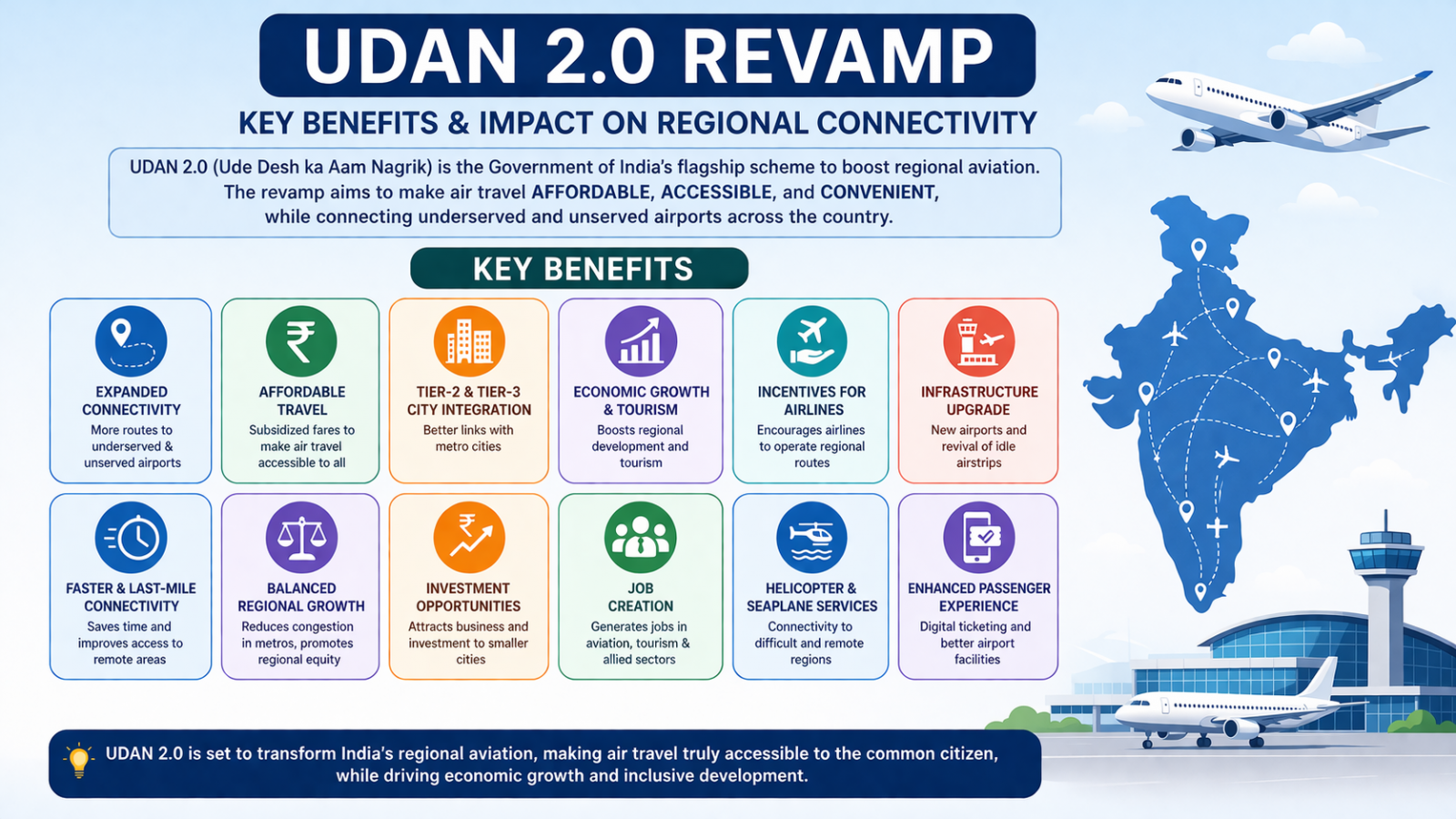
The UDAN 2.0 revamp will put India’s regional aviation sector in a significant boost as it attempts to make air travel more affordable and reachable. UDAN (Ude Desh ka Aam Nagrik), which was started under a flagship regional connectivity scheme of the government, targets connecting underused and not yet accessed airports in the country. The rebranded one focuses on additional routes, better infrastructure, and a more comfortable experience for passengers. UDAN 2.0 will lead to economic growth, tourism, and regional development, as the programme will integrate Tier-2 and Tier-3 cities and make sure that efficient air transport is accessible to the common citizen.

UDAN 2.0 Revamp: Key Benefits & Impact on Regional Connectivity

  • UDAN 2.0 will seek to increase the level of air connectivity in the region by increasing the number of routes to underserved and unserved airports in India.
  • The plan aims to ensure that air travel is affordable to ordinary people through subsidised fares.
  • The Tier-2 and Tier-3 cities will be linked to great metropolitan centres.
  • The project will improve travel demand in isolated and uncharted areas of the country.
  • UDAN 2.0 gives incentives to the airlines operating on regional routes.
  • The construction of new airports and the renewal of idle airstrips are one major priority area.
  • The plan improves the last-mile delivery and saves time by a great margin.
  • It fosters equalisation of growth in the region and alleviates congestion in the big cities.
  • Better air connectivity will be a motivating factor for investment in smaller cities and towns.
  • The programme aids in the employment of people in the aviation, tourism, and other related industries.
  • UDAN 2.0 also provides helicopter and seaplane services in problematic areas.
  • The government is laying emphasis on improving the infrastructure and passenger facilities within the airports.
  • Trade and business opportunities to the regional market will be reinforced by the increased connectivity.
  • The plan plays the role of a general business expansion of the Indian aviation industry.
  • Passenger experience will be improved with the use of digital ticketing and better quality of services.
  • UDAN 2.0 models the accessibility and inclusive growth.
  • Improved connectivity will improve student life, professionals and even small businesses.
  • The initiative is in line with India’s interests to establish itself as a global aviation hub.
  • It lessens the reliance on travel to long distances by road and rail.
  • UDAN 2.0 is, in general, a revolution when it comes to providing access to affordable and extensive air connectivity in India.
Conclusion – UDAN 2.0 Revamp

UDAN 2.0 Revamp will be a tremendous milestone in democratising air travel in India, as it allows more people to be able to afford and have access to air travel. The scheme will improve the economic growth, tourism, and job creation by increasing the regional connections and infrastructure and connecting the smaller cities. It is also necessary to eliminate regional inequalities and improve the movement around the nation. UDAN 2.0 can dramatically change the current state of the Indian aviation industry with the help of further government updates and successfully applied methods of its functioning, and the overall results can move the dream of flying as close to accessible as possible.
ESA’s First Celeste Satellites

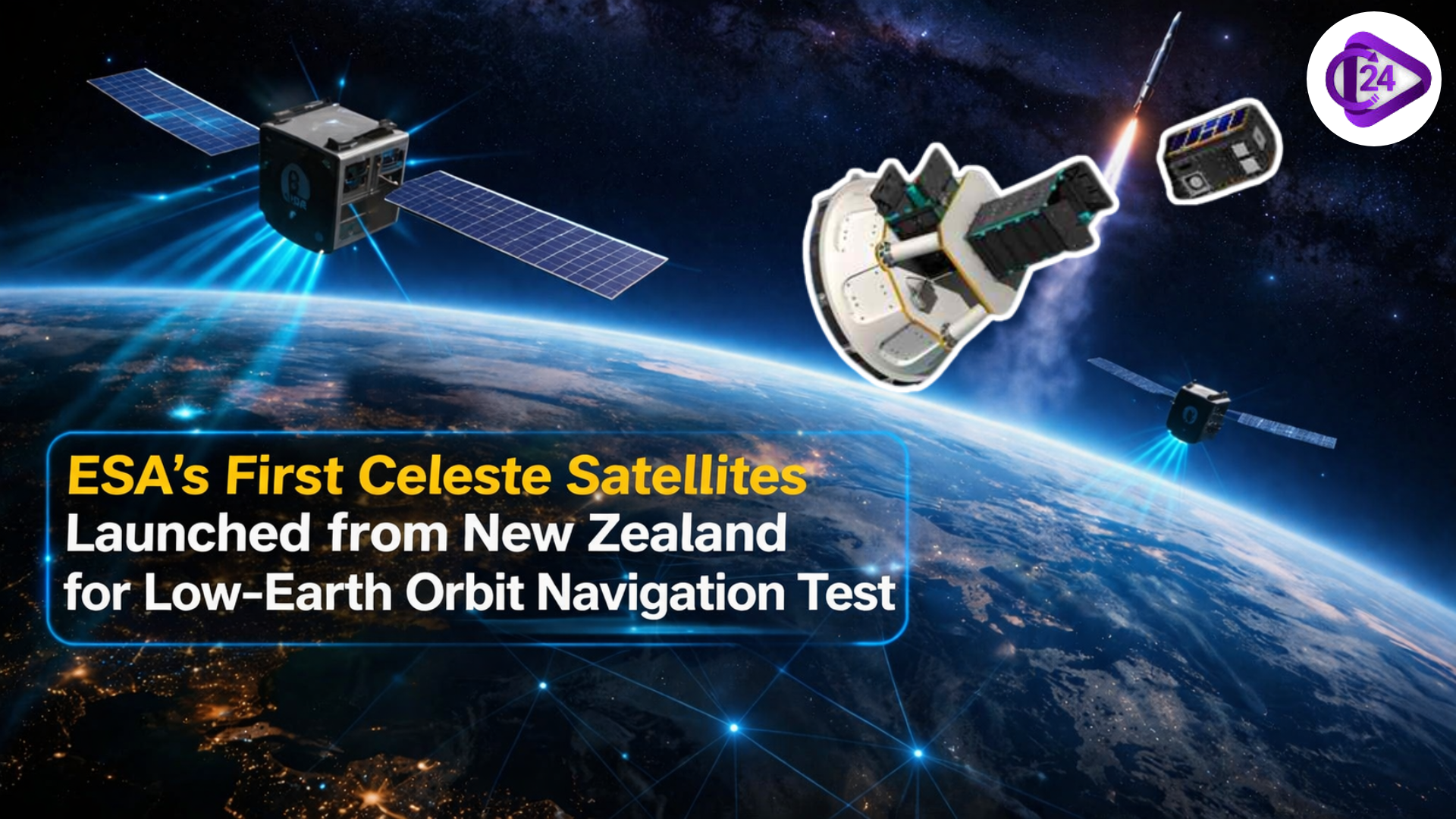
ESA’s First Celeste Satellites Launched from New Zealand for Low-Earth Orbit Navigation Test

The European Space Agency has managed to launch its first Celeste satellites in New Zealand, and this is a significant development in space-based navigation technology. This mission will be a test of advanced positioning and timing systems in Low Earth Orbit (LEO), which can revolutionise satellite navigation and communication. Since more and more people are relying on space infrastructure, the Celeste project of ESA aims to improve the accuracy, resilience, and independence of the navigation systems. The opening also emphasises the international partnership and space exploration, making ESA the leader in the next generation of navigation services.

Key Highlights of ESA’s Celeste Satellite Launch

  • The European Space Agency put up their initial Celeste satellites to test the navigation in Low Earth Orbit (LEO).

  • The operation took place outside of New Zealand, an emerging centre in commercial space launch.

  • Emphasises the creation of stand-alone navigation systems, other than depending on GPS.

  • Intended to enhance the precision of the positioning of satellites in LEO.

  • Increases the resilience of the navigation systems in case of disruption and signal breakdowns.

  • Favours the future constellations of satellites and space internet.

  • Supplies safer satellite operations through orbital tracking.

  • Promotes timing and synchronisation innovations.

  • Helps minimise the reliance on land-based navigation systems.

  • Enhances the European strategic independence in space technology.

  • The Celeste system is made to be very precise and reliable in space missions.

  • Further encourages cross-border cooperation in state-of-the-art space studies.

  • It is predicted to bring advantages to such industries as telecommunications, defence, and Earth observation.

  • Compliant with worldwide tendencies of building LEO satellite networks.

  • Takes a step towards the development of the next-generation space navigation architecture.

What is ESA’s Celeste Mission?

  • The Celeste mission is a project by the European Space Agency aimed at coming up with superior navigation systems in space.

  • It is concerned with positioning, navigation, and timing (PNT) technologies testing in low Earth orbit.

  • Intends to develop a self-reliant and autonomous alternative to the conventional GNSS systems.

  • Promotes satellite constellations and autonomous space.

  • Improves spacecraft navigation and collision avoidance.

  • It was intended to enhance the efficiency and safety of space missions.

  • Contributes to the development of European space and innovation.


Mangroves in Focus After SC Coastal Road Verdict

Conclusion – ESA’s First Celeste Satellites

The European Space Agency launched the first Celeste satellites, and this is a great breakthrough in the technology of space navigation. The mission reinforces the future of autonomous operations and satellite-based services by being used to test innovative positioning systems in low Earth orbit. It is a project that was initiated in New Zealand and is indicative of increased international cooperation in space exploration. Celeste is likely to improve the precision, dependability and robustness of manoeuvring systems, which is likely to precondition the next-generation space facilities and strengthen the European leadership in the sphere of innovative space technologies.

Nagoya Protocol

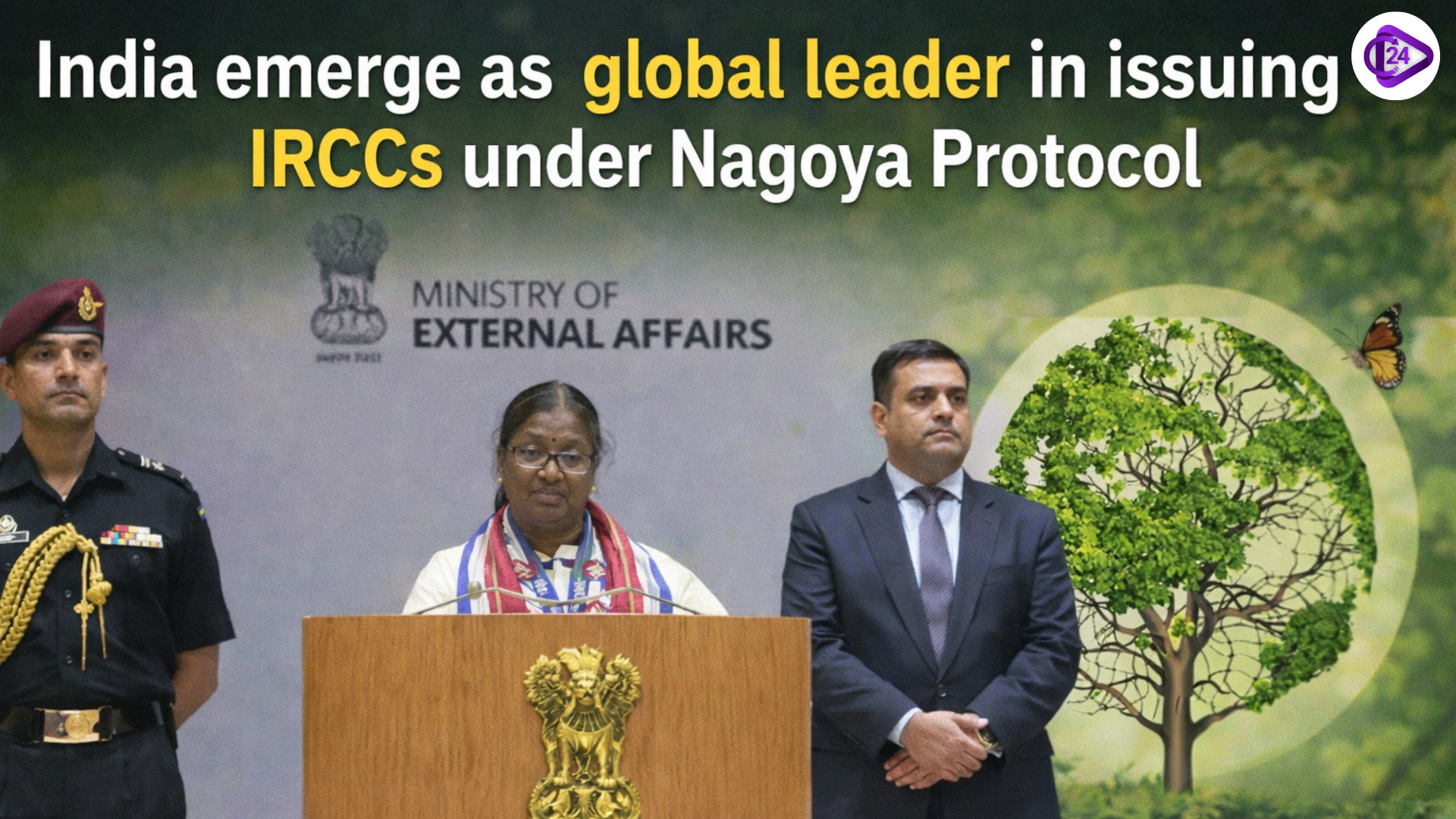
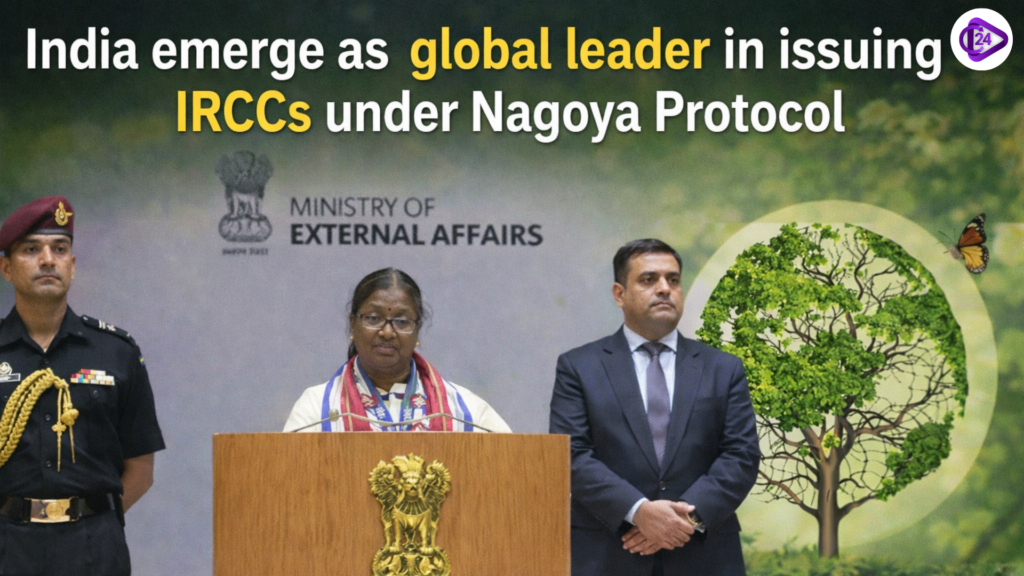
Nagoya Protocol: India Tops World in Issuing IRCCs, Becomes Global Leader

India has become a world leader in the provision of an Internationally Recognised Certificate of Compliance (IRCC) in the Nagoya Protocol, which is a major success story in the regulation of biodiversity. This is a milestone that shows that the country has a well-established regulatory environment and reliance on equitable and fair sharing of the benefits that occur due to genetic resources. The process of improving transparency and accountability in accessing biological resources has been achieved by simplifying the systems and reinforcing the digital systems in India. The success not only enhances the international status of India but also conserves and sustains development in line with international environmental objectives.

Key Highlights of India’s Leadership in IRCCs Under the Nagoya Protocol

  • India is currently among the leading nations in the world to issue IRCCs, with good governance of biodiversity.

  • IRCCs provide access to genetic resources legally and also verify that national laws governing biodiversity are adhered to.

  • The system is consistent with the goals of the Nagoya Protocol of equitable benefit-sharing.

  • The digital ABS (Access and Benefit Sharing) mechanism in India has enhanced transparency and tracking.

  • Helps safeguard the traditional knowledge of local and indigenous people against exploitation.

  • It further encourages research and innovation, and also maintains ethical utilisation of biological resources.

  • Enhances the position of India in the world’s conservation efforts in biodiversity.

  • Favours the environmentally friendly use of natural resources and protection.

  • Promotes biotechnology and pharmaceutical partnerships with foreign countries.

  • It increases the economic growth via controlled bio-resource use.

  • Increases piracy compliance and decreases biopiracy activities that are illegal.

  • India has demonstrated its adherence to international environmental treaties and agreements.

  • Gives companies and researchers who access resources a legal assurance.

  • Enhances trust in the stakeholders in biodiversity-based industries.

  • Contributes significantly to the realisation of sustainable development and ecological harmony.

What is the Nagoya Protocol?

  • The Nagoya Protocol is a Convention on Biological Diversity (CBD) international agreement.

  • In 2010, it was adopted in Nagoya, Japan, to achieve equitable distribution of genetic resources benefits.

  • Intended to avoid the exploitation of biodiversity and safeguard the rights of countries endowed with resources.

  • Presents Access and Benefit Sharing (ABS) of regulated biological resource use.

  • Make sure that the gains, such as profits, research results, and technology, are distributed equally.

  • Promotes the protection of biodiversity and sustainable utilisation of its elements.

  • Promotes transparency and legal security in the utilisation of genetic materials.

  • India is a signatory and is taking the necessary steps to enforce its provisions in the form of national laws.

World Water Day 2026

Conclusion – Nagoya Protocol

The Nagoya Protocol has been an important aspect when it comes to fair and equitable distribution of the benefits that will be received as a result of using the genetic resources. It reinforces the international community in its quest to conserve biodiversity and safeguard the interests of the indigenous people and countries endowed with resources. The protocol encourages long-term ecological balance and responsible innovation by facilitating transparency, access to the law, and sustainable practices. Countries such as India have shown great commitment with proper implementation, making the protocol one of the pillars in ensuring global environmental sustainability and inclusive development.

PM inaugurates Samrat Samprati Museum

PM Inaugurates Samrat Samprati Museum at Koba Tirth in Gandhinagar

Prime Minister Narendra Modi inaugurated the Samrat Samprati Museum at Koba Tirth, which emphasises the spiritual and cultural heritage of India. The museum is dedicated to the life and works of Samrat Samprati, who was a pious ruler of the Mauryan dynasty and promoted Jainism, which is why the museum is devoted to the ancient history and modern presentation. This initiative in Gandhinagar shows the emphasis of the government on heritage tourism and cultural awareness. The museum displays rare artefacts, online exhibits, and historical stories, and provides visitors with a complete experience of the glorious past of India and Jain traditions.

Key Highlights of Samrat Samprati Museum Inauguration

  • The museum is named after Samrat Samprati, the grandson of Ashoka the Great, who contributed immensely to the propagation of Jainism in India.

  • The inauguration made by Narendra Modi highlights the government’s concern to conserve the cultural and religious heritage of India.

  • It is located at Koba Tirth, which is an important Jain pilgrimage site, adding to its spiritual significance.

  • The museum has high-tech digital exhibits, interactive galleries, and 3D projections to inform the visitor about the history of ancient India.

  • There are exhibits of rare manuscripts, sculptures, inscriptions, and artefacts of Jain traditions and Mauryan history.

  • Their objective is to market heritage tourism in Gandhinagar and improve the local economy.

  • Pay attention to youth education concerning the history of Indians, their values, and the contributions of ancient rulers such as Samprati.

  • The museum combines modern technology and traditional storytelling to make the visitor experience exciting.

  • Much of the greater effort is to restore and highlight the Indian systems of ancient knowledge and interfaith unity.

  • It is intended to appeal to scholars, historians, and tourists interested in Jainism and Indian civilisation.

PYQs on Jain Religions

Exam Name Year Question Options Answer
RRB NTPC 2016 Who was the 24th Tirthankara of Jainism? (A) Gautama Buddha (B) Mahavira (C) Ashoka (D) Chandragupta Maurya B) Mahavira
RRB Group D 2018 The concept of Ahimsa is mainly associated with which religion? (A) Hinduism (B) Islam (C) Jainism (D) Christianity C) Jainism
RRB ALP 2019 What are the three jewels (Triratna) of Jainism? (A) Right Faith, Right Knowledge, Right Conduct (B) Dharma, Artha, Kama (C) Karma, Bhakti, Yoga (D) Satya, Ahimsa, Asteya A) Right Faith, Right Knowledge, Right Conduct
RRB NTPC 2020 Who was the first Tirthankara of Jainism? (A) Mahavira (B) Parshvanatha (C) Rishabhdev (D) Neminatha C) Rishabhdev
RRB Group D 2019 Jainism believes in which of the following principles? (A) Violence (B) Idol sacrifice (C) Non-violence (D) War C) Non-violence
RRB NTPC 2021 Parshvanatha is associated with which symbol? (A) Bull (B) Lion (C) Snake (D) Horse C) Snake
RRB ALP 2018 What is ‘Kaivalya’ in Jainism? (A) Heaven (B) Moksha (C) Ritual (D) Temple B) Moksha
RRB Group D 2022 Jainism was founded by whom? (A) Mahavira (B) Rishabhdev (C) Buddha (D) Ashoka B) Rishabhdev
RRB NTPC 2017 Jainism mainly spread in which region? (A) South India (B) North India (C) West India (D) East India C) West India
RRB ALP 2020 How many Tirthankaras are there in Jainism? (A) 10 (B) 18 (C) 24 (D) 28 C) 24
RRB Group D 2021 Which language was used by Jain texts? (A) Sanskrit (B) Pali (C) Prakrit (D) Tamil C) Prakrit

Women’s Reservation Act Update

Conclusion – Samrat Samprati Museum at Koba

The Samrat Samprati Museum at Koba Tirth can be considered one of the major strides in ensuring the rich Jain heritage and ancient history of India are maintained. It was inaugurated by Narendra Modi, and it showcases the legacy of Samrat Samprati in the current exhibitions and rare artefacts. The museum is a significant source of education and spirituality to future generations, as it not only creates awareness of the culture but also increases tourism in Gandhinagar

Frequently Asked Questions (FAQs)

The current affairs cover recent national and international events related to UPSC, SSC, Banking, Railways, and State PCS.

You need to read about the current affairs daily, and revise them every week and every month to keep them longer in your memory.

Yes, Class24 provides free downloadable Daily Current Affairs PDFs for easy revision.

Yes, you can practice MCQs and quizzes to boost your exam preparation.

Absolutely. The content is written in simple, easy-to-understand bilingual language suitable for beginners.

Go to class24.com and click on the current affairs section directly, where you find everything that you need.

ssc-toppers

Start Learning Today with Class24

Related current affairs

Class24 offers free video lectures for smart preparation, covering CGL, CPO, CHSL, MTS, and GD exams. Learn from expert faculty, revise concepts easily, practice with PYQs, and improve speed and accuracy through high-quality, exam-focused video lessons anytime, anywhere.

Get success in your hand. Start study anytime anywhere.

The journey becomes simple and enjoyable when you start taking interest in it. And through our app “Class24”, we will be your trusted partners in developing that interest.

Daily Quizzes
Mock Tests
Ongoing

No ongoing tests right now.