
Day: May 27, 2025

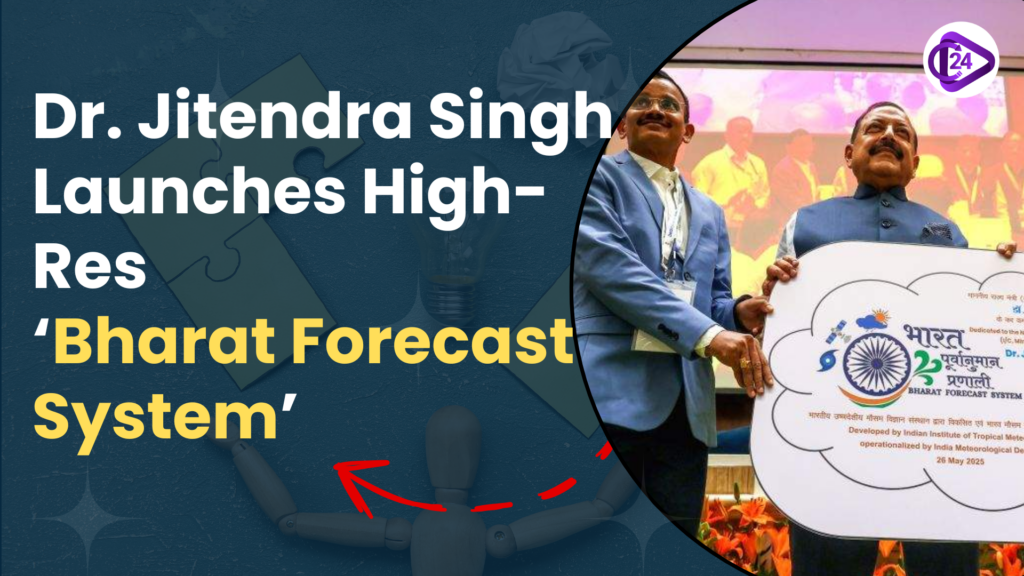
India Launches Bharat Forecast System for Accurate Local Weather

The Indian Institute of Tropical Meteorology (IITM) has built and deployed the Bharat Forecast System, India’s indigenous advanced weather forecast system. Improvements to the system increase the resolution of weather forecasts from 12 km to 6 km, letting users get predictions for the village where their crops grow. It helps India meet its aims of Atmanirbhar Bharat and Make in India, and is in line with India becoming the 4th largest economic power in the world.

Context:

  • Bharat Forecast System, designed by the Indian Institute of Tropical Meteorology (IITM), Pune, is the first of its kind high-resolution weather forecast system created in India. 

  • With the Bharat Forecast System, India can now make much more accurate and local weather forecasts. 

Key Points

Technological Advancement

  • Now the forecast covers villages due to its improvement from 12 to 6 kilometers in resolution.

  • Employs the ‘Triangular Cubic Octahedral Grid’ system for live simulations of weather.

  • Results in 30% better predictions for overly intense rain and 64% improved accuracy in basic weather areas.

Strategic and Economic Importance

  • Helps the economy grow by cutting losses from weather events and making it possible to collect additional gains.

  • Helps multiple industries, mainly agriculture, stay well informed about changes in the environment.

  • Helps India aim to become the strongest global economy.

Development for Indigenous Peoples and Nationalism

  • Indian institutions like IITM, IMD, and ISRO have fully developed these systems, growing towards an Atmanirbhar Bharat future.

  • The system is of value to parts of the world that have similar climate concerns.

Encouraging Women’s Leadership

  • The project is led by four women scientists who represent PM Modi’s idea of strengthening women in society.

  • Indicates that women are playing greater roles in leading scientific work in India.

Working Together and Political Dedication

  • Takes a method that includes the entirety of the science sector and the entire government.

  • As part of continual efforts to improve India’s weather forecasting, Mission Mausam has received a budget of ₹2000 crore.

  • Makes life and business operations easier through accurate forecasts delivered to over 20 ministries.

Linguistic Inclusion

  • The magazine, Indradhanush, launched by IITM, aims to improve the way science is shared in local languages.

Conclusion:

BFS shows how much progress India has made in weather prediction and relying on its own resources. Combining innovation and fair leadership, India is looking after its people and showing the way for unique solutions in other nations. As a result, India is better prepared for climate situations and further promotes sustainable progress.

FAQs

It’s India’s first high-resolution weather forecast system, developed by IITM to give accurate village-level predictions.

It provides precise local forecasts, helping farmers plan better and reduce crop losses due to extreme weather.

Indian institutes like IITM, IMD, and ISRO developed it, led by four women scientists.

It boosts climate resilience, supports agriculture, and strengthens Atmanirbhar Bharat and Make in India goals.

YouTube Channels Protest ANI’s Licence Fee Demands for Using News Footage

Many Indian YouTubers have spoken out after facing reports from ASNI saying they used their footage without proper authorization. Because ANI wants YouTubers to pay a lot of money for news content, many YouTubers argue that these high fees and claims of damages go against fair use rules and stop creativity.

Summary:

  • Anger over ANI asking YouTube creators to pay for its footage led to protests claiming it went against fair use laws. 

  • It points out difficulties in making sure copyright laws support free creativity on the internet.

Key Points

ANI demands that broadcasters pay a licence fee.

  • ANI was seeking over ₹48 lakh and GST annually from anyone using their footage without a license on YouTube.

  • Mohak Mangal was among the YouTubers who argued that they could use a clip for a short time because of fair use law.

The effects on YouTubers

  • Statistics show that YouTube channels may lose income if they receive too many copyright notices from ANI, which could result in suspension if they collect three notices over 90 days.

  • This means people in the creative field are often forced to negotiate with copyright owners at a high price.

Fair Use as described in the Indian Copyright Law

  • Youtubers can use a copyrighted source in limited ways thanks to fair use/fair dealing.

  • The Copyright Act, 1957 permits the use of copyrighted material for personal, critical, review, court, and news functions.

  • YouTubers say they are following the exemptions set out in the law.

YouTube’s Role and Position

  • YouTube steps in to let creators challenge claims about their work from rights holders.

  • The site cannot determine who owns an artwork, but it helps with the enforcement of copyright guidelines.

Creative Expression vs Copyright Protection

  • Some creators say that over-strict copyright enforcement endangers the freedom to create and creates a dangerous pattern.

  • This situation represents the conflict between safeguarding intellectual property and helping people make digital content.

Conclusion

The conflict between ANI and YouTube points to the difficult task of trying to balance copyright rules with the right to express ourselves digitally. Looking after intellectual property is necessary, but too-strict demands for licensing can threaten the lively atmosphere in the creative fields. We require clearer and wider dialogues to align copyright rules with the way content is produced in the digital world.

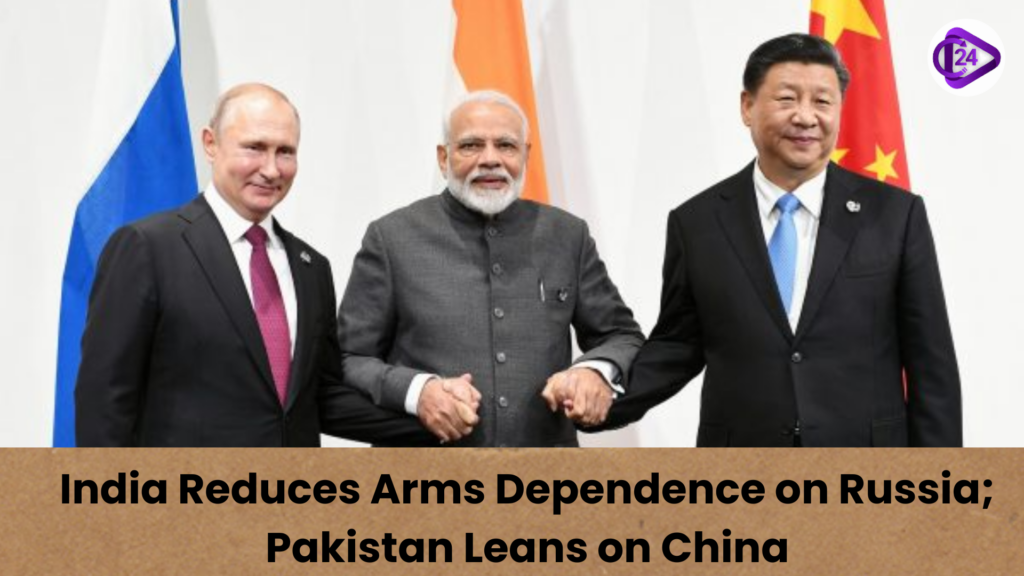
Shifting Arms Dependencies: India Moves Away from Russia, Pakistan Turns to China

During the past decade, India and Pakistan have changed how they acquire weapons systems. India is now buying weapons from the West and Israel, lessening its age-old reliance on Russia. At the same time, Pakistan has turned more to China, dramatically lessening its reliance on buying arms from the United States. The new trend is a result of changes in geopolitics and the formation of partnerships in the region.

Context:

  • India is broadening its source of military equipment from Russia to France, the U.K., Israel, and the U.S., while Pakistan is turning more to China for weapons. 

  • They mark a changing defence and diplomatic priorities for both countries.

Key Points

Who Supplies India’s Arms

  • Back in the 1990s, the biggest source of India’s defence imports was Russia which represented a mammoth 96.5% of all defence imports.

  • In the 2020s, Russia remained the main producer, but imports grew from France (accounting for 9%), the U.K. (5.5%), Israel (5%) and the U.S. (3%).

  • Advanced air power capabilities are being supplied to Arab countries by Western countries and Israel.


Pakistan’s dependence on China

  • The share of China’s weapons sold to Pakistan grew from 19% in the 2000s to almost all (95%) of its total arms imports in the 2020s.

  • In the last 20 years, the share of arms purchased by Pakistan from the U.S. dropped from more than 60% to just under 1%.

  • For more than three decades, China has been responsible for 50%-85% of Pakistan’s imported air power.

Effects of Operations and Today’s Battles

  • Both local systems and weapons obtained from Israel and Russia were used with success in Operation Sindoor.

  • The way the Indian Air Force controls the skies and carries out precise attacks on terror infrastructure demonstrates why a variety of imports is valuable.

  • Using Chinese PL-15 missiles and Turkish UAV signals changes in Pakistan’s arms purchases.

Worldwide Shifts in Arms Export

  • In the 2020s, the U.S. sold over 65% of all arms the world.

  • The decline in Russia’s stakes to 5% is a result, in large part, of political events like the Ukraine war.

  • China sells only 1.8% of the world’s arms, but a third of those go to Pakistan.

Strategic Implications

  • Becoming less dependent on Russia and supporting ‘Make in India’ is achieved through India’s diversification.

  • Pakistan’s support for China advances their partnership, though it makes the country more dependent on only one country for resources.

  • Such trends affect area security and show new changes in world powers joining forces.

Conclusion:

India and Pakistan’s changing weapons purchases are linked to wider changes happening in the region and the world. Buying from Western countries and Israel increases India’s defense, matching its self-made abilities. China and Pakistan are growing closer, yet there is a concern about how much one nation will depend on the other. Noticing these shifts helps us predict South Asia’s future in defence and diplomacy.

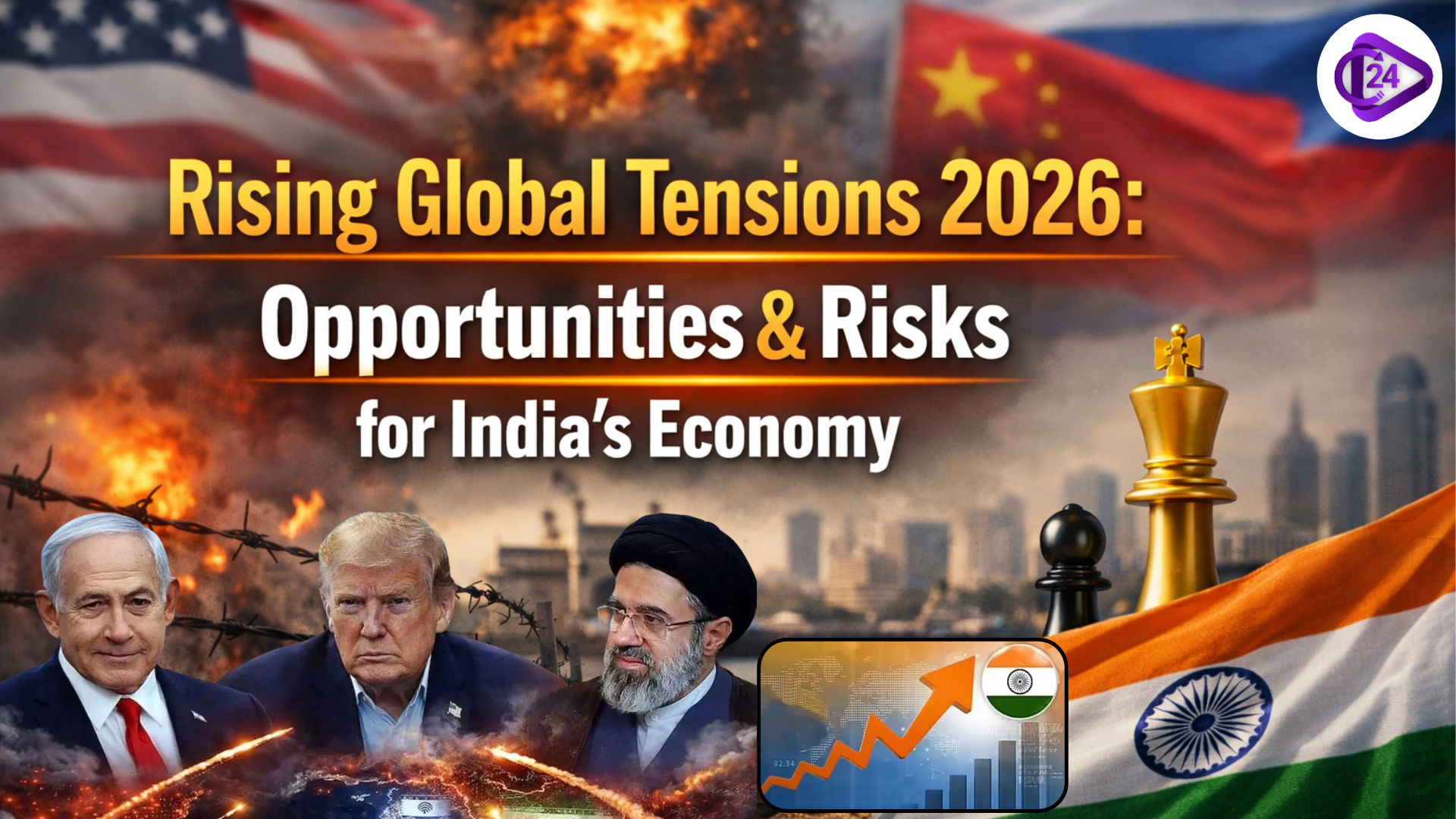
India has now become the fourth biggest economy globally and is set to pass Germany.

Strong economic growth in India comes from an increase in spending at home, improved infrastructure, growth in industrial and service fields, and favorable trends in the population, together with key changes in world relations. The economy faces problems because of worldwide political changes, inflation, and disruptions to the labor force. India has just surpassed Japan to occupy the fourth spot in nominal GDP, with a GDP valued at $4.19 trillion, more than Japan’s GDP of $4.18 trillion. According to the IMF, India will remain one of the fastest-expanding economies and is set to overtake Germany in 2028 to become the third-largest in the world.

Context

  • India has surpassed Japan to enter the fourth rank of global economies, based on nominal GDP, with a current GDP of $4.19 trillion. 

  • The International Monetary Fund (IMF) expects India to retain its title as the fastest-growing major economy and to surpass Germany, becoming the third-largest country by 2028.

Key Points

Economic Growth and Projections

  • India’s nominal GDP rose from $2.1 trillion in 2015 to almost $4.2 trillion in 2025.

  • The IMF predicts growth rates of 6.2% this year and 6.3% next, reaching a GDP of $5.5 trillion by 2028.

  • The forecast for Germany’s growth is very close to zero, opening the way for India to surpass it.

Key Factors Affecting Growth

  • Domestic Consumption: Almost half of what China’s people buy is in rural markets, but faster urbanization is expected to grow the urban population to over 600 million by the year 2030.

  • Demographic Dividend: Because the median age is 29 years, the nation has an advantage in work productivity.

  • Infra and Digital Growth: The government is making major investments using initiatives like PM Gati Shakti, the National Infrastructure Pipeline (NIP) and Digital Public Infrastructure (DPI).

  • Manufacturing and Services: Because of the ‘Make in India’ campaign, PLI and a growing IT & financial sector, Manufacturing & Services is expected to rally.

  • Global Realignment: FDI is being drawn to Vietnam by policies such as ‘China Plus One’ and the Supply Chain Resilience Initiative (SCRI).

Policies Supporting Economic Growth

  • The introduction of GST serves to join different parts of the domestic market.

  • The IBC is making it easier for companies to run their businesses.

  • The government is supporting companies by lowering taxes and pushing Atmanirbhar Bharat to help India become self-reliant and build capital from within.

Concerns

  • Geopolitical uncertainty: Such events may affect the region’s economic development.

  • Inflation: Services are continually getting more expensive, and the prices of key items are now volatile.

  • Employment: At work, People are required to gain new skills because of automation and AI.

  • Trade Deficit: The trade deficit lowered to 1% of GDP, but exports are being slowed down due to problems.

  • Infrastructure needs: The nation’s infrastructure must be revamped, as the Capex-to-GDP ratio of 3.3% is required.

Way Forward

  • Select a range of trading partners to reduce the risks that come from outside the nation.

  • Improve and expand industries within the US and the supply chains that support them.

  • Rapidly promote digital growth to increase access to money and good governance.

  • Create economic decisions that help the environment as much as they promote growth.

Conclusion

India’s advance into the fourth spot on the economic ladder highlights the country’s impressive growth related to how much people spend at home, young population, and important changes in rules and policies. At the same time, dealing with global uncertainties, rising inflation, a tough job marke,t and upgrading infrastructure will affect Canada’s growth and achieving its vision.

Google’s AI Matryoshka: Layered Intelligence and Emerging Privacy Challenges

The AI layers in Google’s Matryoshka model support search, shopping, and content creation, making it possible for Google to drive new ideas forward. Even so, people worry about privacy, user approval, and whether the training data is being handled ethically in the increasing use of AI. Even though it looks set to improve AI and user experience, the subject has also led to many discussions about data privacy, copyright, and ethics in AI use.

Context:

  • In May 2025, at its I/O Developer Conference, Google displayed a system called “AI Matryoshka,” which features AI at the center of its entire range of products.

  • Advanced Gemini 2.5 models form the core of this strategy, which covers infrastructure, APIs, and both consumer and hardware products.

Key Points

Important AI Models and Functions

  • This edition of Gemini features a Deep Think mode for improved reasoning and is strong on the math problems used in the USAMO 2025 exam.

  • Gemini 2.5 Flash is more efficient, now supports multiple readers speaking in 24+ languages, and will be used in Gemini by default.

Improving and Upgrading Hardware and Infrastructure

  • A 10x performance increase (at 42.5 exaFLOPS per pod), TPU v7 “Ironwood” makes it possible for Google to train Imagen 4 and Lyria 2.

Developer ecosystem and tools

  • Improvement to the Gemini API and Vertex AI, now allowing support for Model Context Protocol (MCP) to enhance how AI agents share information.

  • Start using “thinking budgets” to keep an eye on how much compute developers need and Project Mariner to automate some tasks.

User-friendly features

  • AI Mode relies on Gemini 2.5 to help you understand topics better and to provide answers supported by sources.

  • After trying on clothes virtually, customers can purchase them through Agentic Checkout, which raises security questions for their financial details.

  • Gemini app changes include real-time options, tools for watching or reviewing documents and images, and Canvas, a special section for infographics and brief audio.

Privacy, Copyright, and Concerns about Ethics

  • Machines that rely on hidden and vast datasets experience concerns over clarity and fairness.

  • With the help of tools like SynthID, all AI-generated content is now watermarked to help with copyright, even though creators have not received proper recognition or payments.

  • Offering different levels of user protection with Google AI Ultra Tier could make privacy cost more for those who sign up.

Conclusion

This AI is a major step forward in how AI can help people in many daily situations. Even so, it shows the growing clash between creating new technology and making sure data, copyright and equity rules are respected. Those who develop and enforce policies, plus those who develop AI, should work together to promote transparency, consent and fairness in AI.

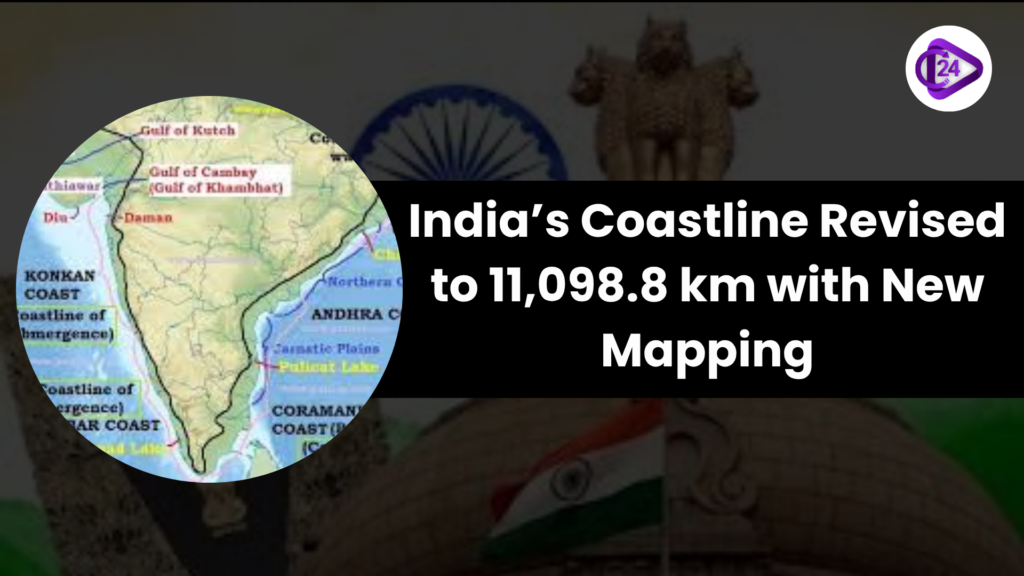
India’s Coastline Length Revised to 11,098.8 km Using Advanced Tech

As shown in the 2023–2024 Annual Report of the Ministry of Home Affairs, the Government of India has increased the approved length of India’s coastline by 40%. The new version does not contain new territory because it is based on updated geospatial mapping, which allows much better measurement of coastal features and nearby islands, creeks, and estuaries. The new data play a key role in improving safety along the coast, economic zones, and in planning for climate change. This alignment is a demonstration of the coastline paradox, since finer-scale measurements find longer coastlines.  Reviews improve the way we address issues along coasts, handle disasters and secure seas.

Context

  • As shown in the 2023–2024 Annual Report of the Ministry of Home Affairs, the Government of India has increased the approved length of India’s coastline by 40%.

  • Through improved digital mapping, the length of India’s coastline has increased. 

  • Tools such as GPS, satellite altimetry, LIDAR-GPS, and drone images have been used. 

Key Points

Measurement Update

  • Previously, the coastline length was 7,516.6 km (as shown at 1:4.5 million scale).

  • With revisions at the 1:250,000 scale, the length is now given as 11,098.8 km.

  • All measurements used the High Water Line (HWL) as found in the electronic navigation charts from 2011.

  • This work was carried out by the Survey of India and the National Hydrographic Office (NHO).

Technologies Employed

  • GIS is used for analyzing data in detail across a geographic area.

  • This satellite method uses super-precise elevation data.

  • LIDAR-GPS is used for mapping topography with high precision.

  • Capturing small coastal landmarks and islands is made easier with drones.

Scientific Principle: The Coastline Paradox

  • According to Lewis Fry Richardson and defined mathematically by Benoît Mandelbrot.

  • You can see from coastlines that length increases as the measurement becomes more detailed.

  • Depending on how you measure it, Britain’s coastline can be anywhere from 2,400 to 3,400 kilometers long.

Implication Result

  • The country’s long coast means there is a need for better surveillance and defense along its waters.

  • Exclusive Economic Zones (EEZ): There is a possible extension of national waters.

  • With better information, authorities are able to better plan for cyclones, floods and when sea levels will increase.

  • More accurate climate change modelling thanks to improvements in our coastal data.

  • Updating the geography curriculum is needed because the latest statistics have been revised.

About the Indian Coast

Data:

  • India has 9 coastal states and 4 Coastal UTs in India.

  • The coastline of India covers around 7,516.6 km.

  • About 6,100 km make up the mainland coastline.

  • The Andaman & Nicobar and Lakshadweep groups form a chain around 1,300+ km long.

  • Goa was the last coastal state to enter India in 1961.

Coastal States of India

  • There are nine coastal states: Gujarat, Maharashtra, Goa, Karnataka, Kerala, Tamil Nadu, Andhra Pradesh, Odisha, West Bengal

  • Daman & Diu, Puducherry, Andaman & Nicobar Islands and Lakshadweep are marine UTs.

Eastern Coast is the Bay of Bengal.

  • The states covered are West Bengal, Odisha, Andhra Pradesh and Tamil Nadu.

  • Description: The land is generally broad and flat, with most huge deltas (Ganga, Mahanadi, Godavari, Krishna, Kaveri), highly vulnerable to cyclones

The Arabian Sea sides of the Western Coast.

  • States included are Gujarat, Maharashtra, Goa, Karnataka and Kerala

  • Special Features: Narrow water paths, backwater rivers and ghats close to the sea

Major Ports:

  • Seven major ports out of the 12 in India are Mumbai, Chennai, Kolkata, Visakhapatnam, Cochin, Kandla (Deendayal), and Mormugao.

Importance of the Coast

  • The area helps fishing, ports, shipping, tourism, oil & gas, and salt production.

  • Important for both the Blue Economy and the Sagarmala Project.

  • The wetlands also feature mangroves, coral reefs, estuaries, plus important areas with a wide range of marine life.

  • The Sundarbans, named by UNESCO, is the biggest mangrove forest on the planet.

  • It plays a major part in India’s defence system, the support of sea trade, and strategy for growth and stability in surrounding countries (SAGAR).

Conclusion

The update of India’s coastline highlights the value of new technologies in geospatial sciences for shaping the nation’s policies and safety. The new knowledge of coastal geography will help enhance rules for oceans, prepare for disasters and support climate-friendly actions, as India shows its commitment to using science for sustainable growth.

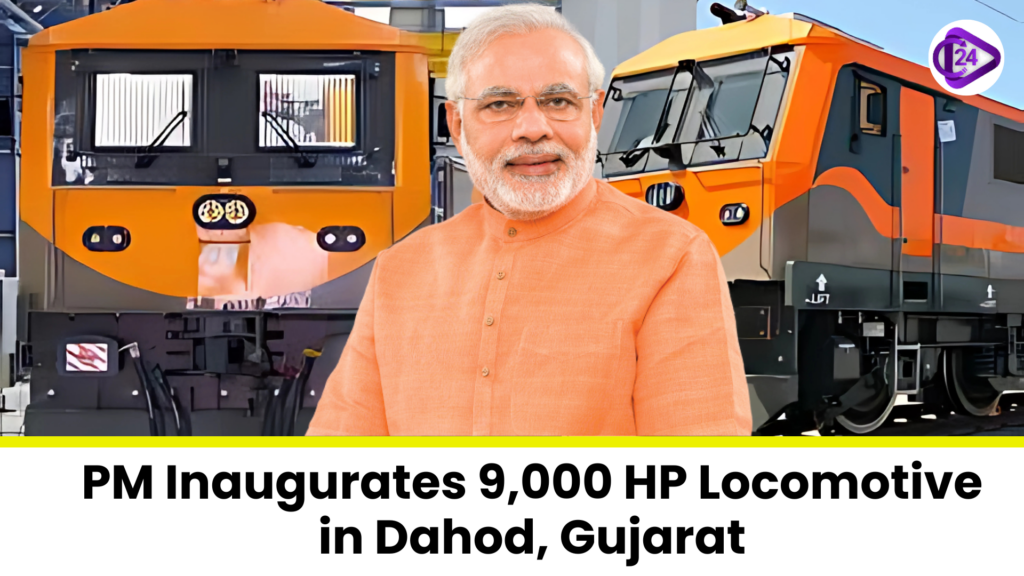
PM Modi inaugurated India’s leading 9,000 Horsepower Locomotive at Dahod, Gujarat

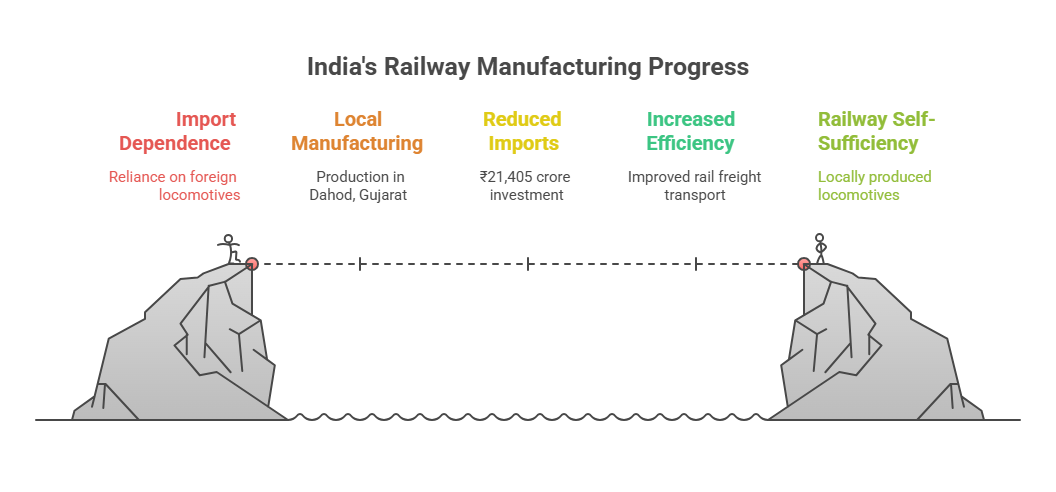
In Dahod, Gujarat, Prime Minister Narendra Modi unveiled D9, the nation’s first 9,000 horsepower locomotive. This milestone proves India’s railway manufacturing progress since the ‘Make in India’ program started. The new Dahod plant plans to produce 1,200 electric locomotives for freight transport over the next 11 years, which will help the local economy and neighboring businesses. The government plans to cut imports from abroad by spending ₹21,405 crore on the project. By using a locomotive, rail freight efficiency is projected to rise along key railroads.

Context:

  • India’s leading minister inaugurated the country’s first 9,000 horsepower electric locomotive in Dahod, Gujarat, pointing out the rise in railway manufacturing. 

  • Building 1,200 locomotives in the Dahod unit will result in more jobs and more efficient work on the rails.

Key Points


Features and Number of Locomotives

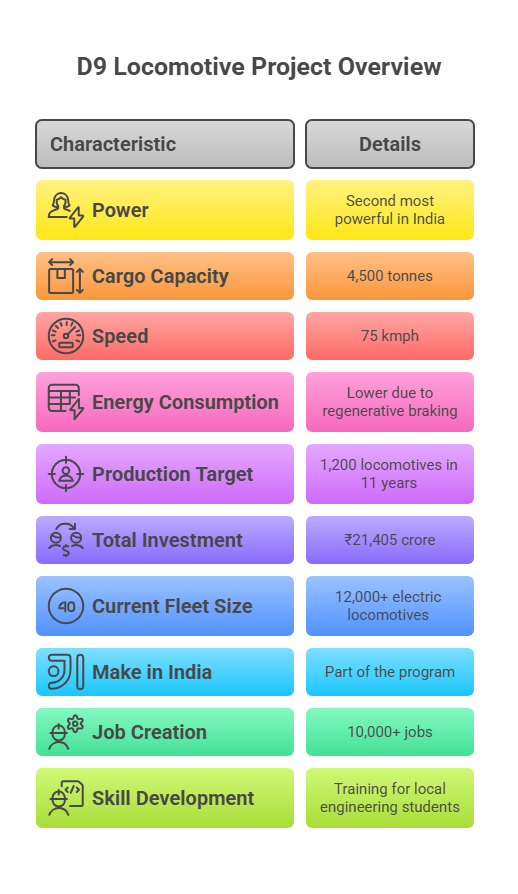
  • The D9 locomotive takes second place among India’s powerful trains, just below the 12,000 horsepower WAG-12 B.

  • The train is designed to carry 4,500 tonnes of cargo at a speed of 75 kmph when using both levels of containers.

  • Regenerative braking systems help to lower how much of energy these cars consume.

Production and Investment

  • It is planned that the Dahod workshop will make 1,200 electric freight locomotives in 11 years.

  • In total, the project will cost ₹21,405 crore.

  • Right now, Indian Railways has a fleet of more than 12,000 electric locomotives.

Make in India

  • The statute forms a part of the ‘Make in India’ program designed to help grow domestic manufacturing.

  • The project is planned to create more than 10,000 jobs, some of them directly and others indirectly, for tribal and related companies.

  • Local engineering colleges are organizing to give students the training they will need in the job market.

Strategic Importance

  • Most of these locomotives will support the Western Dedicated Freight Corridor to raise train speeds from 20-25 kmph to 50-60 kmph.

  • Doing this will result in much better logistics results and greater line throughput.

Additional Infrastructure Development

  • PM Modi unveiled projects to double the track capacity and supply electric power to railways on the Anand-Godhra section, Mehsana-Palanpur section, Rajkot-Hadmatiya section, and Sabarmati-Botad section.

  • The improvement projects, worth ₹2,287 crore, are intended to increase both rail connections and capacity.

Conclusion:

India’s train industry has taken a significant step forward with the launch of a powerful 9,000 horsepower engine in Dahod. This approach provides faster and better freight transport and supports wider economic plans for employment and technological advancement under the ‘Make in India’ campaign. The venture contributes to India becoming a major supplier of railway goods and plays a big role in developing the infrastructure the nation needs for growth.

Frequently Asked Questions (FAQs)

The current affairs cover recent national and international events related to UPSC, SSC, Banking, Railways, and State PCS.

You need to read about the current affairs daily, and revise them every week and every month to keep them longer in your memory.

Yes, Class24 provides free downloadable Daily Current Affairs PDFs for easy revision.

Yes, you can practice MCQs and quizzes to boost your exam preparation.

Absolutely. The content is written in simple, easy-to-understand bilingual language suitable for beginners.

Go to class24.com and click on the current affairs section directly, where you find everything that you need.

ssc-toppers

Start Learning Today with Class24

Related current affairs

Class24 offers free video lectures for smart preparation, covering CGL, CPO, CHSL, MTS, and GD exams. Learn from expert faculty, revise concepts easily, practice with PYQs, and improve speed and accuracy through high-quality, exam-focused video lessons anytime, anywhere.

Get success in your hand. Start study anytime anywhere.

The journey becomes simple and enjoyable when you start taking interest in it. And through our app “Class24”, we will be your trusted partners in developing that interest.

Daily Quizzes
Mock Tests
Ongoing

No ongoing tests right now.