


The UP Home Guard Recruitment process is a major opportunity for many young candidates in Uttar Pradesh. With thousands of vacancies, it’s crucial to pass the written exam, meet the physical requirements, and pass the efficiency test. It’s not enough to simply master the syllabus and exam pattern; follow a smart preparation plan to stand out and have the best chance of passing. In this paper, we’ll cover UP Home Guard exam planning, including UP Home Guard exam preparation strategie, exam study strategie, subject-wise strategie, study schedules, and subject-wise strategie, along with exam study strategies and exam planning strategies. You’ll also learn how to prepare for both the written exam and the physical exam.
Understanding the Exam & Selection Process
It is worth knowing what you are preparing before getting down to researching it. Recruitment to the UP Home Guard normally has various phases:
1. Written Examination
- Objective type test covering subjects like General Knowledge, Reasoning, Numerical Ability, and General Hindi.
- Key parameters: Number of questions, marks, time limit, negative marking (if applicable).
- Being aware of the pattern of the exam enables you to customize yourself.
2. Physical Standards Test (PST)
- Simple measurements such as height (male/female), chest (male) etc.
- It is obligatory to address these minimum standards to progress further.
3. Physical Efficiency Test (PET)
- The running (men/women), perhaps long jump, pushups etc.
- Strength and endurance are a prerequisite.
4. Document Verification & Medical Exam
- Once you clear the written + physical tests, you’ll undergo verification of certificates and medical/fitness check.
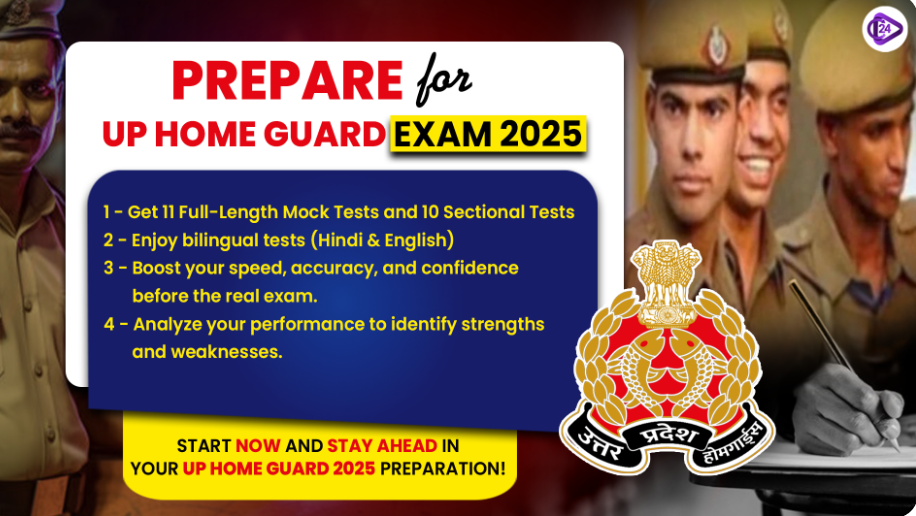
UP Home Guard Exam Preparation Strategie Developing Your Study Plan (Written Exam)
Writing the exam is the first major hurdle. A well‑structured plan helps greatly.
1. Set Clear Goals & Timeframes
- Start Date: Apply as soon as you have decided to apply.
- Milestones: For example, finish GK + Current Affairs in 2 weeks; complete Reasoning in next 2; Mock Tests start by week 4 etc.
- Daily Study Hours: Set a realistic target (say 3‑4 hours/day, increasing closer to exam).
- Revision Time: Designate the last 2 – 3 weeks to exams: revision and mock tests.
2. Subject-Wise Strategy
Here’s how you can break down your studies by subject:
| Subject | Key Topics | Strategy |
| General Knowledge (GK) | Current Affairs, UP‑specific info, History, Geography, Science, Polity | Read daily news, maintain short notes, use flashcards |
| General Hindi | Grammar, comprehension, synonyms/antonyms, idioms | Practice with previous papers, timed exercises |
| Numerical Ability | Number system, %/ratio, time & work, data interpretation | Daily practice + formula sheet revision |
| Reasoning / Mental Ability | Series, puzzles, blood relations, directions, analogies | Solve 20‑30 problems daily under a timer |
3. Mock Tests and Previous Year Papers
- Do frequent mock tests (once a week or once in a fortnight) to develop speed and accuracy.
- Test one: get all tests analyzed and make notes of weak points and improve them.
- Use timed practice to mimic real exam conditions.
4. Time Management & Accuracy
- Time is of the essence: you will have a time constraint and a great number of questions.
- It is best not to get tied up on a single question, but go and come back later in case time allows.
- Finding a balance between trying to get as many questions as possible correct and reducing the number of incorrectly answered questions (where a negative marking applies).
5. Sample Physical Training Schedule
| Week | Running | Strength & Conditioning |
| Week 1‑2 | 2‑km slow run | Push‑ups x20, squats x30 |
| Week 3‑4 | 3‑km moderate pace | Add planks (60 sec), lunges x20 |
| Week 5‑6 | 4‑km with intervals | Add long jumps, burpees |
| Final 2‑3 wks | Simulate test (4.8 km men / 2.4 km women) | Light workouts + stretches |
UP Home Guard Exam Preparation Strategie Smart Study Techniques & Revision Methods
1. Make Short Notes & Flash Cards
- For GK: maintain one‑liners for facts (e.g., major awards, state schemes, geography of UP).
- For Reasoning/Numerical: keep cheat‑sheets of formulas and key strategie.
2. Use the Feynman Technique
- After studying a topic, explain it in simple words (to yourself or a friend).
- This ensures you truly understand it and helps identify gaps.
3. Weekly Review & Error Log
- At the end of each week: review missed questions from mock tests, note recurring mistakes.
- Maintain an “Error Log” where you list question type, mistake reason, and how to avoid repetition.
4. Scheduled Revision
- Use the 3‑Day Rule: revisit topics after 1 day, then after 3 days, then after 7 days.
- Closer to exam: switch to 50% new content + 50% revision + full mock test.
Mental & Emotional Readiness
1. Stay Positive & Motivated
- Have a goal in sight “Be shortlisted to 41,424+ UP Home Guard posts”.
- Celebrate small wins: finishing a chapter, improving mock score, and improving running time.
2. Manage Stress
- Short meditation/breathing exercises (5 – 10 min).
- It is important to have breaks in the course of studying to prevent burnout.
- Get enough sleep (7-8 hours) – this is important in memory retention and physical rest.
3. Mock Test Mindset
- Treat every mock test as “real”: exact time, environment, no distractions.
- After each test, evaluate: what went right, what went wrong, and adjust the plan accordingly.
Resources & Materials
1. Recommended Books & Guides
- General Knowledge: current affairs magazines + state facts, specific to UPS.
- Rationality and Intelligence: textbook problems with numerous solved examples.
- General Hindi: books of grammar, and old papers, to get used to the pattern.
2. Online Tools & Practice Platforms
- Use an online test series to simulate a real exam.
- Access video lessons for tricky topics (especially reasoning/numerical).
- Use fitness apps to monitor running pace, time splits, and strength exercises.
3. Communities & Peer Learning
- Join peer groups or forums of UP Home Guard aspirants.
- Group study for GK/current affairs helps with sharing notes and discussion.
- Buddy system for physical training: run together, motivate each other.
Final 4‑Week Countdown Strategy
As the exam draws near (4 weeks or less before written), shift strategy:
Week 4 (Day 1–7)
- Complete remaining syllabus topics (if any).
- Begin full mock‑tests (2–3 this week).
- Continue fitness training but reduce intensity by day 7.
Week 3 (Day 8–14)
- Focus on weak areas from mock tests.
- Revision: key formulas, flashcards, GK one‑liners.
- Physical: maintain pace, attempt full PET simulation.
Week 2 (Day 15–21)
- Full-length mock every 2 days.
- Time yourself precisely.
- Physical: one light run + one full test simulation.
- Sleep & diet: Ensure you’re fully rested.
Week 1 (Day 22–28)
- Light revision only: no new topics.
- Mock‑test single full run at start of week.
- Day before exam: no strenuous training, early sleep, final check of documents/admit card.
Conclusion
The question of preparing to pass the UP Home Guard exam does not only entail hard study, but it also involves studying smart and in a holistic manner. When you have a proper approach to the written exam, coupled with regular exercises in fitness exercises, you will come out as a force to reckon with in the selection process. Keep time, keep up, adjust when necessary, and keep yourself in shape. By being persistent and having the right strategy of preparation, you will be able to hit through the competition and one step nearer to being a member of the Home Guard force in Uttar Pradesh.
Important Link
FAQs
Q2. Which subjects are most important for UP Home Guard preparation?
Most important are General Knowledge, Uttar Pradesh General Knowledge and Current Affairs.
Q3. How much time is enough to prepare for the UP Home Guard exam?
A period of 6-8 weeks of strict training is adequate.
Q4. Is physical training mandatory for UP Home Guard selection?
Yes, applicants have to pass through PST and PET to qualify.
Q5. Are mock tests necessary for UP Home Guard preparation?
Yes, mock tests aid in enhancing speed, accuracy and confidence.