



UGC NET vs. JRF often causes confusion among aspirants about which to choose as their future career prospect. Both the University Grants Commission National Eligibility Test (UGC NET) and the Junior Research Fellowship (JRF) are crucial qualifications in India’s higher education system, though both are awarded through the same UGC NET examination.
While UGC NET vs JRF both appear similar, their purposes lead to totally different routes. UGC NET primarily leads to Assistant Professor roles, whereas JRF is for research roles with financial support and a PhD purpose.
This article helps clarify the difference between UGC NET and UGC JRF, helping candidates make informed decisions based on their academic and professional ambitions.
UGC NET vs JRF 2025
UGC NET vs JRF, both are important foundations in India’s academic ecosystem, which differentiate the careers in teaching and research, respectively. UGC NET is a national-level examination conducted by the National Testing Agency (NTA) in two sessions a year, in June and December. This exam evaluates the candidates based on teaching and research aptitude as well as subject-specific knowledge. It enables the qualified students to pursue teaching or research career opportunities in higher education.
What is UGC NET?
UGC NET (University Grants Commission National Eligibility Test) is a highly prestigious national examination conducted to determine the eligibility for Assistant Professor roles across Indian educational institutions.
- UGC NET makes candidates eligible for teaching posts.
- It offers lifetime validity to the candidates.
Also Read: UGC NET Exam 2025
What is JRF?
JRF (Junior Research Fellowship) is also awarded through the same UGC NET examination. It is awarded to the top-performing candidates in the UGC NET exam.
- It offers research grants and fellowships to qualified candidates.
- Enables candidates to pursue a PhD or research with financial support.
Key Difference Between NET and JRF 2025
Understanding the UGC NET vs JRF distinction is important for aspirants to align their academic goals, whether they wish to focus on teaching or research advancement. It includes detailed comparisons between UGC NET vs JRF, purpose, eligibility criteria, career benefits, and opportunities to navigate these qualifications effectively. Below are listed the key differences between NET and JRF:
| Aspect | UGC NET | JRF |
| Purpose | Determines eligibility for Assistant Professor posts | Provides a fellowship to pursue advanced research and PhD studies |
| Conducting Body | National Testing Agency (NTA) | National Testing Agency (NTA) |
| Qualification Basis | Qualifying marks in the UGC NET exam | Top 5-7% qualifiers in UGC NET who score above JRF cut-off marks |
| Financial Support | No financial support | Monthly fellowship stipend |
| Age Limit | No age limit | Maximum 30 years with age relaxations |
| Tenure | N/A | Fellowship tenure up to 3 years |
| Career Path | Eligibility for teaching positions | Opportunities to pursue funded research and academic teaching roles |
| Validity of Certificate | Lifetime | Fellowship is time-bound for the tenure of the research project |
Also Read: What is the difference between NET and JRF?
UGC NET vs JRF Eligibility Criteria 2025
UGC NET eligibility criteria for both Assistant Professor as well as JRF roles differ on the basis of the UGC NET age limit as well as the UGC NET JRF age limit. In order to apply for the UGC NET exam, the candidates must meet the UGC NET eligibility criteria 2025. Here we have provided the UGC NET vs JRF eligibility criteria:
| Criteria | UGC NET | JRF |
| Educational Qualification | Master’s degree with minimum required marks (General- 55 %, OBC/SC/ST- 55%) | Master’s degree with minimum required marks (General- 55 %, OBC/SC/ST- 55%) |
| Age Limit | No limit | Up to 30 years (relaxations applicable) |
| Attempt Frequency | Unlimited | Subject to age and eligibility norms |
| Exam Frequency | Twice a year (June and December) | Same examination with higher qualifying marks |
Also Read: UGC NET Eligibility Criteria 2025
Career Options After Clearing UGC NET vs JRF
There are several career options after clearing UGC NET vs JRF exam. It often opens doors to distinct but sometimes overlapping career opportunities in research and academic fields. By understanding the career options after clearing UGC NET vs JRF, aspirants will be able to align their career goals accordingly.
| Feature | UGC NET | JRF |
| Career Focus | Teaching as an Assistant Professor | Research-oriented academic career |
| Job Recognition | Recognized for teaching posts in colleges and universities | Recognized for research grants and PhD funding |
| Research Opportunities | Limited, optional research | Funded projects, collaborative research |
| Academic Progression | Eligible for promotions to Associate Professor and beyond | Access to Post-Doctoral and senior research roles |
Also Read: Career Options After UGC NET Exam
UGC NET vs JRF Cut Off Marks 2025
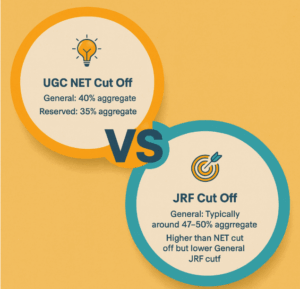
UGC NET vs JRF cut-off marks vary due to their different purposes, with JRF requiring a higher cut-off mark. The JRF cut-off is usually higher as UGC only takes up to the top 5-7% of the candidates who qualify UGC NET. The candidates qualifying JRF are automatically eligible for Assistant Professor roles. Check out the UGC NET vs JRF cut-off marks listed in the table below:
| Category | UGC NET Cut Off (%) | JRF Cut Off (%) |
| General | Approx. 40% aggregate | Higher, typically around 47-50% aggregate |
| Reserved Categories | Approx. 35% aggregate | Also higher than NET cut off but lower than General JRF cut off |
Cut-off marks vary per subject and category, reflecting the competitive nature of the JRF selection process.
Benefits of UGC NET vs JRF 2025
Qualifying the UGC NET vs JRF in 2025 unlocks a variety of benefits in the fields of teaching and research. While UGC NET primarily determines the eligibility for faculty positions across educational institutions, it also opens pathways to advanced research and doctoral studies. Due to this, understanding the benefits of UGC NET vs JRF is essential for the aspirants in choosing their career.
| Feature | UGC NET Benefits | JRF Benefits |
| Eligibility | Qualifies for an Assistant Professor role in universities/colleges. | Qualifies for Junior Research Fellowship (JRF) and PhD admission. |
| Age Limit | No upper age limit for the Assistant Professor role. | Upper age limit of 30 years (relaxation for reserved categories). |
| Career Focus | Teaching as an Assistant Professor | Research-oriented academic career |
| Financial Incentive | None | Monthly stipend of ₹31,000 (first 2 years), ₹35,000 (3rd year as SRF). |
| Job Security & Recognition | Recognized for teaching posts in colleges and universities | Recognized for research grants and PhD funding |
| Research Opportunities | Limited, optional research | Funded projects, collaborative research |
| Skill Development | Focus on teaching and academic skills. | Focus on research, analytical, and technical skills. |
| Academic Progression | Eligible for promotions to Associate Professor and beyond | Access to Post-Doctoral and senior research roles |
| Validity | Lifetime Validity | JRF valid for 2 years (extendable to SRF) |
Also Read: Benefits of clearing UGC NET/JRF exam
Which one to Choose Between UGC NET vs JRF?
Choosing between UGC NET vs JRF mainly depends on your career goals and interests in academia and research.
UGC NET is Ideal for:
- Candidates whose goal is to secure a teaching position in universities or colleges across India.
- Candidates who are above 30 years of age and can’t apply for JRF.
- Candidates who want to focus on teaching and academic careers without immediate financial assistance for research.
JRF is Ideal for:
- Candidates who are inclined towards research and advanced academic studies, such as pursuing a PhD.
- Candidates who are still under 30 years of age.
- Candidates who need allowance for their research work.
Conclusion
UGC NET vs JRF serve distinct yet complementary roles in the Indian academic landscape. Candidates looking to establish a career in teaching may prioritize the UGC NET qualification, while those inclined towards research and higher studies would benefit from aiming for the JRF fellowship. The key difference between UGC NET vs JRF lies in JRF’s financial assistance and research support, which opens the door to advanced academic pursuits. Knowing the difference between UGC NET and UGC JRF is essential for aspirants to plan their career trajectory wisely and leverage the benefits tailored to their goals.
UGC NET vs JRF FAQs

Can a candidate qualify for both UGC NET vs JRF simultaneously?
Yes, candidates who meet the higher cutoff for JRF also qualify for NET.
What is the age limit for UGC NET vs JRF?
There is no UGC NET age limit for Assistant Professor, while the UGC NET JRF age limit is 30 years, with relaxations for reserved categories.
Does qualifying UGC NET guarantee a job?
Qualifying UGC NET makes you eligible to apply for Assistant Professor roles, but does not guarantee a job.
What financial benefits does JRF provide?
JRF recipients receive a monthly stipend to support their research and PhD studies for up to three years.
Can JRF holders apply for teaching posts?
Yes, JRF holders are also eligible to apply for teaching positions in universities and colleges across India.