

JRF Full Form is Junior Research Fellowship, which is a prestigious scholarship program awarded by the University Grants Commission (UGC) to postgraduate candidates who aspire to pursue research in various academic disciplines. The JRF scheme allows researchers to undertake PhD or equivalent research degrees with financial support.
Explore this article covering JRF Full Form, eligibility criteria, subjects, syllabus, and selection Procedure to start your preparation and succeed.
Also Read: UGC NET JRF 2025
UGC NET JRF Full Form 2025 Overview
UGC NET JRF is a national examination that is awarded through a National Eligibility Test (NET) under the University Grants Commission (UGC). UGC NET is conducted by the National Testing Agency (NTA) twice a year, during the June and December sessions.
| Aspect | Details |
| Exam Conducting Body | National Testing Agency (NTA) |
| Purpose | Eligibility for JRF & Assistant Professor |
| Number of Papers | 2 Papers (Paper 1 – Aptitude, Paper 2 – Subject) |
| Exam Mode | Computer-Based Test (CBT) |
| Duration | 3 Hours |
| Marking Scheme | +2 for correct, no negative marking |
| Frequency | Twice a year (June and December cycle) |
Also Read: UGC NET Exam 2025
What is Full Form of JRF?
The JRF Full Form is Junior Research Fellowship. JRF is a national-level fellowship that is awarded to candidates after clearing competitive exams such as UGC NET or CSIR NET.
- It is designed to support researchers in science, the humanities, the arts, and the social sciences.
- Provides a monthly stipend and contingency grant for research expenses.
- Acts as a gateway for admission to PhD programs across Indian universities.
Also Read: Benefits of clearing UGC NET/JRF exam
JRF Full Form in Hindi
For the aspirants preparing for the exam in Hindi medium the JRF Full Form in Hindi is – जूनियर रिसर्च फेलोशिप
- यह एक छात्रवृत्ति योजना है जो शोध कार्य के लिए वित्तीय सहायता प्रदान करती है।
- देश के विभिन्न विषयों में शोध के अवसर उपलब्ध कराती है।
Also Read: What is the difference between NET and JRF?
What is JRF Exam Eligibility?
The JRF eligibility criteria for UGC NET 2025 ensure that only qualified and eligible candidates can compete in this highly competitive examination. The JRF is mainly aimed at promoting research careers in Indian universities and colleges. The candidates must meet the educational qualification and age limits in order to qualify for the JRF eligibility criteria. The following table summarizes the key JRF eligibility criteria:
| Eligibility Parameter | Details |
| Educational Qualification | Master’s degree with a minimum 55% (50% for reserved) |
| Age Limit | Up to 30 years (relaxation for reserved & women) |
| Nationality | Indian Citizen |
| Number of Attempts | No fixed limit, varies by exam cycle |
| Subjects Eligible | Postgraduate subjects related to the exam |
Final year postgraduate students can also apply, provided they complete their degree by the specified deadlines.
Also Read: UGC NET Eligibility Criteria 2025
JRF Subjects
The UGC NET exam offers a wide array of 85 subjects from which the candidates have to choose the subject most relevant to their post-graduation subject. The JRF subjects span from arts, science, commerce, technology, and social sciences. Major subject areas include:
| Subject Groups | Examples |
| Humanities & Social Sciences | Political Science, Sociology, Psychology |
| Sciences | Physics, Chemistry, Mathematics, Environmental Sciences |
| Commerce & Management | Commerce, Business Studies |
| Language & Literature | English, Hindi, Regional Languages |
| Others | Education, Law, Library Science |
Candidates must choose subjects corresponding to their postgraduate specialization.
Also Read: UGC NET Subject List 2025
JRF Syllabus
The JRF syllabus is designed in a way to help assess a candidate’s teaching and research aptitude along with the subject knowledge. The JRF syllabus varies by subject but generally includes two papers:
- Paper 1: General Aptitude – Teaching & Research Aptitude, Reasoning, Comprehension.
- Paper 2: Subject-specific – Detailed syllabus relevant to the subject selected by the candidates.
A broad outline of Paper 1 includes research methodology, logical reasoning, communication, and numerical ability. Paper 2 tests the in-depth knowledge of the chosen subject.
Also Read: UGC NET Syllabus 2025
JRF Selection Procedure
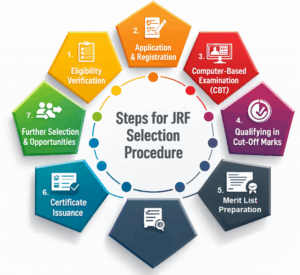
The JRF selection procedure for UGC NET 2025 is a multi-step process that is designed to identify the most eligible candidates for a research fellowship in the Indian higher education institutions. The JRF selection procedure typically involves the following steps:
| Step | Description |
| Eligibility Verification | Verification of candidates’ educational qualifications, age limits, and category-based relaxations. |
| Application & Registration | Candidates fill out online applications, upload scanned documents, and pay the registration fee on the official portal. |
| Computer-Based Examination (CBT) | Candidates appear for a two-paper exam conducted in a single session. |
| Qualifying in Cut-Off Marks | Candidates must score at least the minimum qualifying marks: 40% for General/EWS and 35% for reserved categories. |
| Merit List Preparation | The highest-scoring candidates who meet the cut-off are shortlisted. |
| Certificate Issuance | Qualified candidates receive UGC NET certificates. |
| Further Selection & Opportunities | JRF awardees may be called for interviews or recruited for research projects and academic roles. |
Also Read: UGC NET Selection Procedure 2025
Conclusion
In conclusion, the JRF full form is Junior Research Fellowship (JRF), which is an essential gateway for aspiring researchers in India. The JRF full form reflects its purpose — providing junior researchers with fellowship support to pursue advanced academic research. With a well-defined eligibility criterion, diversified subjects, a comprehensive syllabus, and a rigorous selection process, JRF ensures that talented candidates receive financial aid, enabling a pathway to doctoral and advanced studies. Preparing thoroughly for the UGC NET or CSIR NET exam is crucial for success in securing the JRF.
JRF Full Form FAQs

What is JRF exam eligibility?
Candidates must hold a Master’s degree with at least 55% marks (50% for reserved categories) and be under 30 years of age (with relaxations).
What subjects are available in the JRF exam?
The JRF exam covers a broad range of subjects, including humanities, sciences, commerce, language studies, and social sciences.
What is the JRF syllabus?
The syllabus includes Paper 1 (general aptitude) and Paper 2 (subject-specific detailed syllabus), focusing on research aptitude and knowledge in the candidate’s field.
How is the JRF selection procedure conducted?
Selection is through clearing the UGC NET or CSIR NET exam, with merit lists released based on candidates’ scores and reservation norms.